What Is Conversational Commerce? A Shopify Store Owner's Definition
For a store owner, conversational commerce isn't a buzzword, it's a practical way to use AI-driven chats to recommend products, resolve issues, and drive sales directly within a conversation.


Most definitions of conversational commerce are unhelpful for a store owner. They describe a vague, futuristic world of sentient shopping assistants and frictionless transactions, but they fail to explain what it means for your business *today*. They talk about AI, natural language processing, and machine learning as if these are ingredients you can simply add to your store. The reality is far more practical and immediate. For a Shopify store owner, the term means something specific and profitable: using automated, intelligent conversations to shorten the distance between a customer’s question and their purchase. It addresses the critical moment when a visitor has a simple question, like "Is this jacket waterproof?" or "Do you have this in a size medium?", and the answer isn't immediately obvious. This friction often leads to a lost sale, as modern shoppers expect answers in minutes, not hours. In fact, 82% of consumers expect an immediate response to a sales question.
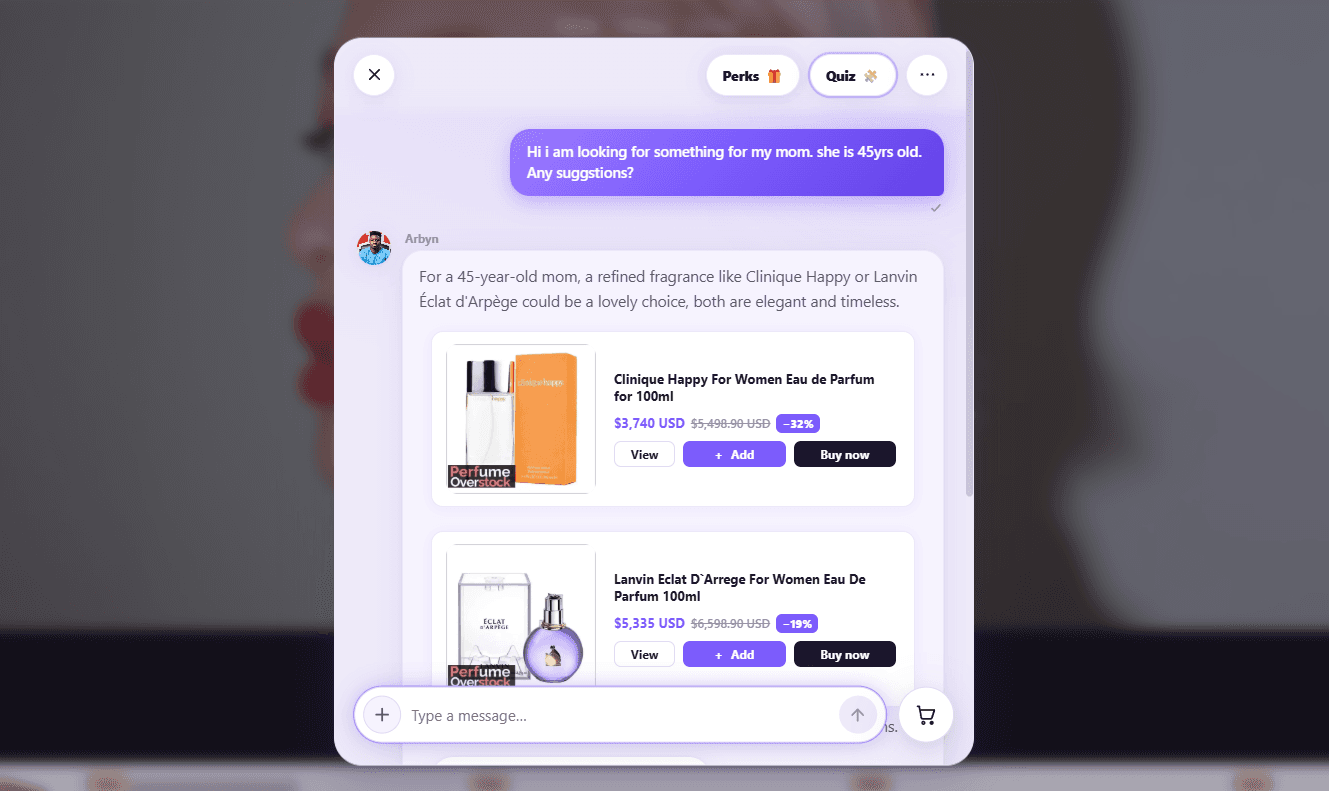
Conversational commerce is the use of AI-powered messaging tools, like live chat and email, to move customers from consideration to conversion directly within a single interaction. It’s not just about answering questions with a link to your FAQ page. It is about recommending the right product at the right moment, like when a customer asks for "a good gift for my mom," and the AI can ask clarifying questions about her interests and budget before suggesting three perfect items from your catalog. It’s about resolving an issue that would have otherwise led to an abandoned cart, such as a concern about a final-sale item's fit, by pulling up a detailed sizing chart and comparing it to a past purchase from the same customer. And most importantly, it’s about taking real, concrete actions in your store, like applying a discount code, initiating a return, or updating a shipping address, without forcing the customer to navigate away from the chat window. This capability transforms a passive support channel, once viewed as a cost center, into an active, revenue-generating sales engine that works for you 24/7.
Beyond the Buzzword: What Conversational Commerce Actually Is (and Isn’t)
At its core, conversational commerce is a fundamental shift from monologue to dialogue. Traditional ecommerce is a monologue; you present your products, write descriptions, and hope the customer finds what they need, much like a static mail-order catalog. It's a one-way broadcast that places the entire burden of discovery on the shopper. Conversational commerce, by contrast, is a two-way street, more like a personal shopping appointment. It uses technology not just to present information, but to interact, understand, and react in real-time. This isn't about replacing the human element of your brand, but about scaling its best parts: the helpful advice, the personal recommendations, and the immediate problem-solving that turns a visitor into a loyal customer. The global conversational commerce market is projected to grow from an estimated USD 10.1 billion in 2026 to nearly USD 39.8 billion by 2036, a clear signal that this is no longer a niche trend but a core component of modern online retail.
This approach is often confused with older, less effective technologies. It is not the clunky, first-generation chatbot that frustrates customers by repeatedly asking "Did that answer your question?" in a maddening loop after failing to understand a simple query. Those bots operate on rigid, predefined scripts and can't deviate from their programming, leading to dead ends and angry escalations to a human agent. Nor is it simply a live chat widget staffed by a human. While human-powered chat is conversational, it doesn’t scale. A single agent can only handle a few chats at once, and your availability is limited to business hours. For a growing store, relying solely on human agents is a recipe for missed opportunities and rising payroll costs, as long wait times can cause customers to stop doing business with a company. Slow response times are a primary driver of lost sales, as research shows that responding to a lead within the first minute can increase conversions by 391%.
The true power of modern conversational commerce lies in the integration of three key elements. First, advanced AI that can understand customer intent, not just keywords. It knows the difference between a pre-purchase question like "How much is shipping to Canada?" and a post-purchase inquiry like "Where is my order?" even if both contain the word "shipping." Second, deep integration with your Shopify store’s backend systems, including the product catalog, inventory levels, and customer order history. This is what allows the AI to give specific, accurate answers like, "Yes, we have 14 of the 'Blue Performance Tee' in size Medium in stock, and I see you previously purchased a Large in another style which ran small, so Medium should be the perfect fit." Third, and most critically, is the ability for the AI to *act*. It can do more than just talk; it can perform tasks. This combination transforms a simple chat window from an information kiosk into a fully functional point of sale, capable of guiding a customer through their entire buying journey, from discovery to checkout, all within a single, seamless conversation.
The Three Pillars of Real Conversational Commerce on Shopify
For a Shopify store owner, the abstract concept of conversational commerce becomes concrete when you see it as a framework built on three practical capabilities: the ability to recommend, the ability to resolve, and the ability to act. These are not separate functions but interconnected parts of a single, fluid customer interaction that build on one another. A recommendation often sparks a question that needs resolution, and that resolution might require an action to finalize the sale. When your store’s conversational tool can perform all three, it stops being a passive support widget and becomes an autonomous sales agent. It’s the difference between having a digital signpost pointing customers in the right direction and having a clone of your best salesperson with perfect product knowledge and infinite patience, available in every corner of your store, 24/7, to guide customers and close sales.
The first pillar is the ability to **recommend**. This goes far beyond a simple search function. A true conversational sales tool actively guides customers toward the right products, acting as a personal shopper. It can run a proactive product discovery quiz in the chat window, asking a customer about their needs, preferences, or style and then presenting a curated list of relevant items. For example, a skincare brand’s AI can ask about skin type, specific concerns like dryness or acne, and budget before recommending a complete, multi-step routine. A fashion store’s agent can ask about an upcoming event and dress code before suggesting appropriate outfits. It can also make intelligent upsell and cross-sell suggestions based on cart contents; when a customer adds hiking boots, the AI can say, "Excellent choice. To prevent blisters on the trail, most customers also purchase our moisture-wicking wool socks. Would you like to add a pair?" This proactive engagement, which can increase average order value by over 10%, mimics the experience of talking to a knowledgeable in-store employee and creates a personalized shopping journey that static product pages cannot replicate.
The second pillar is the ability to **resolve**. Many sales are lost not because of product or price, but because of uncertainty. A customer has a question about shipping, a concern about a return policy, or confusion about sizing, and if they can't get an immediate answer, they leave. Conversational commerce resolves these friction points instantly. By integrating with your Shopify data, an AI agent can answer "Where is my order?" (WISMO) with a real-time tracking update, which is critical since WISMO questions can account for 30-60% of all support tickets. Instead of just a link, it can say, "Your package is currently out for delivery in your city and is expected to arrive today." It can clarify your return policy and, in the same breath, offer an exchange for a different size if a customer is concerned about fit. This turns potential support tickets into successfully completed sales. The conversation becomes a tool for building confidence and loyalty, which is vital when a single bad experience can cause over half of customers to switch to a competitor. Resolving a customer’s doubt in the moment they feel it is one of the most effective ways to prevent cart abandonment.
The final and most crucial pillar is the ability to **act**. This is what separates modern conversational AI from its predecessors. An advanced agent doesn’t just tell a customer what to do; it helps them do it, right in the chat. If a customer is hesitant about a purchase, the agent can be empowered to generate and apply a unique discount code directly to their cart to create urgency and nudge them toward checkout. If a customer ordered the wrong item, the agent can find their order and initiate the cancellation process with the store owner's approval. If a shipping address needs to be corrected post-purchase, the agent can pull up the order, display the current address, ask the customer for the correct one, and submit the change for approval. These actions, performed within the chat interface, eliminate the last hurdles to conversion. The customer doesn't have to click away, navigate to another page, or wait for a human to process their request. The conversation itself becomes the point of transaction, creating a truly seamless and satisfying experience that today's shoppers demand.
Why Your Old Live Chat Widget Is Costing You Sales
Many store owners believe they have conversational commerce covered because they installed a live chat widget years ago. However, a passive, reactive chat tool is often more of a liability than an asset. These older systems function like a digital doorbell; they only work when a customer decides to ring them, and even then, the response is often delayed or unhelpful. If no one is available to answer, the customer is met with an "We'll get back to you" form, which is the digital equivalent of a locked door. This friction is a direct cause of lost revenue. In today's market, customers will not wait; studies show that 78% of consumers buy from the first company that responds to their inquiry. Waiting more than five minutes to respond can decrease your odds of qualifying a lead by 80%, so a promise to reply via email tomorrow morning is effectively a concession to your competitor.
The fundamental flaw of traditional live chat is that it places the burden of engagement entirely on the customer. It waits to be spoken to. This passivity misses the vast majority of sales opportunities that are signaled by digital body language. A customer might be hesitating on a product page, switching between two tabs to compare items, or about to abandon a full cart, but a basic chat widget has no awareness of this context and no ability to intervene. It cannot proactively ask, "Having trouble deciding between those two jackets? I can pull up a comparison for you," or "I see you have items in your cart. Can I help you complete your purchase with a 10% discount?" This inability to engage at critical moments is a massive opportunity cost. Businesses that implement proactive engagement based on user behavior see significantly higher conversion rates. By failing to engage, your passive widget is silently letting potential sales walk away every single day.
Furthermore, even when a customer does initiate a chat, the experience is often fragmented and frustrating. A support agent might be able to answer a question about a product, but if the customer then wants to apply a discount or start a return, they are typically directed to another page or another department. The conversation hits a wall, and the customer is forced to start a new, disconnected process elsewhere. This disjointed journey creates friction, erodes confidence, and makes your brand feel difficult to do business with. True conversational commerce platforms solve this by unifying the experience into a single thread. The same AI agent that recommends a product can also apply the discount, initiate the return, and confirm the order details, all within the same conversational window. This unified workflow is what customers have come to expect. They want their problems solved and their purchases completed with minimum effort, and a tool that can only talk but not act is no longer sufficient; in today's ecommerce landscape, it's a competitive disadvantage.
Measuring the ROI: From Cost Center to Revenue Channel
For decades, customer support has been viewed as a necessary cost center, an operational expense required to handle complaints and issues, to be minimized at all costs. Conversational commerce completely flips this model on its head, transforming your support function into a powerful and measurable revenue channel. When every conversation is an opportunity to sell, guide, and upsell, the return on investment is no longer about deflecting tickets or reducing agent headcount. Instead, the key performance indicators become conversion rate from chat, conversation-influenced average order value (AOV), and total revenue attributed directly to your AI agent’s interactions. This shift in perspective is critical for understanding the true value of an intelligent conversational platform; you're not just buying software, you're hiring a salesperson that works 24/7 for a fraction of the cost.
The most direct measure of ROI is attributed revenue. Modern conversational tools can track when a customer interacts with the AI and then subsequently makes a purchase within a set window, connecting the conversation directly to the sale. This allows you to see, in hard numbers, exactly how much revenue your AI agent is generating each month. The results are often substantial, as brands using these tools can see a significant lift in sales. By proactively engaging visitors with relevant offers, recovering abandoned carts moments before a visitor leaves, and providing instant, accurate product recommendations, the AI agent becomes one of your most effective salespeople. Instead of calculating how much money your support team is costing you in salaries and overhead, you can now calculate how much your automated agent is earning you, making the investment easy to justify and track over time.
Beyond direct conversions, a robust conversational commerce strategy delivers ROI through increased AOV and higher customer lifetime value (LTV). An intelligent agent doesn't just answer the customer's initial question; it looks for opportunities to add more value. For example, if a customer asks about a specific camera, the AI can not only provide the specifications but also recommend a compatible lens, a carrying case, and a memory card, effectively bundling products within the conversation. This automated cross-selling consistently lifts the average order value. Furthermore, by providing a superior, low-friction customer experience, you build loyalty. Customers who have positive, helpful interactions are far more likely to return and make future purchases, with some data suggesting that improving customer retention by just 5% can boost profits by 25% to 95%. Fast, effective service is a key driver of customer loyalty, as a great deal of customer churn can be prevented if a firm resolves the customer's issue on the first contact.
However, this positive ROI is heavily dependent on the platform’s pricing model. Many conversational tools, like Gorgias and Intercom, use a usage-based billing model that charges per ticket or per AI resolution. Under this model, your costs increase every time the AI successfully does its job. A busy sales month, like Black Friday, can lead to a surprisingly large bill, making your expenses unpredictable and eating directly into the ROI you are trying to generate. For instance, Intercom's Fin AI agent charges a published $0.99 per resolution on top of monthly seat costs, meaning 5,000 successful AI interactions would add nearly $5,000 to your bill. Similarly, Gorgias’s model can become costly during high-volume periods, as you pay for both the helpdesk ticket and an additional automation fee of around $0.90-$1.00 for each AI-resolved conversation. A flat-rate, tiered model offers predictable costs, ensuring that as your sales grow, your profits grow with them.
Implementing a Conversational Strategy Without a Team of Agents
The prospect of offering 24/7, real-time conversational support can seem daunting for a small or medium-sized Shopify store. The traditional approach required hiring a team of support agents to cover different time zones, a significant and often prohibitive expense. However, the emergence of sophisticated, deeply integrated AI agents has made this level of service accessible to businesses of any size. A single, well-configured AI can now manage the vast majority of customer interactions, often up to 80% of common inquiries, from initial product questions to post-purchase support, without any human intervention. This allows store owners to deliver an enterprise-grade customer experience that drives loyalty and sales, but without the enterprise-level budget or headcount. It effectively democratizes good service, allowing a one-person brand to compete with larger retailers on responsiveness.
The implementation process begins with choosing a platform that is built specifically for Shopify. Generic chatbot tools lack the deep integration needed to perform meaningful actions like checking inventory or modifying an order. A true conversational commerce app plugs directly into your store’s data, your product catalog, your inventory, your order database, and your customer history. The setup involves "calibrating" the AI on this data, allowing it to learn your products, understand your brand's tone of voice (often by analyzing your past customer emails or About Us page), and establish rules for when to escalate a conversation to a human. This initial configuration is crucial; it’s what enables the AI to provide accurate, brand-aligned responses that feel helpful and authentic, not robotic and generic. You can set rules like, "If a customer mentions the word 'legal' or has a cart value over $1,000, immediately notify me."
Once calibrated, the AI agent becomes your frontline sales and support team. It can proactively engage visitors on your site based on their behavior, such as time spent on a product page or items added to a cart. It can answer an endless stream of common questions like "Do you ship to Australia?" or "Is this shirt available in blue?" instantly, freeing up countless hours of your time to focus on growing the business. Instead of manually handling routine inquiries, you can work on marketing campaigns, source new products, or negotiate with suppliers. For more complex issues or high-value customers, the AI can seamlessly hand off the conversation to you or a team member, providing the full context of the interaction so you can pick it up without missing a beat. This hybrid model combines the scale and efficiency of AI with the empathy and expertise of human oversight, ensuring no customer is left behind.
Critically, the financial model of the platform determines whether this strategy is sustainable for a growing store. Tools that charge per resolution, like Zendesk, can create a scenario where you are penalized for your own success. As your traffic grows and the AI handles more conversations, your bill climbs unpredictably. A reported rate of $1.50 to $2.00 per AI resolution can quickly add up, turning a valuable tool into a costly liability during your busiest months. This is why a flat-rate, tiered pricing structure is so essential for Shopify store owners. With a tool like Arbyn, you choose a plan with a predictable monthly price. This aligns the platform’s success with your own. For example, the Starter plan is free and includes 150 AI conversations per month. As you grow, you can move to the Growth plan for $59/month, which includes 500 conversations. For high-volume stores, the Agent plan offers unlimited conversations for a flat $99/month. This predictability allows you to scale your conversational strategy confidently, knowing your costs are fixed and there are no overage charges. You can install Arbyn from the Shopify App Store and get started with a full-featured AI agent on the permanent free plan.
The line between talking to a brand and shopping with a brand is dissolving. Customers no longer see a distinction between asking a question and making a purchase; to them, it's all part of a single experience that should be effortless. The stores that will thrive in the coming years are those that embrace this reality, transforming every point of contact into an opportunity to build a relationship and drive a sale. This isn't a futuristic prediction; it's a reflection of current customer expectations, which have been shaped by the instant, personalized experiences offered by market leaders. Conversational commerce isn't about the future of retail; it's about meeting the expectations of today's customer with speed, intelligence, and a genuinely helpful attitude, scaled to work for you even when you're not working.
Written by
For seven years I have led customer success and technical support inside high-growth SaaS and e-commerce companies. Customer Support Lead at DripShop.live, a live-commerce SaaS. Technical Support Specialist at Replo (Y...
View full profile