The CRO Case for Selling Inside Support Instead of After Checkout: A Worked Example
The highest-converting space in your store isn't the checkout page; it's the chat window a customer opens three days after their first purchase.

The highest-converting space in your store isn't the checkout page; it's the chat window a customer opens three days after their first purchase. This idea runs counter to a decade of conversion rate optimization (CRO) orthodoxy, which has rightfully treated the moment immediately following payment as a unique opportunity. For years, CRO has been a discipline of funnel analysis, heat mapping, and relentless A/B testing, meticulously refining every pixel, button color, and call-to-action to reduce friction on a pre-set path. The logic is sound and has been proven by countless store owners: the customer’s trust is at its peak, their payment details are entered and vaulted, and adding one more item is nearly frictionless. This has given rise to a dominant, high-leverage strategy: the post-purchase upsell. Yet a different, more powerful opportunity exists, one grounded not in transactional momentum but in conversational context. The debate between in-chat selling vs post purchase upsell isn't about which one is easier to implement, but which one builds a more profitable, defensible business over the long term. While one optimizes a transaction by playing a numbers game, the other optimizes a relationship by starting a dialogue, transforming a potential support cost into a source of significant revenue and lasting loyalty.
The Post-Purchase Upsell: A Numbers Game on Shaky Ground
The appeal of the post-purchase upsell is its intoxicating blend of simplicity and safety. An offer presented after the initial sale is complete carries zero risk of cart abandonment, a critical feature that placates the deepest fears of any ecommerce store owner focused on preserving their hard-won primary conversion. If the customer declines, the original order is unaffected. The upside, however, can be significant. Industry benchmarks, backed by data from tens of thousands of store owners, place the average conversion rate for these one-click offers anywhere from 3% to 8%, with some highly optimized stores reporting rates as high as 10% or even 15%. It’s a compelling proposition: a risk-free mechanism to increase average order value (AOV) from customers who have already proven their intent to buy. Let's model this with our hypothetical Shopify store, "The Modern Wardrobe," specializing in minimalist apparel with a focus on sustainable, high-performance fabrics. The store generates 2,000 orders per month with an average order value of $85. They implement a standard one-click post-purchase upsell app, offering a $25 set of premium merino wool socks with every order of their bestselling bamboo-viscose trousers. This feels like an easy, almost passive win, a way to incrementally boost margin without investing a single dollar in new traffic acquisition.
Using a conservative and widely cited conversion rate from platforms that process thousands of these offers, the math looks undeniably promising. Data from over 40,000 store owners shows an average take rate for post-purchase offers is around 4.7%. If we assume only half of The Modern Wardrobe's 2,000 orders are for the specific trousers that trigger the offer, that's 1,000 opportunities. At a 4.7% take rate, the store secures an additional 47 sales per month. At $25 per sale, that's an extra $1,175 in monthly revenue, or $14,100 annually, seemingly from thin air. The entire process hinges on powerful psychological principles like buying momentum and anchoring. The customer just committed to an $85 purchase, so a $25 add-on feels small by comparison, a classic example of the anchoring bias where the initial price frames the perception of the second. Their positive feelings about the purchase are at a peak, creating a brief window of heightened suggestibility. The sales tactic is sound, the technology is proven, and the revenue is real. But this model overlooks a critical element: context. The offer is blind. It doesn't know *why* the customer bought the trousers, whether they already own the socks, or if they have a more pressing question about their order, like wondering about the specific care instructions for the unique fabric. It's an educated guess, a monologue from the brand *at* the customer at the precise moment the customer believes the conversation is over.
The Customer's Mindset: Transaction Complete vs. Conversation Open
Understanding the fundamental difference between these two selling motions requires stepping outside of analytics dashboards and into the customer's perspective. The post-purchase moment is one of cognitive finality. The customer has completed their task: they researched, they decided, they navigated the checkout, they paid. Their mental loop is closed, a state psychologists refer to as post-purchase evaluation. In this phase, they are not looking to make new decisions but to reinforce the one they just made, seeking confirmation that they made a good choice. The appearance of an upsell offer, no matter how seamless, is an interruption, a new request when they were expecting a confirmation and a "thank you." For many, it introduces a flicker of transactional fatigue or even post-purchase dissonance, the psychological discomfort that can lead to buyer's remorse, especially if the offer feels misaligned or pushy. This is the core of transactional selling; it's efficient, scalable, and emotionally distant. It works, but it leaves a significant amount of value and goodwill on the table by treating all customers with the same generic, albeit targeted, offer.
Contrast this with the mindset of a customer opening a support chat. Here, the mental loop is deliberately and actively open. The customer is not just receptive to engagement; they are actively seeking it and have invited the brand into a dialogue. They have a question, a problem, or a need, a specific intent that they are willingly sharing, often with a high sense of urgency because it stands between them and the value they expect from their purchase. This is a fundamentally different psychological posture. They are not in a state of transactional completion but one of active inquiry, a moment of peak relevance for the brand. An offer made inside this context, when executed correctly, is not an interruption but a continuation of the helpfulness they are seeking. This is the foundation of consultative selling: a process that prioritizes understanding the customer's needs before making a recommendation. It transforms the interaction from a brand's monologue to a customer-brand dialogue. The customer isn't a passive recipient of a blanket offer; they are an active participant in a conversation that can lead to a sale, organically and helpfully, because their question has been answered and their confidence has been boosted. This is where true brand loyalty is forged.
Modeling the In-Chat Selling Opportunity: A Deeper Look
Let's return to our hypothetical store, The Modern Wardrobe, with its 2,000 monthly orders. What does the in-chat opportunity look like? First, we need to estimate the number of conversations. While it varies, a common support contact rate for ecommerce, the ratio of support inquiries to total orders, is a key operational metric. In the apparel sector, where questions about fit, material, and returns are frequent, this contact rate can be substantial. With online apparel return rates often ranging from 24% to as high as 40%, it's not uncommon for a brand to see a contact rate of around 30%. For our store, this translates to roughly 600 support conversations per month. These aren't just costs to be minimized; they are 600 invitations to engage with the store's most active and invested customers. Not every conversation is a sales opportunity. A customer angrily asking about a late delivery is not a candidate for an upsell. But a significant portion of these interactions are what can be termed "commercially relevant." These include pre-purchase questions about sizing ("Will this shrink?"), post-purchase inquiries about product care ("How do I wash this silk shirt?"), or even simple order status checks (WISMO), which still represent an engaged customer touchpoint.
Let's be conservative and assume only 30% of these 600 conversations, 180 per month, present a natural context for a sales offer. Now, what is the conversion rate for a relevant, contextual offer made inside a helpful conversation? This is where the numbers diverge sharply from blind upsells. While hard data is emerging, industry reports on conversational commerce consistently show conversion rates multiple times higher than traditional web funnels because they resolve doubt and reduce friction instantly. Multiple analyses have noted that visitors who engage with a website's chat feature are 2.8 times more likely to convert, and adding chat can increase overall conversions by 20%. Let's use a modest 20% conversion rate for our model, a figure that feels achievable given that businesses using personalized, real-time engagement report significantly higher conversion lifts, with some reporting chat conversion rates as high as 40%. Out of 180 relevant conversations, a 20% conversion rate yields 36 sales. If the offer is the same $25 pair of socks, that's $900 in monthly revenue. At first glance, this appears to be less than the $1,175 generated by the post-purchase model. This is where a superficial analysis stops, but a deeper look reveals why the in-chat model is vastly superior.
Why the In-Chat Model Wins: AOV, LTV, and the Second Order
The in-chat selling model isn't about selling the same low-friction item. Its power lies in the ability to sell a *better*, more relevant, and often higher-priced item. A post-purchase offer must be simple and cheap to work; a general rule suggests keeping the upsell price under 25-30% of the original order value to maximize acceptance. This is because the offer needs to be an impulse decision, not a considered one, leveraging the customer's fleeting buying momentum. A live conversation has no such constraint. An agent, human or AI, can understand the context of the customer's needs and make a much more ambitious, personalized recommendation. For a customer who just bought the $85 trousers and is asking about matching shirts, the agent can recommend a specific $60 shirt that completes the outfit, explaining why the fabric and fit are complementary. The offer isn't a generic accessory; it's a personalized solution. Let's re-run our model with this more realistic scenario. Instead of a $25 item, the average value of a successful in-chat sale is $60. With 36 successful sales, the monthly revenue is now $2,160. This is nearly double the revenue from the post-purchase upsell model, generated from fewer absolute conversions but with far greater customer value.
The benefits extend far beyond the immediate AOV increase. The most critical impact is on Customer Lifetime Value (LTV). A customer who accepts a one-click post-purchase upsell has completed a transaction. A customer who receives a helpful, personalized recommendation in a support chat has had an experience. They feel understood and valued, which directly impacts their likelihood to buy again; in fact, recent surveys show that an overwhelming 86-93% of consumers are more likely to make another purchase after a positive customer service experience. Consultative selling builds trust and fosters loyalty, which are the primary drivers of customer retention. In an industry like fashion and apparel, where average annual customer retention rates can hover between a stark 22% and 32%, every positive touchpoint matters. The customer who was successfully upsold in a support chat is not just worth the extra $60 from that one sale; they are now significantly more likely to become a repeat purchaser because the brand has demonstrated it cares about their individual needs. The conversation turned a potential support cost into a profit center and a powerful retention tool, fundamentally altering the economics of customer service and recognizing that repeat customers generate a disproportionately high amount of revenue.
The CRO Case: Optimizing Conversations, Not Just Clicks
The true case for in-chat selling is that it redefines the scope of Conversion Rate Optimization. For years, CRO has been a discipline focused on web pages, funnels, and clicks. It has sought to remove friction from a predetermined path, a philosophy that has been incredibly valuable but is now incomplete. The post-purchase upsell is the logical endpoint of this philosophy: a final, optimized click in a silent, asynchronous journey designed for an anonymous mass. But modern ecommerce is not silent. It's conversational. Customers have questions, and the brands that answer them best, with speed, accuracy, and relevance, will win. The new frontier of optimization is not about improving the click-through rate on a static offer; it's about improving the quality and commercial outcome of every customer conversation. This is Conversation Rate Optimization, and it yields far more than a simple AOV bump, it builds defensible brand equity by proving your value one answer at a time, turning customers into advocates. This shift is about seeing every question not as a ticket to be closed, but as an opportunity to be opened.
This approach transforms the support channel from a cost center to be minimized into a scalable, high-margin revenue stream. Every question about product sizing, material, or care becomes a gateway to a guided selling experience. Every WISMO query ("Where Is My Order?") becomes an opportunity to discuss the customer's next purchase, turning a moment of anxiety into one of anticipation. This is precisely the model that advanced AI agents are built to execute. An AI like Arbyn is designed not just to answer support questions but to understand the commercial context behind them. It can access order history, product details, and customer data in real-time to provide a deeply personalized response. For example, it can handle the initial query about order status and, in the same breath, notice the customer's purchase history of performance fabrics and make a relevant, timely recommendation for a new technical jacket that just launched. It allows a store to have thousands of these consultative conversations every month without hiring a proportional number of sales staff. Because Arbyn's pricing is a flat monthly fee rather than a charge per ticket or resolution, the ROI of every successful in-chat sale is dramatically amplified. The marginal cost of each additional conversation approaches zero, unlike human-powered chat models that can cost $5-$15 per interaction.
Ultimately, the choice between in-chat selling and post-purchase upsells is a choice between two different business philosophies. One sees the customer journey as a funnel to be optimized for a single, final transaction. The other sees it as an ongoing relationship to be nurtured through helpful, context-aware conversations. While the post-purchase upsell offers a quick and easy revenue lift, it's a tactic that plays at the edges of the customer experience. In-chat selling goes to the very heart of it, turning your most engaged customers into your most valuable ones. A landmark study by Bain & Company found that an increase of just 5% in customer retention can increase profitability by 25% to 95%, making the relationship-building aspect of conversational selling one of the highest-leverage activities a brand can pursue. For store owners looking to build a resilient, high-LTV business, the path forward isn't about finding one last click after checkout. It's about opening a conversation. You can start turning your support channel into your most effective sales channel by installing Arbyn from the Shopify App Store.
Written by
For seven years I have led customer success and technical support inside high-growth SaaS and e-commerce companies. Customer Support Lead at DripShop.live, a live-commerce SaaS. Technical Support Specialist at Replo (Y...
View full profileKeep reading
View all posts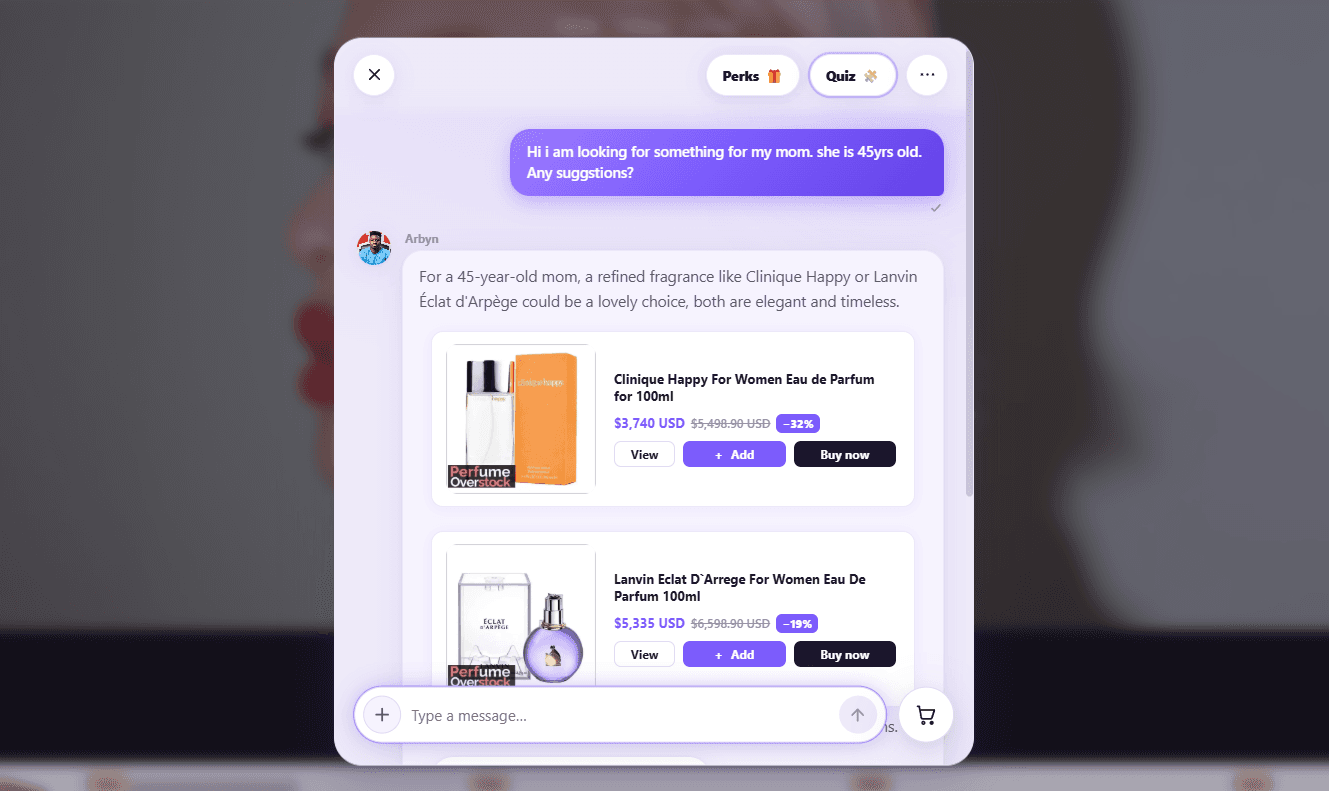
Is a Chat Widget Worth It for Shopify Conversion Rate?
Odera Joseph · 7 min
Return Visitor Retargeting Inside Chat: A Shopify CRO Tactic Most Stores Skip
Odera Joseph · 9 min
Spend-Threshold Triggers: The Free-Shipping Nudge Your Shopify Chat Should Be Making
Odera Joseph · 8 min