The Best Agentic AI Customer Support Tools for Shopify in 2026
The best agentic AI tools for Shopify go beyond answering questions, they take action.


Most AI support tools are fundamentally stuck in the past, a relic of a previous technological era. They operate as glorified FAQ bots, impressively capable of answering "Where is my order?" with a tracking number but utterly powerless to do anything meaningful about it. For a Shopify store owner, this creates a deeply frustrating illusion of automation, a costly mirage that shimmers with promise but offers no real substance, especially when modern shoppers expect and demand instant resolutions. With many customers demanding immediate support, a bot that only provides a tracking link without context, empathy, or recourse comprehensively fails to meet this fundamental expectation. This failure has a direct cost, as studies show over 60% of consumers will consider switching brands after just one or two poor service experiences. You pay a recurring fee for an AI tool, yet your highly-trained support team remains bogged down in a demoralizing loop, manually processing every single refund, cancellation, and shipping address change. The real bottleneck was never just answering simple questions; it's the crushing operational workload of taking action, a workload that multiplies exponentially during peak seasons like Black Friday. This critical distinction separates basic, passive chatbots from the agentic AI platforms that will define Shopify support in 2026. An agentic tool doesn't just talk; it acts, directly and securely manipulating orders, subscriptions, and customer data within Shopify, finally delivering on the long-overdue promise of true, end-to-end automation.
The Hidden Costs of "Automated" Support
The sticker price for a customer support platform is rarely the final number on your monthly invoice, serving more as a down payment on a mountain of contingent costs. A significant and often dangerously unpredictable expense comes from the very automation you sought to implement in the first place. Many platforms, including some of the most established names in the Shopify ecosystem, have built their business models around per-resolution or per-ticket fees. This means that every single time their AI successfully resolves a customer issue, you pay a specific, metered fee. While this sounds like a fair value exchange on the surface, it creates an incredibly volatile billing structure where your support costs scale directly and punishingly with customer engagement. During a Black Friday campaign that drives a 500% surge in traffic and inquiries, these fees can cause your support bill to skyrocket without warning. Imagine a successful sale generates 5,000 automated resolutions; at a typical $0.90 fee, that's an immediate $4,500 charge on top of your base plan, a shocking bill that can erase the profit margin from the very sale you worked so hard to create. This model quickly becomes a punitive tax on growth. The average cost per contact for e-commerce support can range from as low as $2.70 to over $5.60, and that's before the premium for these AI-specific action fees is factored in. This variable cost structure makes financial forecasting a nightmarish guessing game and actively penalizes stores for providing efficient, automated service to a growing and engaged customer base.
Beyond the direct and often shocking financial costs, there is a substantial operational drag that traditional AI tools fail to eliminate, creating a frustrating "purgatory" for support tickets. When an AI can only answer basic questions, it effectively becomes a low-skill triage system for your human agents. The bot handles the simplest informational queries, but every request that requires a tangible action, a refund, an exchange, a cancellation, an address update, is escalated, often after a frustrating, circular conversation with the bot. This leaves your human team starting their day with a queue of dozens of angry customers who have already failed to get help. The agent must first read the entire negative interaction history, then manually open Shopify, locate the order, and begin the very task you hired the AI to solve. This broken workflow does little to reduce agent burnout, a significant issue in an industry where annual turnover rates can be as high as 30-45%. The cost to replace a single agent can be substantial, often estimated at $10,000 to $20,000 in recruitment, hiring, and training expenses, with some studies indicating the total cost including lost productivity can be up to 150% of the agent's annual salary. The promise of AI was to free up human agents for high-touch, complex, and revenue-generating interactions that build lasting customer loyalty. Instead, for many store owners, it has merely created a new, expensive line item on their P&L without fundamentally changing or improving the nature of their team's daily workload.
What 'Agentic AI' Actually Means for a Store Owner
The term "agentic" has been co-opted by marketing teams and diluted into a popular buzzword, but for a Shopify store owner, its meaning is concrete, operational, and transformative. An agentic AI is a system that possesses the delegated authority and technical capability to perform tasks and make changes within other software platforms on your behalf. It's the profound difference between an AI that can *tell* a customer your return policy and an AI that can actually *initiate the return*, generate the QR code for a label-free drop-off, and process the refund directly within your Shopify admin the moment the return is scanned by the carrier. This powerful capability hinges on deep, two-way API integration, allowing the AI to do more than just read data; it can write data, execute commands, and trigger complex workflows. For example, a customer wanting to swap a product in their upcoming subscription, add a one-time item to the same shipment, and push the delivery date back by one week can make the request in plain language. A true agentic AI will then interface with the subscription app's API to perform all three actions sequentially, confirming each step with the customer in the chat, a task that would have otherwise required a frustrating login to a customer portal or a multi-day email exchange with support. This is the critical leap from a passive information provider to an active operational assistant, capable of handling multi-step processes that have historically required hours of human intervention.
From an store owner's perspective, this completely transforms the function of customer support from a reactive cost center focused on ticket resolution times to an efficient, autonomous operational hub. The most common, time-consuming, and repetitive support tasks are not just answered but are fully executed, 24/7, without any human oversight required. These actions include complex order tracking (WISMO) that can proactively notify a customer of a shipping delay with a personalized apology and a 10% discount code for their next purchase, processing returns and exchanges according to your store's specific rules, canceling orders before they are fulfilled, updating shipping addresses, and even managing customer subscription preferences through deep integrations with apps like ReCharge or Skio. The most advanced platforms are now enabling their AI to perform these tasks fully autonomously, while others have implemented a crucial human-in-the-loop system for more sensitive actions. For instance, an address change for an unfulfilled order might be fully automated, but a refund over $100 could trigger a push notification to your phone or a Slack message saying, "Approve $125.50 refund for order #11345 to Jane Doe? [Approve] [Deny]". This provides a critical layer of financial control and oversight while still completely removing the manual data entry, tab switching, and processing from your team's plate. The ultimate goal of a true agentic platform is to drastically reduce the number of tickets that ever need to reach a human inbox, not by deflecting customers, but by genuinely and completely resolving their issues from start to finish.
Evaluating the Top Agentic Platforms in 2026
When evaluating agentic AI tools for Shopify, the core differentiator is not just the glossy marketing claims about what they automate, but the fine print explaining how they do it and, most importantly, what it costs. The market is currently dominated by platforms that have bolted AI capabilities onto existing, legacy helpdesks, often resulting in convoluted, layered, and expensive pricing models designed to maximize their revenue, not your efficiency. Gorgias, a very popular helpdesk in the Shopify ecosystem, offers its AI Agent as a powerful add-on that can perform actions like processing refunds and modifying orders. However, its pricing structure can be a significant and painful hurdle for scaling brands. Gorgias bills for both the base helpdesk plan (which is tiered by a limited number of tickets) and a separate, additional fee for each automated interaction, currently around $0.90 per resolution on an annual plan. Critically, each AI-resolved ticket also consumes one of the billable helpdesk tickets from your base plan, a form of "double-billing" that can lead to shocking cost escalation. Consider a store on the Pro plan ($360/month for 2,000 tickets) that successfully automates 60% of their 2,500 monthly inquiries. They would pay $1,350 in AI fees (1,500 resolutions x $0.90) and also blow past their ticket limit, forcing an upgrade to a more expensive plan. This punishes success and disincentivizes the very automation the tool is meant to provide.
This punitive, usage-based model is unfortunately the industry norm. Another major player, Intercom, has rebranded its entire company around its AI agent, Fin, which also boasts powerful agentic capabilities but comes with a similarly layered and expensive cost structure. Intercom's pricing combines a high per-seat fee for human agents with a per-resolution fee of $0.99 for its Fin AI agent. For a small team of five agents on a mid-tier plan, this means the monthly cost is a combination of their seat licenses (around $425/month) plus the completely variable cost of every single conversation the AI handles. If that team automates 3,000 conversations a month, a very reasonable number for a growing store, they add nearly $3,000 in resolution fees alone, pushing the total annual software cost toward an astonishing $40,000. Other platforms like Richpanel have also shifted to an AI-centric model, charging per-seat fees plus a metered rate for AI-handled conversations, around $0.20 per conversation but with a significant monthly minimum spend on AI credits, creating a high barrier to entry for smaller brands. Even Tidio, known for its accessible entry-level plans, treats its AI agent, Lyro, as a severely limited, usage-capped add-on. A store might pay for a base Tidio plan and then pay an additional $39/month for just 50 AI-handled conversations, a laughably small limit that a growing store could exhaust in a single afternoon during a sale. The common thread across all these dominant platforms is a pricing model that creates extreme financial uncertainty and penalizes stores for successfully leveraging automation at scale.
| Platform | Primary Billing Model | Reported AI Action Fee (2026) | Key Limitation |
|---|---|---|---|
| Gorgias | Tiered by ticket volume + Per AI resolution | ~$0.90 per resolution | AI resolutions also consume a paid helpdesk ticket, creating a double-charge. |
| Intercom (Fin) | Per agent seat + Per AI resolution | $0.99 per resolution | AI fees scale with volume and can easily exceed seat costs for active stores. |
| Richpanel | Per agent seat + Metered AI conversations | ~$0.20 per conversation | Requires a significant minimum monthly spend on AI credits. |
| Tidio (Lyro) | Tiered plan + Metered AI conversations | ~$39/mo for 50 conversations | AI is a limited, usage-based add-on, not a core, unlimited feature. |
The Trade-Offs: Control vs. Full Autonomy
The rapid move toward agentic AI introduces a critical strategic decision for store owners: determining the precise and appropriate level of autonomy for these powerful automated systems. Granting an AI the unilateral ability to issue refunds, cancel orders, or send high-value gift cards without any human oversight carries inherent and significant risks. A single misconfigured rule or an exploited vulnerability discovered by a fraud ring on Reddit could lead to thousands of dollars in financial losses in a matter of hours. Imagine a post on a deals subreddit details a loophole in your AI's return logic: 'If you claim the item was damaged and the order value is under $50, the bot instantly refunds without requiring a return.' Within hours, you could face hundreds of fraudulent claims, leading to thousands in automated losses before you even notice. Consequently, the most sophisticated and trustworthy platforms are not just building autonomous agents; they are building robust, intuitive systems of control and governance around them. This most often manifests as a hybrid, "human-in-the-loop" approach, where low-risk actions (like tagging a ticket or providing a tracking update) are fully automated, while high-risk or high-value actions are automatically flagged for human approval. For example, an AI might be empowered to unilaterally change a shipping address for an unfulfilled order but would be required to seek a one-click confirmation from a manager before processing a refund of over $100. This model provides the best of both worlds: it eliminates the tedious manual labor of executing the task while keeping a human in ultimate control of the crucial financial decision.
This "approval-gated autonomy" is a core feature, not a bug or a temporary crutch. It acknowledges the complex realities of running a business where financial controls, fraud prevention, and policy enforcement are paramount. Platforms that offer granular control over these permissions are providing a vastly more valuable service than those that offer a binary, all-or-nothing choice between full autonomy and no action at all. Store owners should be able to define precise rules with ease, such as setting a maximum refund amount of $75 for automatic processing, limiting a "free replacement" offer to once per customer per year, or flagging orders with potential signs of fraud for mandatory human review. For instance, a rule could automatically require approval for any order cancellation where the shipping and billing addresses are in different countries or if the customer has a return rate over 50%. The true intelligence of an agentic system is not just in its ability to act, but in its ability to know when *not* to act, to recognize ambiguity, detect abnormal patterns, or sense heightened customer frustration and escalate to a human for the empathy and nuance required. The best platforms also maintain an immutable audit log, showing every action taken by the AI and which human (if any) approved it, ensuring complete accountability. As these tools mature, the focus will shift from simply adding more autonomous actions to providing more sophisticated and customizable guardrails that allow store owners to deploy automation with confidence.
Beyond Support: Agentic AI for In-Conversation Sales
The true potential of agentic AI extends far beyond simply cost-cutting in customer support; that is only the beginning. The very same conversational interface that seamlessly resolves a complex return request can also become a powerful, proactive sales channel. The most forward-thinking platforms are integrating their agentic capabilities directly with your product catalog, inventory levels, and customer data to drive new revenue directly within the chat widget. This transforms the AI from a reactive problem-solver into a proactive, personal sales associate for every visitor on your site. When a customer asks if a particular shirt comes in blue, a simple chatbot might answer "yes" or "no." An agentic sales AI can confirm availability in the customer's size, show a product image, recommend a matching pair of pants to create a bundle, and add both items to the customer's cart in a single, fluid conversation. This is a far more effective and personalized shopping experience, with research from Salesforce showing that brands using AI personalization drive 25% higher conversion rates. Some platforms, like Rep AI, focus heavily on this "agentic commerce" model, using behavioral algorithms to proactively engage shoppers who show signs of abandoning their cart or hesitating on a product page. This can turn potential churn into completed sales, with some studies from firms like Boston Consulting Group showing that effective personalization can lift overall revenues by 6-10%.
This unique capability to sell within the conversation creates a direct, measurable link between your support tooling and your top-line revenue growth. By analyzing a customer's query, their full purchase history, and their real-time browsing behavior, the AI can make intelligent, personalized recommendations that significantly increase average order value (AOV). For example, if a customer is asking about the warranty on a high-end coffee machine, the AI can not only provide the warranty information but also suggest a subscription for coffee beans, noting their past purchase of a specific dark roast. It can then generate and apply a unique discount code to incentivize the immediate purchase of a machine-and-bean bundle, directly within the chat. Consider a customer asking about setting up a subscription for dog food. An agentic AI can complete the subscription setup via a ReCharge or Skio integration, and then add: 'Since you've bought our dental treats before, would you like to add them to your subscription for 15% off? Your dog gets their favorite treats on schedule, and you save on every order.' This type of intelligent, data-driven upsell feels like helpful service, not an aggressive sales pitch. This ability to execute sales-related actions, creating bundles, applying dynamic discounts, adding items to a cart, and even initiating the Shopify Checkout, is a hallmark of a truly agentic platform. It reframes the entire purpose of a chat widget from a tool for handling complaints to a primary channel for personalized, conversational commerce, driving sales and improving the customer experience at the exact same time.
The Future is Flat-Rate Agentic AI
The evolution from simple, frustrating chatbots to powerful, action-taking agents marks a significant and permanent turning point for Shopify support. However, as long as this transformative power is locked behind unpredictable, usage-based pricing models, its true potential will remain out of reach for the vast majority of growing brands. The industry is ripe for a fundamental paradigm shift, moving away from punitive models that penalize growth and toward a structure that makes powerful automation accessible, predictable, and scalable. This is the entire philosophy behind Arbyn. We believe that true agentic AI, the kind that can update shipping addresses, initiate returns, manage subscriptions, and drive new sales inside the conversation, should not come with a variable, per-resolution bill that causes budget anxiety. A usage-based model fundamentally works against you, creating a perverse incentive structure that makes you fear a successful marketing campaign because of the support costs it will generate. This model creates a bizarre reality where a marketing success feels like a financial liability. You celebrate a 10x spike in traffic while simultaneously bracing for a support software bill that could wipe out the profit from that very same spike. It fundamentally misaligns the goals of the software provider with the goals of the store owner, who should be free to pursue growth without limitation.
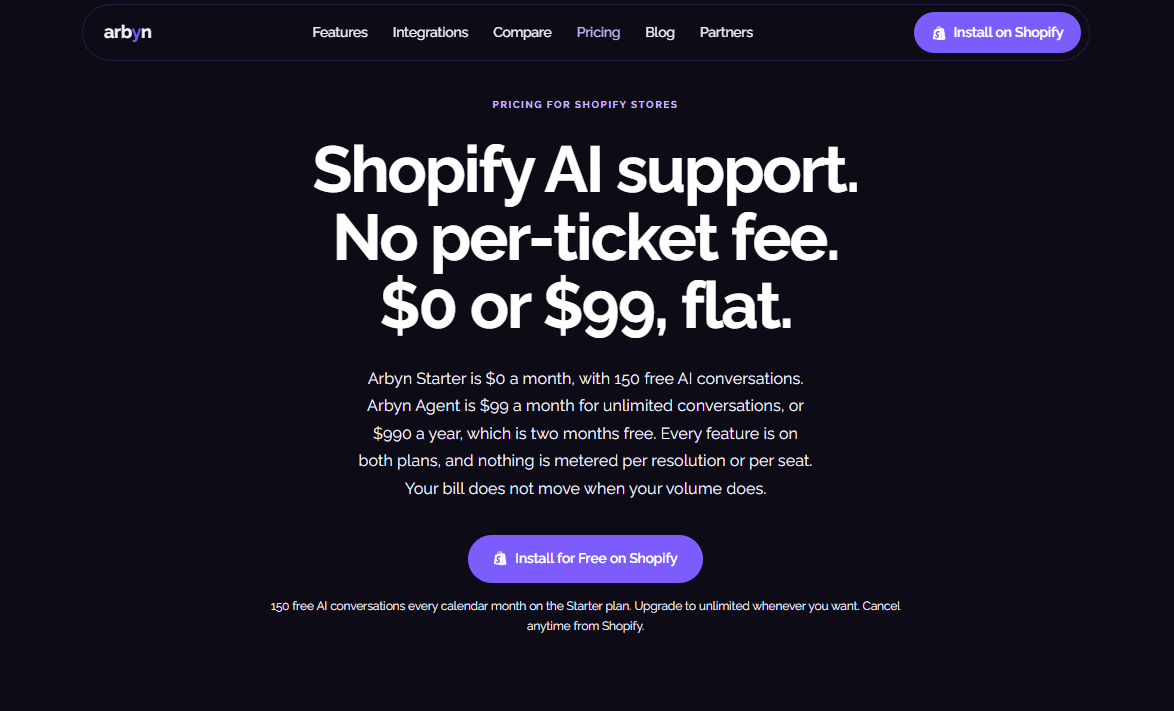
Arbyn offers all the advanced agentic capabilities of the leading platforms, including fully autonomous actions for routine tasks and intuitive, owner-approved workflows for sensitive operations like refunds and cancellations. The crucial difference lies in the business model. Arbyn's Starter plan is permanently free for up to 150 conversations per month, with the full, un-gated feature set included. This means from day one, the AI can process exchanges, modify subscription orders, respond to 'Where is my order?' queries with proactive carrier status details, and even offer a discount to a customer who experienced a delay. For stores that outgrow that generous limit, the Arbyn Agent plan offers unlimited conversations and unlimited automated actions for a single, flat monthly fee of $99. There are no per-resolution fees, no ticket-volume tiers, no seat licenses, and no surprise overage charges. This predictable, transparent pricing finally allows store owners to budget for their support costs with 100% certainty, no matter how much their business grows or how many conversations they successfully automate. The goal is to make powerful, action-oriented AI a standard, affordable utility for every Shopify store, not a metered luxury reserved for enterprises with massive budgets. If you're ready to move beyond basic chatbots and implement a true AI agent that works for a fixed cost, you can install Arbyn from the Shopify App Store and have a genuine agentic system running in minutes.
Written by
For seven years I have led customer success and technical support inside high-growth SaaS and e-commerce companies. Customer Support Lead at DripShop.live, a live-commerce SaaS. Technical Support Specialist at Replo (Y...
View full profile