9 Best Gorgias Alternatives for Shopify Stores in 2026
Gorgias's per-ticket pricing and hidden AI fees can lead to unpredictable, escalating costs; these nine alternatives offer more stable billing models for growing Shopify stores.

You had a great month. A new collection dropped, a paid campaign hit its stride, and your Shopify sales notifications were firing nonstop. Then the invoice for your helpdesk arrived. The number is double what it was last month, a jarring figure that eats directly into the margin you just fought to earn. For a store that just crossed six figures in monthly revenue, a sudden support bill of over $2,000 feels like a penalty for a successful influencer collaboration. The culprit is your support platform, Gorgias, and a billing model that scales your costs right alongside your customer engagement. The base plan seemed reasonable, but the overages from thousands of new customer conversations, compounded by separate fees for every ticket your AI agent resolved, have created a painful financial surprise. This experience is forcing a question for a growing number of store owners: when your support tool penalizes you for growth, it may be time to look for Gorgias alternatives.
The core issue isn't the software's capability, but its economic model. A system built on per-ticket allotments and separate, stacked charges for AI automation creates inherent budget volatility. Every successful marketing campaign or seasonal sales spike carries the hidden penalty of a higher support bill. For a scaling business, this unpredictability is more than an inconvenience; it’s a liability that makes financial planning a moving target. You are forced to constantly second-guess growth decisions, wondering if a planned ten-percent ad spend increase will trigger a support bill that negates the potential return on investment. This uncertainty complicates the calculation of fundamental metrics like your cost of goods sold and operating expenses, turning what should be a stable software cost into a variable that behaves more like a raw material. You need a platform that supports your growth, not one that taxes it. This guide explores nine of the best Gorgias alternatives, each offering a different approach to pricing and functionality, designed to give your Shopify store a stable, predictable foundation for customer experience operations without the bill shock.
The Hidden Costs in Per-Ticket and Per-Resolution Billing
To understand the need for alternatives, you first have to dissect the billing model that drives so many store owners to look for them. Gorgias’s pricing structure is built on two primary layers: a monthly subscription that includes a set number of "billable tickets," and a separate, additional fee for automated resolutions handled by its AI Agent. This dual-charge system is where costs can spiral. For example, the Pro plan might cost $360 per month for 2,000 tickets. If your store handles 3,000 tickets that month, you face overage charges for the extra 1,000, which at a rate of $0.36 per ticket adds another $360 to your bill. But the complexity deepens with AI. If the AI Agent resolves 1,500 of those tickets, you are charged an additional fee of around $0.90 for each of those automated resolutions. Crucially, an AI-resolved conversation still consumes one of your helpdesk tickets from your plan's allowance. This means you are effectively billed twice for a single automated interaction: once against your ticket quota and once as a separate AI fee, a practice often referred to as "double-billing".
This model creates a scenario where your most efficient support channel, AI automation, becomes a significant and variable cost center. A store on the Pro plan that automates 1,500 resolutions could see over $1,350 in AI fees alone, turning a $360 base plan into a nearly $2,000 monthly expense before any human-handled ticket overages are even considered. The very tool meant to create efficiency and reduce agent workload generates its own parallel cost structure that grows directly with its success. It’s like paying an employee a salary and then also paying a per-task fee for every item they complete, a model no business would accept for its payroll. For a Shopify store experiencing a high-volume period like Black Friday, what looks like a successful quarter in sales can become a disappointing one in profitability, purely due to a support bill that grew exponentially and without a clear ceiling. This fundamental misalignment, where greater automation and customer engagement lead directly to runaway costs, is the primary driver for seeking alternatives with more predictable billing.
The problem is magnified by the lack of transparency in how these costs are presented. While the base plan prices are clear, the true, all-in cost is a complex calculation of ticket volume, overage rates, and AI resolution volume. A store owner has to act as a financial analyst, constantly modeling their projected support volume against a multi-variable cost formula to forecast their monthly expenses. This operational overhead is a distraction from the core business of selling products and connecting with customers. Time spent building spreadsheets to predict a SaaS bill is time not spent on product development, creative marketing strategy, or team leadership. The ideal helpdesk should function as a stable utility with a predictable monthly charge, not a volatile stock whose price fluctuates based on external events. Competitors have recognized this pain point, leading to a new wave of platforms built on fundamentally different pricing philosophies, primarily centered on per-agent seats or unlimited flat rates, which restore budget predictability to customer support operations.
Why Predictable CX Costs Are a Strategic Advantage
A volatile support budget is more than a line-item problem; it's a strategic handcuff. When your customer service expenses can double or triple based on seasonal traffic or the success of a marketing campaign, it becomes nearly impossible to perform accurate financial forecasting. This uncertainty directly impacts your ability to allocate capital toward other growth initiatives, such as inventory expansion, new product development, or increased marketing spend. For example, instead of confidently investing an extra $10,000 in ads for a holiday sale, you might hold back half that amount as a contingency for a potential support bill overage. That is capital that isn't working to grow your business. If that withheld $5,000 ad spend could have generated a 4x return, the business has lost out on $20,000 in potential revenue. Predictable costs, therefore, are not just an operational convenience but a critical component of a healthy, scalable business model. Knowing your support software will cost the same amount whether you handle 1,000 or 10,000 conversations a month provides the stability needed to invest in growth with confidence.
Furthermore, unpredictable billing models can inadvertently create perverse incentives within your support team. When every AI resolution comes with a tangible cost, a store owner might feel pressure to limit automation to control expenses. This leads to a situation where you are deliberately making your support operation less efficient to manage a software bill. Imagine that 70% of your inquiries are simple "Where is my order?" questions. While you could automate all 5,000 of them in a month, a per-resolution fee of $0.90 would add $4,500 to your bill, leading you to only automate half and force your agents to handle the rest manually. This is a false economy. True operational efficiency comes from maximizing automation, freeing up human agents to focus on high-value interactions that drive sales, build relationships, and increase customer lifetime value. A pricing model that penalizes you for this is fundamentally misaligned with the goals of a modern e-commerce business, leading to agent burnout from repetitive tasks and slower, more frustrating experiences for customers.
Ultimately, a helpdesk is a foundational piece of your store's infrastructure. Like your Shopify subscription or your fulfillment partner's fees, its costs should be a predictable part of your cost of goods sold or operating expenses. When these costs are stable, you can build a sustainable financial model around them. You can accurately calculate your customer acquisition cost (CAC) and lifetime value (LTV) without having to account for a wildly fluctuating support variable that can swing by thousands of dollars month-to-month. This financial clarity allows for more aggressive and intelligent decision-making, especially when presenting financials to partners or potential investors. A business with predictable operating costs is inherently less risky and more attractive, potentially influencing everything from loan terms to a company valuation. Choosing a Gorgias alternative with a more predictable pricing structure is not just about saving money in the short term; it's about adopting a more robust and scalable financial strategy for the long-term health of your business.
Per-Seat Leaders: Zendesk and Intercom
For businesses looking to escape ticket-based billing, the most established alternatives are platforms that price per agent seat. This model provides cost predictability tied to headcount, not customer volume. Zendesk is one of the titans in this space, offering a range of "Suite" plans that bundle multichannel support into a per-agent monthly fee. The Suite Team plan starts at $55 per agent/month, with the popular Suite Professional plan at $115 per agent/month when billed annually. However, Zendesk has also adopted a layered approach to AI. While base plans include some AI capabilities, the full-featured "Advanced AI" add-on can cost an additional $50 per agent per month. On top of that, Zendesk meters automated resolutions beyond a certain allowance, with overage rates reportedly around $1.50 to $2.00 per resolution. So while the base cost for a five-agent team on Suite Professional is a predictable $575 per month, adding the AI features and factoring in potential AI overages can reintroduce the variable, usage-based fees that store owners were trying to escape.
Intercom offers a similar per-seat structure, with plans like Essential starting at $29 per seat/month and the more functional Advanced plan at $85 per seat/month when billed annually. Intercom's highly capable AI is billed separately at a widely cited price of $0.99 per resolution. This creates a hybrid model: predictable costs for your human team, but variable costs for your AI agent that scale directly with its usage. For a team of ten agents on the Advanced plan ($850/month) where the AI agent handles 2,000 resolutions, the AI fees alone would add another $1,980, bringing the total monthly cost to $2,830. While this is more transparent than Gorgias's double-billing, it still presents the same fundamental challenge of a support budget that fluctuates with customer activity. The key benefit over Gorgias is that the seat-based model provides a stable cost for human agents, but the per-resolution AI fee remains a significant and potentially enormous variable to manage for any business serious about automation.
A third major player in the people-centric category is Gladly. Gladly's entire philosophy is built around a single, lifelong conversation with a customer, rather than a series of tickets, allowing agents to see every past interaction in one continuous timeline. Its pricing reflects a focus on the human agent, with a model that has been reported around $150-$180 per user per month, often with a 10-agent minimum, making it a premium choice for teams that want to deliver high-touch service. Recent information suggests a more customized enterprise quoting process without public tiers, positioning it for larger, more complex support operations. Gladly also offers an AI pricing model described as "Resolutions + Assists," with its Shopify plan listing rates of $1.50 per AI Resolution and $0.25 per AI Assist. This captures the value of both full AI resolutions and instances where AI helps a human agent, but it also means that even partial automation contributes to a variable bill. For store owners whose primary goal is to cap costs based on team size, these per-seat models can offer a degree of predictability, but as AI becomes a core function, the per-resolution fees charged by Zendesk, Intercom, and Gladly mean they are not a complete escape from usage-based billing.
The Metered Middle: Tidio, Richpanel, and Reamaze
Between the ticket-based model of Gorgias and the pure flat-rate platforms, a number of Gorgias alternatives offer different flavors of metered billing. These tools often provide more transparency or different variables for their usage charges, which can be a better fit for certain businesses. Tidio, for example, combines a live chat and chatbot platform with a multi-layered pricing structure. It offers a free plan and an affordable Starter plan at around $29/month, but these come with tight limits on "billable conversations" (50 and 100 per month, respectively). Its powerful AI is a separate add-on, starting at around $39 per month for just 50 AI conversations. A store on the Starter plan needing 200 AI conversations could see their bill jump from $29 to over $107 per month, as they would need to purchase a larger AI package. Store owners must therefore track three separate usage meters: billable conversations for the plan, conversations for the AI add-on, and "Flow triggers" for other automations, which can reintroduce the same complexity as tracking Gorgias tickets and AI fees.
Richpanel takes a different approach, combining per-seat pricing with a metered charge for AI conversations. Helpdesk seats for human agents are priced around $99 per seat per month, while AI conversations are billed at approximately $0.20 each, with some plans having a monthly minimum spend. This model clearly separates the cost of human agents from the cost of AI automation. Unlike Gorgias, an AI-resolved conversation does not also consume a separate "ticket" from a shared pool. This transparency is a significant advantage. A team with three agents that handles 1,000 AI conversations would pay a predictable $297 for the seats plus $200 for the AI, for a total of around $497 per month. This allows a store owner to clearly see the ROI of their AI investment, as the cost scales with automation volume at a low per-unit price and without confusing double-billing. It provides a predictable base cost with a variable layer that is much more manageable and transparent.
Reamaze offers a more straightforward per-seat model that feels like a direct response to Gorgias's complexity. Its plans are priced per user, such as the Basic plan at $29/user/month. Unlike many competitors, Reamaze includes its chatbot functionality, known as "Cues" and rule-based bots, within its core plans without a separate, per-resolution fee structure. This is a crucial distinction; the included bots are for building automated workflows, not generative conversational AI, which is why the cost remains fixed. The key differentiator is its simplicity. You pay for the number of staff members using the platform, and your bill remains stable regardless of how many customer conversations you have. For a five-person team on the Basic plan, the cost is a simple 5 * $29 = $145 per month. This makes it an extremely attractive option for Shopify stores that have outgrown basic email support and want a full-featured helpdesk without the risk of volatile, usage-based billing from either tickets or advanced AI.
The Flat-Rate Challengers: Rep AI, Zowie, and Arbyn
The most direct answer to the problem of unpredictable billing is a new class of challengers offering flat-rate pricing. These platforms eliminate usage-based variables almost entirely, providing a single, fixed monthly cost for support automation. Rep AI is a strong contender in this space, focusing on turning support into a sales channel. Its pricing is based on your store's monthly session volume rather than tickets, with plans starting around $99/month for 10,000 visitors. This model aligns cost with overall store traffic, which is often more predictable than ticket volume. For many stores, traffic may grow 20% month-over-month, while support tickets could spike 200% due to a single shipping delay. The key is that once you are within a traffic tier, your cost is fixed. It doesn't matter whether the AI handles 500 or 5,000 conversations. This decoupling of cost from automation usage encourages you to maximize AI's role, offering a level of predictability that per-ticket and per-resolution models lack.
Zowie is another platform carving out a space with a focus on automation. While pricing information is less public and often customized for enterprise clients, its model is built around delivering a high degree of automation without penalizing for it. Zowie focuses on automating entire support workflows, with case studies showing it can automate over 70% of inquiries for some brands. The value proposition is tied to reducing the need for human intervention altogether, thereby lowering payroll costs. For example, if Zowie costs a fixed $3,000 per month but eliminates the work of two full-time agents, a payroll cost of over $6,500/month based on an average salary of about $39,000 per year, the ROI is clear and immediate. For stores with a high volume of repetitive, easily automated questions, like those in fashion, electronics, or consumer goods, investing in a platform like Zowie can yield significant savings by controlling headcount, which is often a far larger expense than the software itself.
Perhaps the most straightforward approach comes from Arbyn, a platform built specifically to solve the billing-model problem. It offers a completely free plan, Arbyn Starter, that includes 150 AI conversations per month with full features. For stores that outgrow the free tier, the Arbyn Agent plan is a simple, flat $99 per month for unlimited conversations. This model entirely removes the penalty for growth. Whether you have a slow month with 200 conversations or a massive Black Friday spike with 20,000 conversations, the bill is the same. This absolute predictability is a powerful advantage for financial planning and peace of mind. Arbyn handles support across email and live chat, can take actions like changing a shipping address or processing a return, and is designed to drive sales within the support conversation. By moving to a pure flat-rate subscription, Arbyn provides budget certainty, allowing store owners to focus on growing their business without ever worrying about a surprise invoice from their helpdesk. For Shopify stores burned by the variable costs of other platforms, you can install Arbyn for free from the Shopify App Store and align your support costs with a fixed, predictable model.
The landscape of customer support tools is no longer just a competition of features; it's a competition of business models. The choice you make is a strategic one that will directly impact your store's profitability and your ability to scale. While per-ticket and per-resolution pricing might seem logical on the surface, the hidden costs and volatility they introduce can be a significant burden on a growing business. A store owner should be able to look at a sales report showing a 50% increase in orders with excitement, not with a sense of dread about the corresponding software invoice that might erase those gains. By exploring alternatives with per-seat, transparently metered, or true flat-rate pricing, you can regain control over your support budget and your financial destiny. The right platform is one that lets you celebrate a month of record-breaking sales without dreading the software bill that follows.
Written by
For seven years I have led customer success and technical support inside high-growth SaaS and e-commerce companies. Customer Support Lead at DripShop.live, a live-commerce SaaS. Technical Support Specialist at Replo (Y...
View full profileKeep reading
View all posts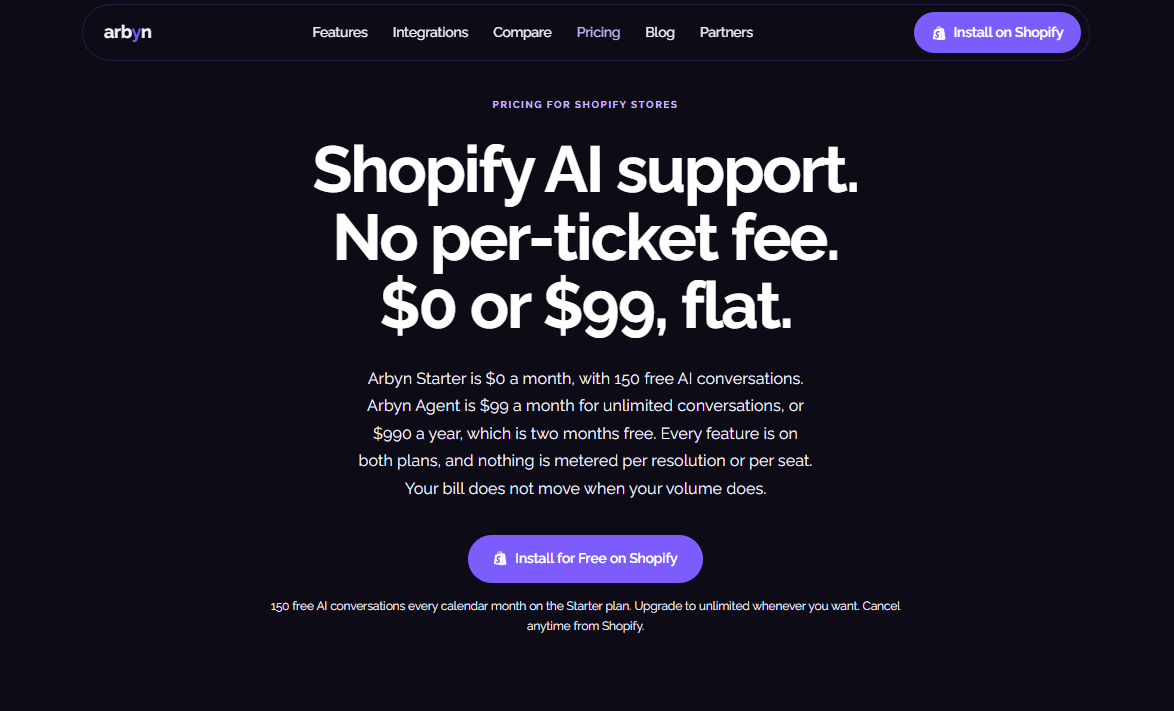
Shopify Support App Pricing Pages Decoded: What the Fine Print Means
Odera Joseph · 7 min
The Shopify Support Stack Most Stores Actually Need at Each Growth Stage
Odera Joseph · 8 min
How to Switch Shopify Support Apps Without Losing Your Ticket History
Odera Joseph · 9 min