Shopify Support App Pricing Pages Decoded: What the Fine Print Means
That cheap Shopify support app isn't so cheap once you account for the per-ticket fees, AI resolution charges, and forced plan upgrades hidden in the fine print.

You open the invoice on a Tuesday morning, and the number is wrong. It’s double what you expected. Last month, it was 50% higher. The month before, it was a little less, but still not the number you saw on the pricing page when you signed up for your helpdesk app. You chose the plan that seemed reasonable, maybe $60 a month, maybe a little more, and for a while, the bill matched. But as your Shopify store grew, so did this mysterious, unpredictable expense. This isn't a software glitch; it's the carefully engineered business model designed to monetize your success. The Shopify support app ecosystem is littered with pricing structures designed to look affordable on the surface while burying the real costs in usage-based metrics, complex add-on fees, and punishing ticket volume overages. That low monthly price is often just the cost of admission, not the cost of doing business, and store owners are left paying a penalty for their own growth, turning a key operational tool into a volatile liability.
The Illusion of the Low Base Price
The journey into cost overruns almost always begins with an attractive sticker price. A helpdesk promises to streamline your customer service for a low monthly fee, a figure that feels like a rounding error in your overall budget. Platforms like Gorgias, for example, have plans that start as low as $10 or $60 per month. For a new store owner, this seems like an incredible deal to manage customer emails and chats professionally. The problem is that these entry-level plans are built around strict limitations, most commonly a cap on "billable tickets." A starter plan might include only 50 tickets per month, and a basic plan might cap you at 300. For a store doing any real volume, these limits are exhausted quickly, sometimes within the first week of a busy month. Once you cross that threshold, a meter starts running at around $0.40 per additional ticket, fundamentally changing the economics of your support operation from a fixed cost to a variable one you can't easily control.
This model creates a fundamental misalignment. Your goal as a store owner is to grow, more customers, more orders, and inevitably, more conversations. But for many support platforms, your growth is their revenue driver, and their pricing is engineered to capture a slice of that success. The advertised base prices become functionally meaningless once your ticket volume consistently exceeds the low caps. You are not actually paying for the software; you are paying for access, and your usage determines the final bill. This structure is common across the industry. Whether it's a ticket-based system or a per-agent model where adding team members escalates costs, the initial price is rarely the true price. A per-agent plan from a provider like Zendesk can start at $55 per agent per month, but essential features like advanced workflow capabilities and CSAT surveys are often locked behind the "Professional" tier at $115 per agent. This layered approach makes it nearly impossible for a store owner to forecast their support costs with any accuracy, turning a critical operational budget line into a source of monthly financial anxiety.
The psychological effect is just as damaging as the financial one. Store owners and their support teams find themselves in a defensive crouch, trying to limit conversations to avoid triggering overage fees. This is the exact opposite of what great customer service should be. You want to encourage engagement, answer questions thoroughly, and build the relationships that lead to repeat purchases, which account for 65% of a typical company's revenue. Instead, you're incentivized to deflect, automate poorly, or provide curt answers to keep conversations from becoming "billable tickets." This cost-avoidance mindset can be devastating, as over half of consumers will switch to a competitor after just one bad experience. The low base price creates an illusion of affordability, but the reality is a system that punishes you for engaging with your own customers. The a-ha moment arrives with the first bill that is double or triple the expected amount, and the realization that the pricing model isn't designed to support your business, but to extract value from its growth.
Decoding the Add-Ons: Where Costs Hide in Plain Sight
The base subscription fee is only the beginning of the story. The true, all-in expense of modern Shopify support apps is found in the layers of add-ons and metered services stacked on top. The most significant and often most surprising of these is the per-resolution fee for AI agents. Platforms like Intercom have built their AI offering around a simple-sounding premise: you pay a flat fee, like $0.99 for every conversation the AI resolves without human intervention. On paper, this seems fair, you only pay when the AI successfully does its job. The problem lies in the volume and the ambiguous definition of "resolution." A store handling 5,000 conversations a month with a 50% AI resolution rate could see an additional $2,475 in AI fees alone, completely dwarfing a seat-based plan. Furthermore, a resolution is often counted not just when a customer confirms their issue is solved, but also when they simply abandon the chat, leaving store owners paying for interactions that may not have been helpful at all.
This model is rapidly becoming an industry standard. Gorgias, a dominant player in the Shopify ecosystem, employs a particularly punishing version of this. When their AI agent resolves a ticket, you are often charged twice: once for the billable ticket itself, which counts against your plan's monthly allotment, and a second time for the automation fee, which can be around $0.90 to $1.00 per AI resolution. This "double-billing" can cause costs to skyrocket during busy periods like Black Friday, where a sudden influx of conversations can lead to thousands of dollars in unexpected overages for both tickets and AI resolutions. Similarly, Zendesk bundles a small number of "automated resolutions" into its suite plans, but once that allowance is used, a meter starts running at a rate reported to be around $1.50 to $2.00 per resolution. These fees are rarely highlighted on the main pricing page, forcing store owners to dig through documentation or learn the hard way when the first invoice arrives.
The add-on economy extends far beyond AI. Essential channels that you assume are included often cost extra. Want to add voice support or SMS to your Gorgias helpdesk? That's frequently a separate monthly charge plus usage fees, with voice tickets costing as much as $2.40 each and SMS tickets around $1.60 each on a pay-as-you-go model. Even within the core product, features that seem standard can be locked behind more expensive tiers, forcing you to upgrade your entire subscription to unlock one critical feature. Tidio's pricing structure is a prime example of this complexity, where the core plan, their AI agent, and automated flows are all billed from separate quotas. A starter plan might cost $29 per month, but adding a meaningful number of AI conversations requires an AI add-on that starts at $39 per month for just 50 conversations. A store owner might think they are buying a single solution, but they are actually juggling three different meters, each with its own potential for overages, turning a seemingly simple subscription into a complex web of fees that makes budgeting a nightmare.
The Punishment for Growth: Why Scaling Support Breaks the Bank
For a growing Shopify store, success should feel exhilarating. More orders, more website traffic, and more customer interactions are all signs of a healthy business. Yet, with many helpdesk pricing models, these very indicators of growth become sources of intense financial strain. The per-ticket and per-resolution models create a direct, linear relationship between your conversation volume and your software bill. As your store scales, your support costs do not just increase; they can escalate exponentially, eating into the very margins you worked so hard to build. This structure effectively punishes store owners for becoming more successful. A Black Friday sales event that doubles your order volume can easily triple or quadruple your support bill for the month, turning a celebratory sales record into a budget crisis come December.
This pain is felt most acutely by store owners who bought into the promise of a low, predictable monthly cost. These pain points are common, with user reports documented in industry analyses showing bills jumping from $4,000 to $9,000 in a single month after a platform switched to a resolution-based model, while another user saw their costs increase from $119 to $854 per month. These are not edge cases; they are the logical outcomes of a pricing model designed to scale with customer interactions, not with the value it provides. When your support software costs more as it deflects more tickets with AI, the incentive structure is fundamentally broken. You are paying more for the AI to do the very job you hired it for, creating a perverse scenario where maximum efficiency for the tool results in maximum cost for you. This is a profound and unsustainable misalignment of interests between the software provider and the store owner.
The problem goes beyond just the raw cost; it fundamentally changes how you approach customer service strategy. Instead of thinking, "How can we create the best possible experience for every customer?" you are forced to think, "How can we minimize the number of billable interactions?" This leads to suboptimal decisions, such as making help articles intentionally dense to discourage live chats or removing the chat widget from product pages with high traffic. You begin to see customer conversations not as opportunities to build loyalty but as liabilities to be contained. The per-contact cost for e-commerce can range anywhere from $2.70 to $5.60, and that's before the unpredictable software fees are layered on top. When your helpdesk bill for a month with 800 conversations approaches $400 or more, as some store owners report with platforms like Gorgias, you are no longer paying for a tool; you are paying a tax on growth. This model is fundamentally unsustainable for scaling brands that need to manage costs while delivering the exceptional service that prevents customer churn, a problem that costs U.S. businesses over a hundred billion dollars annually.
Calculating Your True Cost Per Conversation
To escape the cycle of surprise invoices, you must look past the advertised monthly rates and calculate your "all-in" cost per conversation. This single metric reveals the true financial impact of your helpdesk software and provides a stable, reliable number for budgeting and comparison. The formula is not complex, but it requires you to gather data points that pricing pages often obscure. Start with your base monthly subscription fee. Then, add the cost of any per-agent seats. Next, and most critically, you must account for all usage-based charges. This includes overage fees for exceeding your plan's ticket limit, per-resolution fees for your AI agent, and any additional costs for channels like SMS or voice. Once you have a total monthly cost, divide it by the total number of customer conversations you handled in that month. The result is your true cost per conversation, the great equalizer in helpdesk pricing.
Let's walk through a hypothetical but realistic example for a store handling 1,000 conversations per month. Many stores at this volume might find themselves on a plan like Gorgias's Pro tier or a comparable plan from another provider. The analysis, using recently reported 2026 pricing figures, often reveals a stark difference between the sticker price and the final bill. The numbers below illustrate how quickly the costs add up, especially when AI automation fees are layered on top of a base plan.
| Platform & Plan | Base Cost | Usage Fees (Example) | Estimated Total Monthly Cost |
|---|---|---|---|
| Gorgias (Pro Plan) | ~$360/mo for 2,000 tickets | Assuming 40% AI automation (400 resolutions) @ ~$0.90/resolution = $360 in AI fees | ~$720/mo |
| Intercom (Advanced Plan) | ~$85/seat/mo (e.g., 3 seats = $255) | Assuming 40% AI automation (400 resolutions) @ $0.99/resolution = $396 in AI fees | ~$651/mo |
| Zendesk (Suite Professional) | ~$115/seat/mo (e.g., 3 seats = $345) | Assuming 40% AI automation (400 resolutions) @ ~$1.50/resolution (after small allowance) = ~$600 in AI fees | ~$945/mo |
This table illustrates how quickly the costs add up and why the initial sticker price is so misleading. In each scenario, the base plan fee, which is the most visible number on a pricing page, accounts for only a fraction of the final bill. The AI resolution fees are the silent budget killers, in some cases costing more than the entire seat-based subscription. A store owner who budgeted for a $360 monthly expense on a Gorgias Pro plan could easily find themselves paying over $700 without changing their plan or adding any agents. Performing this calculation for your own store is the first step toward regaining control. It exposes the hidden variables and forces a clear-eyed assessment of what you are truly paying for. Once you have this number, you can compare platforms on a true apples-to-apples basis, ignoring the marketing claims and focusing instead on the model that offers the most predictability and value for your specific volume.
The Alternative: Realigning Your Tools with Your Goals
The widespread frustration with unpredictable, usage-based billing has created a clear and urgent need for an alternative model, one that aligns the software's cost with the store owner's goals, not their support volume. The most direct and powerful solution to this problem is a flat-rate pricing structure. In this model, you pay one fixed, predictable price per month for access to the entire platform, regardless of how many conversations you have, how many tickets your AI resolves, or how much your business grows. This approach fundamentally changes the relationship between you and your support tool. Instead of being penalized for growth, you are empowered by it. You can have ten thousand conversations in a month for the same price as one thousand, completely removing the fear of overage charges and surprise invoices that plague scaling businesses.
The best pricing model is the one that stays predictable as your team grows.
This predictability has a powerful ripple effect on your entire operation. When you are no longer worried about the cost of each individual interaction, you can focus entirely on the quality of that interaction. Your team can spend more time with customers, solving complex problems and building relationships without a manager looking over their shoulder at a running meter. Your AI can be deployed to resolve as many routine inquiries as possible, freeing up your human agents for high-value conversations that drive sales and build loyalty. The goal finally shifts from ticket deflection to genuine problem-solving. A flat-rate model turns your support function from a cost center to be minimized into a growth engine to be maximized. You can actively encourage customers to reach out, knowing that every conversation is an opportunity to delight, not an expense to be contained.
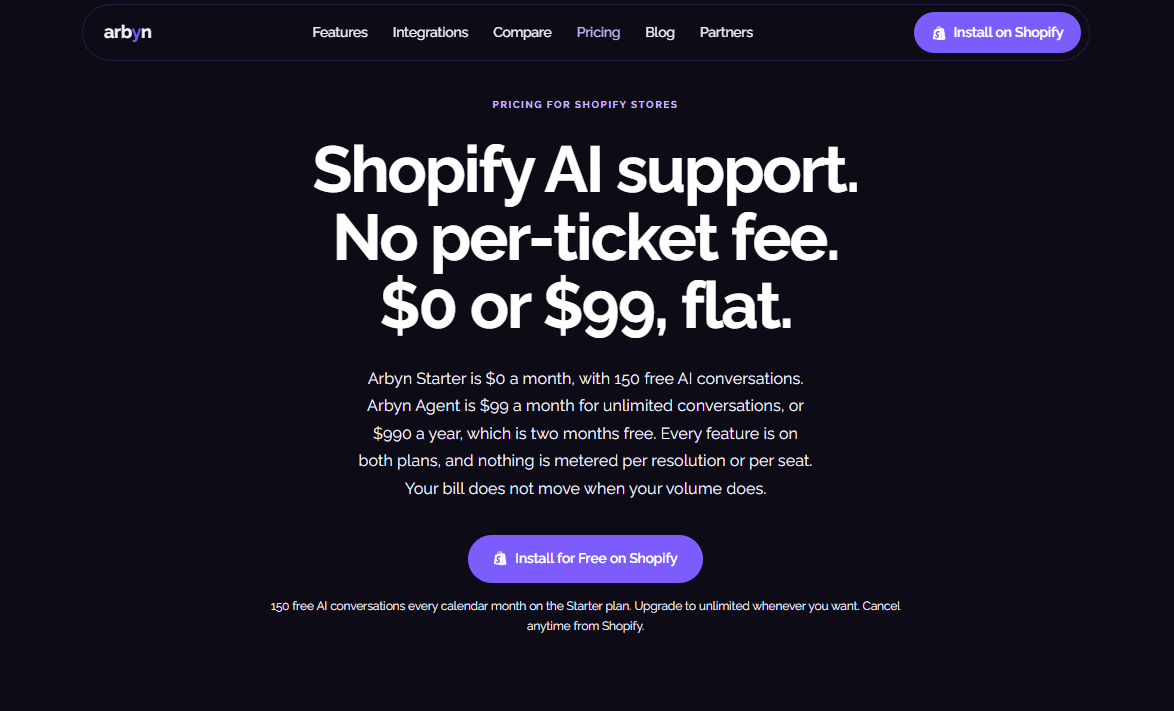
This is the philosophy behind Arbyn. After experiencing the pain of escalating helpdesk bills firsthand as store owners, we built a support and sales agent for Shopify on a fundamentally different model. For stores just starting, the Arbyn Starter plan is permanently free and includes 150 full AI conversations per month. For growing stores, the Arbyn Agent plan is a flat $99 per month for unlimited conversations and unlimited AI resolutions. There are no per-ticket fees, no per-resolution charges, and no hidden add-ons. That single monthly price is the price you pay, no matter how busy you get during your peak season. It’s a simple, transparent model designed to grow with you, not at your expense. If you're tired of decoding complex pricing pages and fighting with unpredictable monthly bills that can reach over $700 or $900 for a modest volume, you can install Arbyn from the Shopify App Store and see what's possible when your tools are truly on your side.
Ultimately, choosing a support platform is about more than just features; it's about choosing a business partner. You must decide if you want a partner whose success is tied to your rising costs or one whose success is tied to your growth and stability. By moving away from the convoluted world of usage-based pricing toward a predictable, flat-rate model, you can bring certainty back to your budget. This allows you to stop wasting energy decoding invoices and instead refocus that energy on what actually matters: serving your customers, building your brand, and growing your business with confidence.
Written by
For seven years I have led customer success and technical support inside high-growth SaaS and e-commerce companies. Customer Support Lead at DripShop.live, a live-commerce SaaS. Technical Support Specialist at Replo (Y...
View full profile