How Shopify's Managed Markets Program Changes International Support
Shopify's Managed Markets program automates the logistics of global selling, but it creates a new, complex category of international support questions that store owners must be prepared to answer.

You wake up to an angry email from a customer in Germany. They were just hit with a €45 customs fee to receive the order they placed last week, a fee they never expected. They’re demanding you cover the cost or they’re refusing the package and demanding a full refund. Before 2022, this was a daily reality for store owners venturing into cross-border sales, a logistical nightmare of calculating duties, managing VAT, and fielding confused, frustrated support tickets. While platform-level tools have evolved significantly to handle the financial side of this complexity, the need for sharp, responsive international support has not disappeared; it has simply changed shape. The logistical friction is gone, but the conversational friction remains, creating a new challenge for stores scaling globally.
The Old World: The Chaos of Manual International Selling
For years, selling internationally on Shopify was a high-friction, high-risk endeavor undertaken only by store owners with significant resources or a high tolerance for operational chaos. The platform provided the storefront, but you were on your own for everything else. This created a steep barrier to entry, turning a massive global market into a series of costly administrative hurdles. The core challenge was that every country is its own distinct regulatory and financial ecosystem. Selling a t-shirt from Los Angeles to a customer in Toronto is one thing; selling that same t-shirt to customers in Paris, Tokyo, and São Paulo required navigating three entirely different sets of rules. This complexity manifested in several painful ways for store owners, turning the support queue into a minefield of international incidents that eroded margin and customer trust with every ticket.
The most immediate pain point was duties and taxes. Every country has a threshold, known as a *de minimis* value, below which imports are tax-free. Exceed that value, and a shipment is subject to import duties, value-added tax (VAT), or goods and services tax (GST). For a store owner, this meant either attempting to calculate these fees upfront, a monumental task requiring constantly updated knowledge of hundreds of tariff codes and tax rates, or shipping packages Delivery Duty Unpaid (DDU). The latter option offloaded the responsibility to the customer, resulting in the exact kind of angry email that started our story. Customers, accustomed to seamless domestic online shopping, were blindsided by unexpected carrier fees and customs charges, leading to refused shipments, chargebacks, and a torrent of negative reviews. The support cost of managing these escalations was immense, requiring agents to become quasi-experts in international trade policy just to explain why an order was being held hostage by a local post office.
Beyond taxes, currency and payment localization presented another major hurdle. While Shopify has long offered multi-currency display, the underlying transaction mechanics were often complex. True localization means allowing a customer in Japan to pay in Yen using their preferred local payment method, like Konbini, not just seeing a cosmetic price in Yen before being charged in USD at checkout. Without this capability, cart abandonment rates for international customers were notoriously high. Each potential market required research into its preferred payment gateways, followed by a technical integration, if one was even available. Compounding this was the issue of currency fluctuation. A price set in Euros on Monday could be worth significantly less in dollars by Friday, creating accounting headaches and eating into profit margins on already expensive international sales. This financial uncertainty made it difficult to plan and price effectively for a global audience.
Finally, there was the sheer operational weight of compliance and logistics. Each country has its own rules about what can be imported. A cosmetic ingredient perfectly legal in the United States might be a restricted substance in the European Union. A children's toy might require specific safety certifications in Australia that aren't necessary in Canada. Store owners were responsible for knowing and enforcing these restrictions, with mistakes leading to seized shipments and permanent bans from certain markets. Shipping itself was a maze of carrier negotiations, customs declarations (CN22 and CN23 forms), and inconsistent tracking. A package could be meticulously tracked to the destination country's border, only to disappear into the local postal system for weeks, generating a steady stream of "Where is my order?" tickets that support teams were powerless to answer with any certainty. This combination of financial risk, regulatory burden, and support overhead kept many stores from ever truly tapping into their international potential.
What is Shopify Markets and Markets Pro?
Recognizing that the manual approach to global commerce was unsustainable for the vast majority of its user base, Shopify began a fundamental platform shift. The goal was to transform international selling from a complex, opt-in challenge to a streamlined, default capability. This initiative produced two distinct but related tiers of service: Shopify Markets and Shopify Markets Pro. Understanding the difference is critical, as they solve very different parts of the international selling puzzle. One provides the tools for you to manage the complexity yourself, while the other aims to manage that complexity for you, for a fee. This distinction is the foundation of the modern approach to cross-border sales on the platform and directly impacts the type of international support a store owner needs to provide.
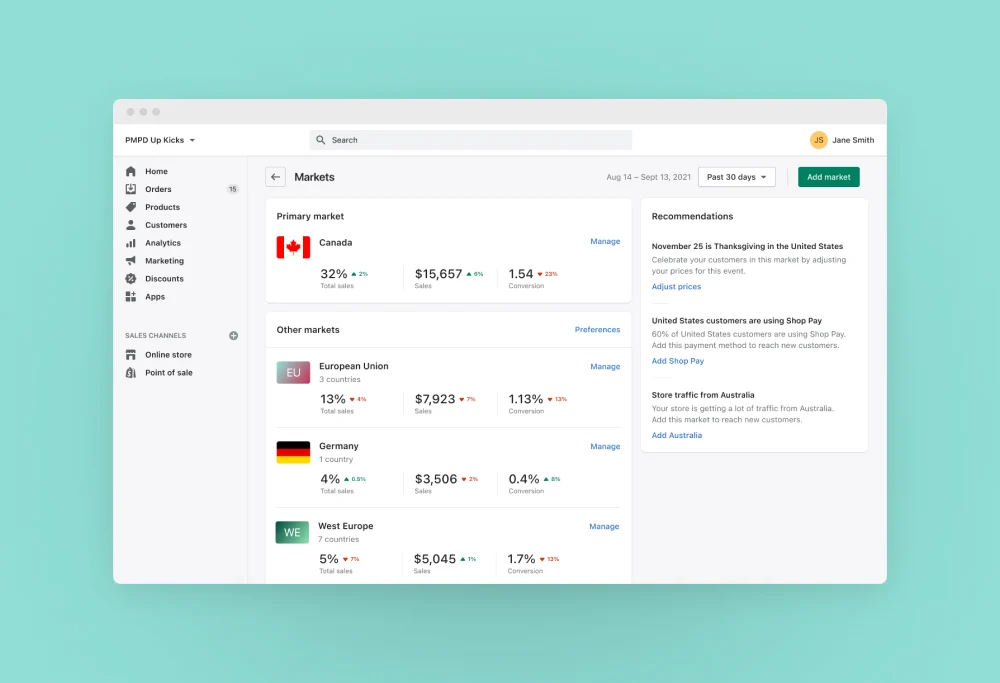
Shopify Markets, first introduced in 2021 and now included with all Shopify plans, is the foundational layer. It’s a cross-border management tool built directly into the Shopify admin that allows store owners to organize their global presence from a single storefront. Instead of launching separate, resource-intensive expansion stores for each country, you can create "markets" that group countries together. For a market like the European Union, you can enable local currencies, set market-specific pricing to account for different costs, and use translation apps to localize the storefront content. A customer visiting from France sees prices in Euros and product descriptions in French, creating a more native and trustworthy shopping experience. While higher-tier Shopify plans had some of these features before, Markets centralized them into a single, intuitive interface, making localization accessible to stores on any plan. However, with standard Shopify Markets, the store owner is still the store owner of record. This means you are still legally responsible for handling customs paperwork, registering for and remitting VAT in countries where you meet the sales threshold, and ensuring your products comply with local laws. It gives you the localization tools, but the compliance burden remains squarely on your shoulders.
This is where Shopify Markets Pro enters the picture. Often referred to as Managed Markets, this premium service is an extension of the base Markets functionality, powered by a partnership with the cross-border logistics company Global-e. The single most important change with Markets Pro is that it introduces a store owner of record model. When an international order is placed through a store using Markets Pro, Global-e, not the store owner, becomes the legal entity responsible for that transaction. This is a structural shift that offloads the vast majority of compliance and logistical complexity. Global-e handles the calculation and remittance of all duties and import taxes, assumes responsibility for adhering to local regulations, and manages the international shipping and fulfillment. This means store owners no longer need to register for VAT in multiple countries or worry about surprise fees for their customers; Markets Pro guarantees a landed cost at checkout, so the price the customer sees is the final price they pay.
The service comes at a cost, typically a transaction fee and a currency conversion fee on the order value, which covers the duties, taxes, and use of local payment methods. In exchange for this fee, store owners gain access to a suite of features designed to eliminate cross-border friction. This includes a wide array of local payment methods worldwide, competitive express shipping rates with carriers like DHL, and built-in fraud protection on international orders. For a U.S.-based store owner, this means they can start selling to over 150 countries almost overnight, without needing to hire an international tax advisor or negotiate with a dozen different shipping carriers. It transforms international expansion from a multi-year strategic project into a feature that can be enabled from the Shopify admin. This automation of logistics and finance, however, is where the new international support challenge begins.
How Managed Markets Automates Global Compliance
The core value proposition of Shopify's Managed Markets program is the radical simplification of global compliance. It takes the most complex, risk-laden aspects of cross-border selling and abstracts them away behind a single, integrated service. By stepping in as the store owner of record, the program effectively acts as an outsourced international operations team for your store. This allows store owners to focus on marketing and product, rather than becoming experts in global trade law. The automation touches several key areas, each one designed to remove a specific point of failure that historically plagued international ecommerce and flooded support inboxes with intractable problems. Understanding these mechanisms reveals the power of the program, but also helps define the new boundaries of where platform automation ends and human-led support begins.
First and foremost, Managed Markets automates the entire lifecycle of duties and import taxes. In the old model, a store owner had to decide between not collecting duties and angering customers, or trying to calculate them and risking massive inaccuracy. Managed Markets eliminates this dilemma. Powered by Global-e's extensive logistics network and data, the system automatically calculates the precise amount of duty and tax for every item in an order, for every destination country, at checkout. This calculated amount is then collected from the customer as part of their initial payment, creating a "guaranteed landed cost." There are no surprise fees upon delivery because the customs clearance has been prepaid. Global-e then takes on the responsibility of remitting these collected funds to the respective government authorities in each country. For the store owner, this removes the enormous administrative burden of registering for VAT/GST in multiple jurisdictions, filing periodic tax returns, and managing payments to foreign tax agencies. The risk of non-compliance, which can result in heavy fines and a ban on importing to a country, is shifted from the store owner to the store owner of record.
The program also automates adherence to international trade restrictions. Every country maintains a list of prohibited and restricted goods. Selling animal products, certain electronics, or even specific types of printed materials can be illegal in some markets. Managed Markets automatically screens carts at checkout against the import regulations of the destination country. If a customer in Italy attempts to purchase a product that is restricted for import, that item is automatically flagged and often cannot be shipped, preventing a compliance issue before it even happens. This proactive restriction management saves store owners from the costly scenario of having packages seized and destroyed by customs, and the subsequent support nightmare of explaining the situation to a customer whose order has vanished. It turns a reactive, manual process of checking country-specific rules into a proactive, automated guardrail integrated directly into the checkout flow.
Finally, Managed Markets streamlines payment and financial reconciliation. A major driver of international cart abandonment is the lack of familiar, trusted payment options. The program dramatically expands payment localization by offering a wide array of local methods, from Klarna in Germany to other regional wallets, that go far beyond standard credit card processing. This builds customer trust and measurably increases conversion rates. On the back end, it solves the problem of currency fluctuation. With a guaranteed foreign exchange feature, the exchange rate is locked in at the time of the transaction, protecting the store owner's margin from market volatility during the days or weeks a payment is processing or an order is in transit. Instead of receiving hundreds of individual international payments in different currencies, the store owner receives a single, consolidated payout from Global-e, simplifying accounting and reconciliation. This suite of automated financial and compliance tools represents a profound shift, solving the logistical problems that once defined international selling.
The Lingering Support Gap: Where Managed Markets Stops
While Shopify's Managed Markets program brilliantly solves the logistical and financial complexities of cross-border commerce, it’s a mistake to assume it eliminates the need for robust international support. In fact, by enabling thousands of stores to sell globally with ease, it creates a new and more nuanced set of support challenges. The platform automates the *transaction*, but it does not automate the *conversation*. The store owner of record handles the tax remittance and customs paperwork, but your support team still handles the customer. When questions arise, they are no longer about unexpected fees you failed to predict, but about the intricate workings of a global logistics system that is now an integral part of your customer experience. This creates a critical support gap between the automated backend and the customer-facing frontend.
Customers now have questions that are more specific and complex. Instead of a generic "Why was I charged a customs fee?", the questions become, "My order to Brazil is being returned by customs because the product is restricted. I thought you handled this at checkout, why was I allowed to buy it?" or "The DHL tracking shows my package cleared customs in Frankfurt, but it hasn't moved in five days. Can you tell me what the holdup is?" These are not questions your support team could have answered before, but they are questions customers now expect you to answer. Because you offer a seamless international checkout experience, the customer's perception is that you own the entire end-to-end process. They don't know or care about the distinction between your brand and a third-party store owner of record like Global-e. When their package is delayed, they contact you, the brand they trust.
This gap is most apparent when exceptions occur. While the system is designed to be seamless, international shipping is inherently complex. A product might be misclassified by a customs agent, a package might be damaged in a consolidation warehouse, or local delivery in a rural area might be handed off to a third-party courier with poor tracking. In these moments, your support team is on the front line. They need to be able to communicate effectively with a customer who may not speak English as their first language, understand the context of the issue within the Managed Markets framework, and provide a clear, empathetic, and accurate response. Simply telling a customer "that's handled by our partner" is a recipe for a poor experience. The customer bought from your store, and they expect your store to solve their problem. This requires a new level of training and tooling for support teams, equipping them to handle conversations that span multiple languages, time zones, and logistical systems.
Furthermore, the pre-purchase experience still generates a significant volume of support inquiries that fall outside the scope of logistical automation. Customers will have questions about product suitability for their region, sizing differences between the US and Europe, or power compatibility for electronics. A potential customer in the UK might ask via live chat, "Will this lamp work with a 240V outlet, or will I need a converter?" These are crucial, revenue-driving conversations that determine whether an international visitor becomes a customer. Managed Markets ensures they can pay in pounds and have duties handled, but it doesn't answer their product-specific questions. Providing excellent international support therefore requires a two-pronged approach: efficiently managing post-purchase logistical questions created by the new system, and effectively handling pre-purchase conversational commerce to capture global demand in the first place.
Closing the Loop with International Support Automation
The operational elegance of Shopify's Managed Markets program solves the structural headaches of global selling, but it simultaneously elevates the importance of the customer conversation. When the mechanics of duties, taxes, and compliance are flawlessly automated, the quality of your customer support becomes a primary brand differentiator. The lingering support gap, the space between the automated backend and the customer's inbox, is precisely where modern support tools can close the loop. The challenge is no longer about manually calculating VAT; it's about delivering clear, fast, and context-aware answers to customers in any language, at any time. This final mile of the international customer journey is where automation, when applied correctly, can turn a potential problem into a moment of exceptional service.
The most immediate and scalable solution is deploying an AI agent capable of multilingual communication. The reality of selling into 150 countries is that you will receive support tickets in dozens of languages. A customer in Japan should not have to run their question through Google Translate to get help. An effective AI support agent can automatically detect the customer's language and conduct the entire conversation, from the initial query to the final resolution, in their native tongue. This isn't just about cosmetic translation; it's about understanding intent and providing accurate information. When a customer asks "Wo ist meine Bestellung?" the AI should instantly recognize this as a "Where is my order?" (WISMO) request, retrieve the latest tracking information from Shopify (which now includes detailed cross-border data via Managed Markets), and deliver a precise, helpful status update in German. This capability alone handles a massive percentage of common international support queries without requiring a human agent to be involved.
Beyond simple translation, AI can be trained on the specific nuances of your international operations. It can be equipped with knowledge base articles explaining how guaranteed landed costs work, why certain products are restricted in specific regions, and what the typical delivery windows are for different countries via DHL Express. When a customer asks why their friend in Canada received an order in two days but their order to Australia is taking over a week, the AI can provide a detailed explanation referencing the different shipping lanes and customs clearance times. This turns the support interaction from a simple status update into an educational moment that builds trust and manages expectations. The AI acts as a specialized, infinitely scalable tier-one agent, freeing up human support staff to handle only the most complex and sensitive international escalations, such as a high-value order damaged in transit.
This is where tools designed for the Shopify ecosystem provide a distinct advantage. An AI agent like Arbyn, for example, is built to integrate directly with Shopify's data structures. It can handle multilingual conversations for WISMO, product questions, and policy inquiries out of the box. Because it lives inside the Shopify environment, it understands the context of orders placed through both standard Markets and Managed Markets. While it does not perform the duty calculations itself, that is the job of the store owner of record, it can explain the results of those calculations to the customer in their own language. By automating these predictable, high-volume international support conversations, store owners can fully capitalize on the global reach provided by Managed Markets without having to build a multinational, multilingual support team to keep up with the new demand.
Automating the financial and logistical side of global e-commerce was the first critical step, and Shopify has delivered a powerful solution. The final step is automating the conversations that this new global scale creates. By pairing the transactional efficiency of Managed Markets with the conversational efficiency of a capable AI support agent, store owners can create a truly seamless, end-to-end international customer experience. You can add an agent to your store to see how it handles the new wave of questions that global selling brings, ensuring that as your brand crosses borders, your customer support never misses a beat. The future of international commerce isn't just about shipping products; it's about shipping answers, quickly and clearly, in every language.
Written by
For seven years I have led customer success and technical support inside high-growth SaaS and e-commerce companies. Customer Support Lead at DripShop.live, a live-commerce SaaS. Technical Support Specialist at Replo (Y...
View full profileKeep reading
View all posts
Shopify's AI Feature Roadmap: What's Native vs What Still Needs an App
Odera Joseph · 7 min

What Shopify store owners Should Watch For in Platform Roadmap Announcements
Odera Joseph · 7 min

How Shopify's Winter and Summer Editions Affect Support Apps Each Year
Odera Joseph · 8 min