Shopify's AI Feature Roadmap: What's Native vs What Still Needs an App
Shopify's native AI tools are powerful, but they can't take action on customer orders; for that, you still need an app.

A peculiar reality exists inside the Shopify ecosystem of 2026. The platform has shipped a vast array of new AI-powered features, from an administrative assistant that can build complex discount campaigns from a single sentence to storefronts that can sell products inside a chat conversation. You can ask your store to forecast sales by SKU for the upcoming holiday season, automatically segment at-risk customers for a personalized "we miss you" email campaign, or even use AI to generate entire marketing videos for social media from just your product pages. Yet for all this astonishing innovation, a customer who places an order and immediately realizes they chose the wrong size cannot simply cancel or modify it themselves. This stands in stark contrast to overwhelming consumer demand for autonomy; recent industry data from Microsoft shows that a majority of customers try to solve issues via self-service first, a figure that is even higher for younger demographics. Natively, Shopify does not allow a customer to autonomously cancel their own completed order; they must find a contact page, send a message, and wait for a human to manually process the request in the admin panel, introducing friction and delay into a process customers want to control themselves.
This single, stubborn fact reveals the fundamental dividing line in Shopify’s AI strategy. There is the AI that helps you, the store owner, write, market, and manage your business, and then there is the AI that can act on behalf of your customer to alter a transaction. As of today, only one of those comes built-in, creating a critical distinction between advisory AI and agentive AI. The first category suggests, drafts, and analyzes, making your job easier by acting as a brilliant but purely consultative partner. The second, agentive category, would need the authority to execute financially sensitive tasks like issuing refunds, processing exchanges, or changing order contents, a responsibility Shopify has chosen to keep firmly in human hands, akin to a CFO who must personally sign every check. Understanding this distinction is the key to building a support stack that is genuinely efficient, not just technologically current, because it clarifies what problems the platform solves for you and which ones you must solve yourself with an extended toolset.
Shopify's AI Universe in 2026: The "Magic" and The "Sidekick"
Shopify’s investment in artificial intelligence is undeniable, primarily consolidated under two names: Shopify Magic and Sidekick. These are not a single tool, but a suite of capabilities embedded throughout the platform, designed to act as a co-pilot for the store owner. Shopify Magic is the contextual AI that appears right where you work. For a store owner importing a new collection of 200 products with cryptic supplier codes, Magic transforms "Model #7B-Blue" into a compelling description detailing the "ocean-blue merino wool sweater with a relaxed-fit neckline, perfect for breezy coastal evenings," complete with SEO-optimized keywords and styling suggestions. It’s the feature that generates compelling product descriptions from a few keywords, saving brands with large catalogs countless hours. It also drafts blog posts, suggests a dozen high-open-rate email subject lines for campaigns, and even uses AI to edit product photos, swapping a sterile studio backdrop for a lifestyle shot of a sunny beach or color-correcting an entire catalog to match a specific brand palette without needing Photoshop. Think of Magic as a specialist assistant, showing up in different departments of your business to accelerate content and creative workflows. It is exceptionally good at the blank-page problem, turning what was once a week-long content project for a new product launch into a single afternoon's work. The goal here is democratizing high-quality creative and content production, and for many operations, it delivers transformative efficiency.
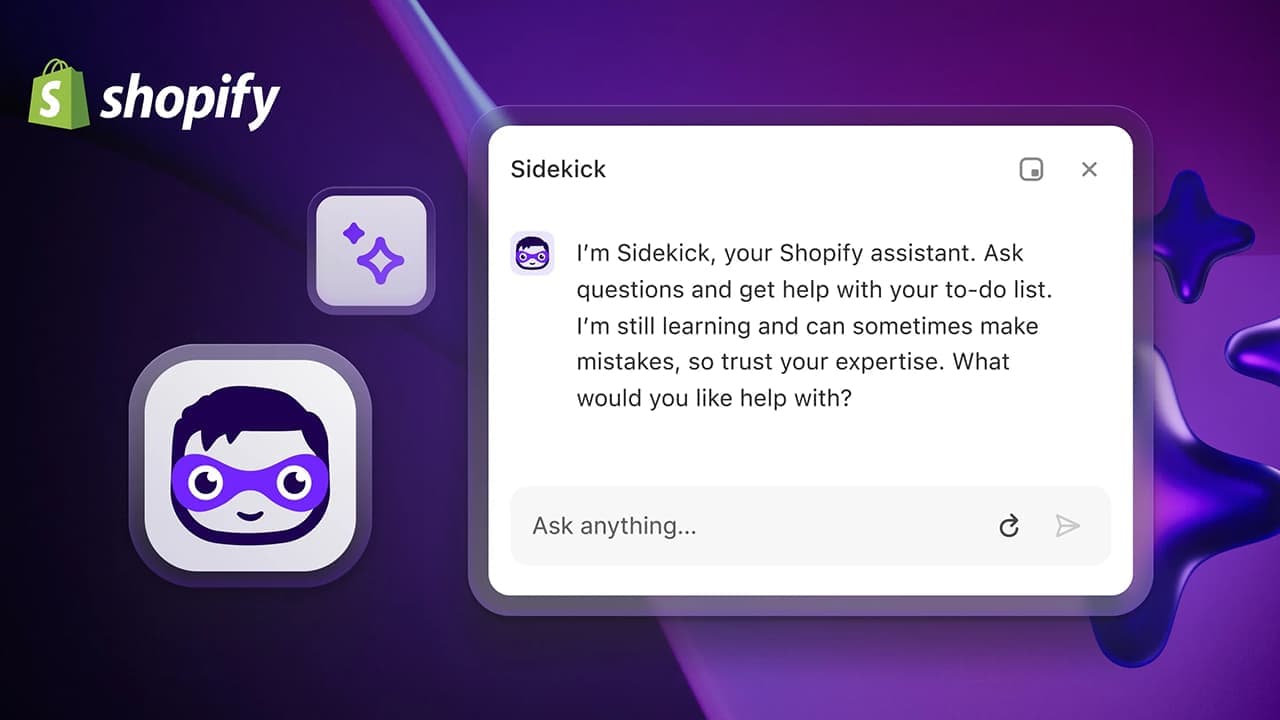
Sidekick is the next evolution: a centralized, conversational AI assistant for your entire admin. It’s the chat interface you can ask, "Show me my top-selling products last month," or more powerfully, "Create a 15% 'flash sale' discount for the entire summer collection, make it active for the next 48 hours, generate a unique code for it, and then draft a tweet announcing the sale." Where older versions of the AI might have pointed you to the right admin screen, Sidekick in 2026 is designed to understand the request and execute the multi-step task for you, saving you from navigating through three or four different menus. It understands your store's data, your products, orders, and customer segments, making its assistance contextually aware and deeply powerful. On the customer-facing side, Shopify Inbox, the platform’s free live chat tool, now includes an AI sales associate. This bot can handle a significant portion of common order inquiries, as a large volume of support requests are simple, repetitive questions like "Where is my order?" or "What is your return policy?". It can instantly answer with tracking information or quote your store's policy page. It’s a solid first line of defense, capable of deflecting the high-volume, low-complexity questions that would otherwise occupy a human agent’s time. But across this entire impressive suite, a common thread emerges: these tools are built primarily to assist the store owner, operating within the Shopify admin or providing surface-level answers on the storefront, but they do not, on their own, possess the authority to fundamentally alter a completed transaction.
The Native Action Gap: Where Shopify's AI Draws the Line
For all the power of Sidekick and Magic, a critical boundary exists that defines the limits of native automation. Shopify’s native AI tools do not, by default, perform meaningful post-purchase order modifications in direct response to a customer's request. This is the "action gap." A customer can ask the Shopify Inbox bot to cancel an order, but the bot can only respond with information, such as "To request a cancellation, please reply to your order confirmation email." The system is designed for the customer to make a request, which a human agent must then locate and fulfill manually. Official Shopify documentation and extensive community discussions confirm this limitation is by design. For a store processing 3,000 orders a month, a standard 2% request rate means 60 customers are hitting this wall, translating to three manual cancellation tasks per business day. You must navigate to the specific order, click 'More actions,' select 'Cancel', choose the refund method, enter the correct refund amount, decide whether to restock the items, confirm you are not refunding more than the amount paid, and finally click a second time to confirm the action, a process involving at least seven clicks across multiple screens for every single request. There is no native, automated workflow that allows an AI to perform these sensitive steps based on a customer's chat message, creating a recurring, time-consuming, and error-prone manual task.
This isn't an oversight; it appears to be a deliberate design choice rooted in security and the primacy of store owner control. Allowing an autonomous agent to issue refunds, cancel orders, or change shipping addresses introduces significant risk and financial liability. What if the AI misunderstands a customer's sarcastic comment about "wanting to cancel their whole life" and proceeds to cancel their $2,000 order? This isn't hypothetical; incidents such as a Scottish Government AI providing flawed policy advice have demonstrated the real-world consequences of unmonitored AI. Or consider the Zillow Offers failure, where an AI pricing model over-optimized for a stable market led to massive losses when market conditions changed, forcing a shutdown of the entire division. Shopify's cautious approach prioritizes the integrity of the checkout and the order ledger, which is the ultimate system of record for your business's revenue. The platform's AI can summarize a customer's request, it can suggest a reply for a human agent, and it can even pull up the correct order in the admin for you. But the final, authoritative click, the one that moves money from your account or alters your inventory levels, is reserved for the store owner or their staff. This creates a clear and understandable ceiling on native automation. While AI can handle the conversation, the resolution of any issue requiring an order change still lands squarely on a human's to-do list, creating the very manual work and potential for delay that AI promises to eliminate.
Bridging the Divide: The Role of the Shopify App Ecosystem
This native "action gap" is precisely where the third-party app ecosystem thrives, creating a market for specialized, action-oriented tools. While Shopify provides the foundational platform and advisory AI, specialized applications extend its capabilities by deeply integrating with its APIs to perform the tasks the native AI will not. For customer support, this is a mature and highly competitive space. Platforms like Gorgias, Zendesk, and Intercom have built robust Shopify integrations specifically to bridge this divide between conversation and action. Their tools are designed to pull a customer's complete order history directly into the support inbox, giving an agent full context without ever leaving the conversation. More importantly, these integrations are granted specific API permissions, with your explicit approval during installation via an OAuth screen detailing every requested permission, to take action on your behalf. An agent, or an AI powered by these platforms, can often process a refund, cancel an entire order, or edit a shipping address directly from the support ticket interface, transforming a five-minute, multi-screen task into a few clicks within a single window.
The difference in workflow efficiency is night and day. For example, Gorgias heavily promotes its "Automate" features, including an AI Agent which it states can be configured to "fully resolve requests from shoppers who want to make changes to their orders, including cancelling an order" or changing an address. This is possible because the app is explicitly granted permission to execute these functions via Shopify's API. Similarly, Intercom’s documentation for its Shopify integration notes that teammates can "process line-item refunds, issue gift cards, and create replacement orders" all from within the inbox conversation. Zendesk's official Shopify app also states that agents can process common requests like refunds and cancellations directly from the sidebar in their workspace, turning customer data into actionable buttons. These apps are not just suggesting responses; their AI and automation tools are empowered to execute the necessary steps in the Shopify admin via API calls. This transforms the role of AI from a conversational partner to a functional store owner. It’s the critical difference between an AI that tells you how to cancel an order and an AI that prepares the cancellation for you, awaiting only a final human approval. This essential layer of operational capability is something that, for now, can only be acquired through the Shopify App Store.
The True Cost of AI: Native Convenience vs. App Capability
The primary advantage of Shopify’s native AI tools is undeniable: they are included with your Shopify subscription at no extra cost, a remarkable value proposition. For a new store owner or a solo entrepreneur, having access to an AI that can write professional product descriptions and handle basic customer questions 24/7 through Shopify Inbox is an incredible force multiplier. It dramatically lowers the barrier to entry and allows a small operation to appear polished and responsive from day one without any additional software spend. This convenience is powerful, but it comes with a hidden operational cost that emerges and grows directly in line with your store's success. As order volume grows from ten a day to a hundred a day, so does the absolute number of requests for cancellations, refunds, address changes, and exchanges. While the native AI can field the initial query, every single one of these requests ultimately creates a manual task for a human. That time adds up quickly, creating a significant drag on productivity that can damage customer loyalty; research shows that customers find long wait times to be one of the most frustrating parts of a service experience.
This is where the calculation shifts from upfront software cost to ongoing labor cost. The "free" native tools may be costing you hundreds or even thousands of dollars a month in valuable employee time. Assuming a support agent's loaded cost is a conservative $30 per hour, a figure that can easily exceed $35 an hour in many US markets when accounting for benefits, taxes, and overhead, an employee spending just two hours per day on manual order modifications that could be automated is costing the business over $1,800 per month. This doesn't even account for the revenue impact. Studies have shown that businesses responding quickly to customers win more sales, and research by Frederick Reichheld of Bain & Company famously demonstrated that a 5% increase in customer retention can boost profits by 25% to 95%. Investing in a paid third-party application that can automate these order actions is not just an added expense; it's a strategic move to reduce operational drag and reclaim that lost time. These apps turn a multi-step manual process into a one-click approval or, in some cases, a fully autonomous action governed by rules you set. The return on investment is measured in reclaimed hours, faster resolution times for your customers, and a support team that can focus on the complex, high-value customer relationships that truly drive growth, rather than the transactional tasks that drain resources and morale. The choice isn't simply free versus paid; it's about identifying the point at which the cost of manual repetition outweighs the cost of automation software.
Building Your 2026 Support Stack: A Decision Framework
Deciding when to move beyond Shopify's native tools and invest in a dedicated support application is a critical inflection point for a growing store. The right answer depends entirely on your store's current scale, order volume, and specific operational pain points. There is no single solution that fits everyone, but a clear framework can guide the decision. For a brand-new store or one with fewer than a hundred support conversations a month, the native tools are often perfectly sufficient. Using Shopify Inbox to chat with customers and manually processing the occasional refund or cancellation in the admin is a completely manageable workflow when you're only getting one or two such requests per week. At this stage, the primary business goal is to validate your product and find market fit, and the free, built-in tools are an ideal, capital-efficient choice for this crucial phase. At this scale, handling support personally is a feature, not a bug, providing direct qualitative feedback from your first customers.
The tipping point arrives when your support team starts expressing clear frustration or when your key metrics begin to slip. When you hear phrases like "I spend all day processing refunds" or "I can't keep up with the address change requests," you have definitively outgrown the native stack. This often coincides with a rising First Response Time, which top-performing companies strive to keep as low as possible, or an increase in negative reviews mentioning slow service. This typically happens as a store scales past a few hundred support conversations a month and order modification requests become a daily, high-volume reality. At this stage, the manual processing of order actions is no longer a minor inconvenience; it's a significant operational bottleneck that increases customer wait times and burns out your team. This is the moment to invest in an app that bridges the action gap. Tools like Arbyn are built for this exact stage. It combines the conversational AI you expect with the direct ability to execute order actions, like initiating a return or changing a shipping address. Crucially, for money-moving actions like refunds and cancellations, it prepares the action and waits for your one-click approval, maintaining store owner control while eliminating all the manual data entry. For a flat monthly price, it takes on the unlimited, repetitive work that slows your team down, allowing you to scale your support capacity without needing to scale your headcount. You can add it to your store directly from the Shopify App Store and immediately shift your team's focus back to growth-oriented activities.
Shopify has built an extraordinary suite of AI tools to help you run your business more effectively. The platform's native AI is a world-class assistant for you, the store owner, empowering you to create content, analyze data, and manage your admin with unprecedented speed. However, the line is currently drawn at the customer-facing execution of order-level changes. For an AI that can truly act as an agent for your customers, canceling orders, processing refunds, and resolving issues autonomously, the app ecosystem remains the necessary and powerful extension. The most strategic store owners in 2026 will not see this as a flaw, but as a clear roadmap. They will leverage Shopify's free native tools for as long as they serve the business and know precisely when to invest in the operational power of an integrated app to unlock the next level of growth.
Written by
For seven years I have led customer success and technical support inside high-growth SaaS and e-commerce companies. Customer Support Lead at DripShop.live, a live-commerce SaaS. Technical Support Specialist at Replo (Y...
View full profileKeep reading
View all posts
How Shopify's Managed Markets Program Changes International Support
Odera Joseph · 8 min

What Shopify store owners Should Watch For in Platform Roadmap Announcements
Odera Joseph · 7 min

How Shopify's Winter and Summer Editions Affect Support Apps Each Year
Odera Joseph · 8 min