Shopify's Winter '27 Editions: What’s New for AI and Support Automation
While Shopify's Winter '27 Editions have not been announced, the platform's trajectory offers a clear preview of what's coming for AI and support automation.


Shopify’s twice-yearly Editions announcements have become defining moments for the entire ecommerce industry, redrawing the map of what’s possible for store owners. While the official Shopify Winter '27 Editions release is still on the horizon, the platform's recent trajectory provides an unmissable preview of what’s to come. The announcements from the Summer '26 Edition, coupled with a relentless focus on agentic commerce and the expanding capabilities of tools like Sidekick, are not just incremental updates; they are signposts pointing toward a fundamental shift in how stores will operate, market, and, most critically, provide customer support. These events are significant enough to impact the entire ecosystem, from app developers to marketing agencies. For store owners trying to plan their technology stack and budget for the coming year, waiting for the official press release is a defensive posture. The smarter strategy is to understand the direction of travel and prepare for the inevitable collision of more powerful native AI tools with the realities of customer service automation.
The Foundation: Recapping the AI Trajectory from Summer '26
To accurately forecast what Winter '27 will deliver, one must first understand the groundwork laid by previous releases. The Shopify Editions Summer '26 update, sometimes referred to as the "Everywhere Edition," was less about isolated features and more about a seismic philosophical shift: AI is now a default sales channel. The most significant change was the full-throated embrace of "agentic commerce," the idea that customers will increasingly discover and purchase products within AI assistants like ChatGPT, Google's AI Mode, and Microsoft Copilot. This was enabled by making the Universal Commerce Protocol (UCP) a default setting for all stores, effectively making every product catalog on the platform legible to these new AI shopping agents right out of the box. This wasn't just a technical update; it was a declaration that the primary storefront is no longer the only, or perhaps even the most important, place where commerce happens. The data supports this direction, with some reports showing a massive 15x growth in AI-attributed orders in the year leading up to these changes, part of a rapidly growing multi-billion dollar market. This move fundamentally reframes a store owner's job from just designing a website to curating a product catalog that can be understood and recommended by third-party algorithms.
Supporting this strategic pivot were a host of updates aimed at improving the quality of the data that feeds these AI systems. The Summer '26 Edition introduced standardized metafield definitions specifically for AI consumption, covering attributes like use-case descriptions and product compatibility. It also enhanced the Shopify Catalog service, which automatically standardizes and enriches product data, a crucial step since data syndicated by Shopify drives double the conversion rate in AI chats compared to scraped data. An example would be an AI confidently recommending a product because it knows the `material` is 'vegan leather' and the `care_instructions` are 'wipe clean', rather than guessing from a block of text. These changes underscore a critical reality for store owners: the quality and completeness of your product data have become paramount. An audit of stores shortly after the release found that only a small fraction, as low as 8%, had populated the new AI-readable metafields, indicating a significant gap between the platform's capabilities and store owner adoption. This gap represents both a risk for those who fall behind and a major opportunity for those who act decisively to structure their data for this new agentic reality.
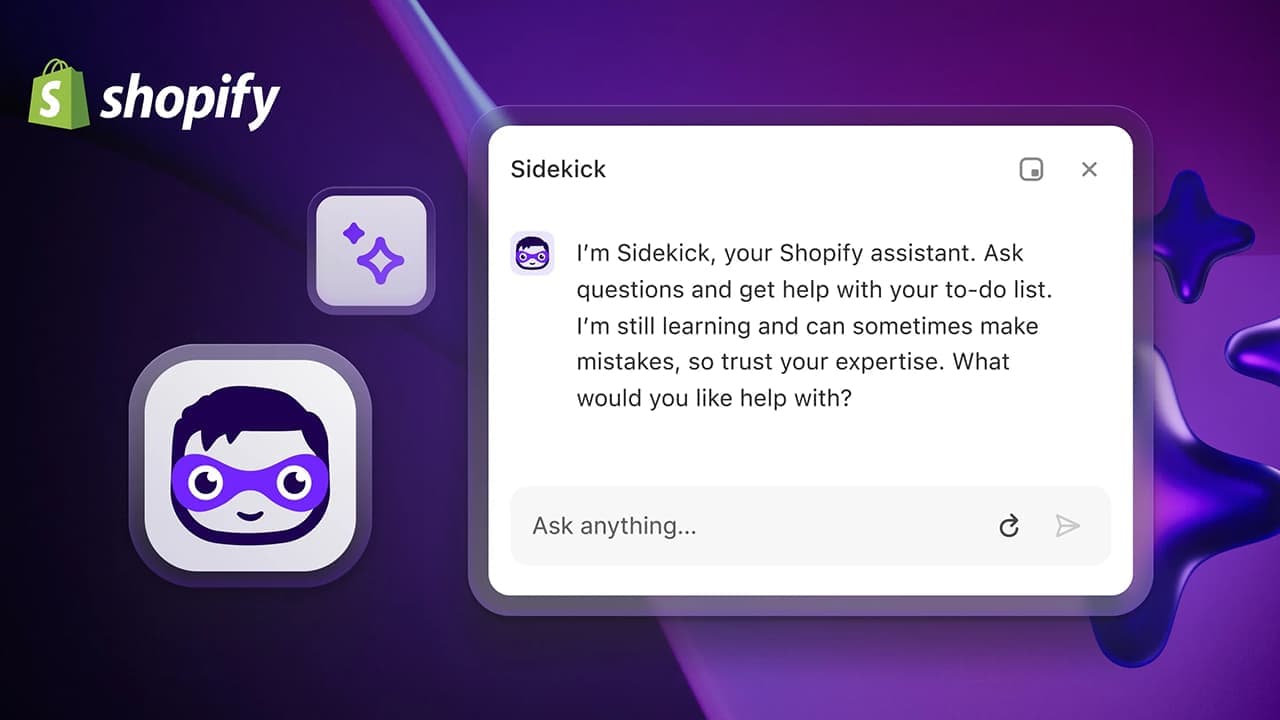
Beyond the data layer, Shopify continued to embed its AI assistant, Sidekick, deeper into the admin workflow. Sidekick evolved from a simple content generator into a conversational commerce assistant capable of analyzing store data, answering complex "how-to" questions, and executing multi-step tasks. For instance, an store owner could ask, "How do I create a product bundle with a 10% discount?" and Sidekick could guide them through the process or even create the bundle directly. It can now generate performance summaries, identify low-stock items, and even proactively surface insights through a feature called Sidekick Pulse, which recommends actions based on store trends. A proactive insight might look like: "Your 'Coastal Linen Shirt' is trending on social media and inventory is low; consider placing a new purchase order." This evolution from a passive tool to an active assistant is a core part of Shopify's strategy to simplify store management and reduce operational overhead. The AI isn't just writing product descriptions anymore; it's being positioned as a digital team member that helps with analysis and decision-making. This established trajectory, making product data universally accessible to AI and embedding a conversational assistant into every workflow, is the essential context for predicting what comes next.
The Rise of the Agentic Storefront: Where Shopify Is Headed
The concept of "agentic commerce" is the single most important strategic directive from Shopify's leadership, and it's the key to deciphering the company's future plans. CEO Tobi Lütke has been explicit that AI agents will become a common way people shop, framing it as an inevitable evolution of user behavior. This vision extends far beyond a chatbot on a homepage. It imagines a world where a customer's personal AI assistant handles the entire shopping journey, from discovery and comparison to purchase and post-purchase support, often interacting directly with a store's backend systems without ever loading a webpage. This is not a far-off hypothetical; Shopify has already released tools to make commerce "trivial" for AI agents to execute and has enabled integrations with major players like Microsoft Copilot. The entire platform is being reoriented to serve not just human visitors but these autonomous, intelligent agents that act on behalf of customers. This shift has profound implications for every aspect of running an online store, moving the point of sale from a .com address to any conversational interface.
For store owners, this means the competitive landscape is changing. The battle for visibility is moving from Google's search results page to the recommendation algorithms of various AI assistants. Amazon's CEO has already acknowledged this shift, noting that customers using their AI shopping assistant spend 40% more per order on average, demonstrating the immense value of being the default choice within these new environments. Shopify's strategy appears to be a direct response, aiming to equip its millions of independent stores with the tools to compete on this new terrain. By standardizing product data through the Shopify Catalog and Universal Commerce Protocol, the platform is creating a collective discovery engine. An AI agent can now query the entire Shopify ecosystem for "running shoes for wide feet," compare options across multiple independent stores, and facilitate a purchase, all within a single conversation. This creates a powerful network effect where the richness of one store's data benefits the discoverability of all.
The operational challenge for store owners is to transition from thinking about "keywords" to thinking about "attributes" and "use cases." An AI agent doesn't browse your collections; it queries your catalog for specific, structured data points. Is this shirt made of breathable fabric? Is this supplement vegan-certified? Is this phone case compatible with a specific model? A query for a "summer wedding guest dress" will be answered by filtering for attributes like `event: wedding`, `season: summer`, and `material: silk` or `chiffon`. These are the questions that agentic systems ask, and stores with incomplete or unstructured data will be invisible. The Summer '26 Editions laid the technical foundation for this, but the onus is now on store owners to populate that foundation with high-quality, accurate, and comprehensive information. The future of AI-driven sales depends less on clever marketing copy and more on the meticulous, almost boring, work of data hygiene. The stores that treat their product catalog as a structured database for machines, not just a gallery for humans, are the ones that will be recommended and, ultimately, chosen by the next generation of shoppers.
Predicting the Winter '27 AI Upgrades for Shopify Magic and Sidekick
Given Shopify's clear trajectory, the Winter '27 Editions will almost certainly focus on making its native AI tools more autonomous and actionable. The evolution of Shopify Magic and Sidekick is shifting from assistance to execution. While currently adept at generating content like product descriptions or analyzing past performance, the next logical step is to empower these tools to act on their own analysis within stricter, store owner-defined guardrails. For example, instead of Sidekick merely reporting, "Your 'Classic Crewneck' in black is running low on stock," a future version might proactively state, "Sales velocity for 'Classic Crewneck - Black' is 3 units per day and you have 10 units left. I have drafted a purchase order to your supplier for 100 units, your average monthly quantity, for your approval." This moves the AI from being a consultant to being a proactive team member that handles logistics planning.
We can also anticipate a significant expansion of Sidekick's capabilities into more complex, multi-step workflows. Currently, it can perform discrete tasks like "put all t-shirts on sale for 20% off." The Winter '27 update will likely introduce more sophisticated chain-of-thought reasoning, allowing it to handle broader commands like, "Run a flash sale for the next 48 hours on our five slowest-moving products from last quarter, announce it to our VIP customer segment, and then revert the prices." This requires the AI to not only understand the command but also to query sales data, identify products, create a customer segment based on order history, draft a marketing message, schedule price changes, and schedule the reversion. Executing this single command involves at least six distinct steps that would currently take a human store owner considerable time and focus. This level of automation, which currently requires either a human or a complex web of third-party apps, is the clear end-goal for an integrated AI assistant. It aligns with the company's stated mission to simplify operations and reduce the cognitive load on store owners.
Furthermore, expect the line between Shopify Magic (the underlying AI infrastructure) and Sidekick (the conversational interface) to blur as AI becomes more deeply embedded across the admin. The "sparkle" icons for generating text are just the beginning. The Winter '27 Editions could see AI moving into more complex domains like merchandising and pricing. Imagine an AI-powered collections manager that automatically curates a "Trending Now" collection by analyzing real-time sales data and social media mentions, far beyond simple rule-based logic. Or consider dynamic pricing suggestions where the AI analyzes competitor pricing, inventory levels, and historical demand to recommend optimal price points. For example, it might suggest, "Increase the price of the 'Waterproof Jacket' by 5% as a key competitor is out of stock and a rainstorm is forecast in your top shipping region." The platform already has features for generating theme blocks from a text prompt; the next iteration could be generating entire landing pages optimized for a specific campaign or audience. Each of these potential advancements follows the same pattern: taking a task that is currently manual, data-intensive, or requires specialized skill, and making it accessible through a simple, natural language command or an automated process.
How Winter '27 Will Reshape Customer Support Automation
The most significant impact of Shopify’s AI trajectory will likely be felt in customer support. As native tools become more powerful, the baseline for what a store’s support function should be able to do will be permanently raised. Currently, Shopify Inbox offers basic chat functionality, but the advancements predicted for Winter '27 could transform it into a much more capable AI agent. Imagine a Shopify Inbox that doesn't just answer "Where is my order?" but is deeply integrated with Sidekick's action-taking abilities. A customer could message, "I need to change the shipping address on my last order," and the AI could understand the request, check if the order has shipped, perform the address update directly in the Shopify admin if it has not, confirm the change with the customer, and notify the fulfillment center, all without human intervention. This moves beyond simple Q&A into genuine, automated resolution, saving countless hours of manual work.
This shift creates a new dividing line in the world of support automation tools. The first category will be tools that primarily provide information, they can look up an order, explain a return policy, or tell a customer when a product will be back in stock. The second, more advanced category will be tools that can *take action*, issue a refund, apply a discount code, start a return process, or change an order. The predicted Winter '27 updates will likely push Shopify's native tools firmly into the first category, handling the most common ecommerce support questions with ease. This will put immense pressure on third-party helpdesks that primarily compete on providing basic, informational AI responses. If Shopify gives away a "good enough" informational AI for free as part of its core subscription, external tools will need to provide significant additional value to justify their cost. Their survival will depend on their ability to perform complex, multi-step actions that the native AI cannot, especially those involving financial transactions or complex logic.
For store owners, this is a critical moment to re-evaluate their support stack. The reliance on expensive, per-seat, or per-ticket helpdesks like Gorgias or Zendesk becomes harder to justify if a significant portion of incoming queries can be handled by a free, native tool. The key questions to ask are: What percentage of our support tickets are simple, informational requests? And what percentage require a real action to be taken in the Shopify admin? As the native tools absorb more of the former, the ROI of a paid helpdesk shifts entirely to its ability to handle the latter. This is where the architecture of the support tool becomes critical. A tool that is deeply integrated with Shopify's APIs and is built to perform actions, not just retrieve data, will become exponentially more valuable. A tool that is essentially a wrapper around a large language model with a knowledge base will see its value proposition steadily eroded by Shopify's own offerings, which have direct, privileged access to the core platform data.
The Operational and Financial Impact for Store Owners
The relentless march of Shopify's AI strategy forces a fundamental re-evaluation of a store's operational structure and budget. As native AI tools absorb more routine tasks, from content creation to data analysis and basic customer support, the role of human team members will necessarily evolve. Staff will be freed from repetitive, low-value work and can be redeployed to higher-impact activities. For example, a customer service professional can move from endlessly answering "Where is my order?" to proactively managing community engagement or developing personalized outreach programs for high-value customers. This is a positive shift, but it requires a conscious decision to redesign workflows and retrain staff. A store that continues to employ people for tasks that Sidekick can do in seconds will be operating at a significant cost disadvantage compared to a competitor who has fully embraced the new paradigm of human-AI collaboration.
This shift has a direct and immediate impact on a store’s software budget. For years, the default for a growing Shopify store was to add a suite of third-party apps for support, marketing automation, and analytics, with each app carrying its own subscription fee. A growing business can easily spend between $50 and $300 a month on apps, with customer support tools alone often costing from tens to hundreds of dollars per month. As Shopify integrates more of this functionality into its core platform at no additional charge, store owners have a powerful opportunity to consolidate their tech stack and slash their monthly software spend. Why pay hundreds of dollars a month for an external AI chatbot that answers basic FAQs when a future version of Shopify Inbox might do it for free? Why pay for a separate analytics tool to generate sales reports when Sidekick can do it with a simple conversational prompt? Every store owner should be auditing their app subscriptions and asking a simple question: "Is this tool's core function on Shopify's AI roadmap?" If the answer is yes, it's time to start planning for a transition.
This is where a new generation of AI tools, built with this future in mind, offers a different value proposition. Instead of fighting the tide of native Shopify features, these tools focus on doing what Shopify’s own AI likely won't: performing complex, money-moving actions and offering a predictable, flat-rate pricing model. For example, while Shopify's AI may become proficient at answering questions, a specialized tool like Arbyn is built to go further, handling actions like issuing refunds or applying discounts once a store owner approves them, all within the chat. This capability to execute guarded financial actions is a critical differentiator. Crucially, it does so for a flat monthly fee, eliminating the variable, per-resolution costs that plague older helpdesk models. This aligns perfectly with the future that Shopify is building. As the platform commoditizes informational AI, the premium will shift to action-oriented AI with transparent pricing. Store owners can use Shopify's free tools for the basics and plug in a cost-effective, powerful agent like Arbyn to handle the complex resolutions, creating a best-of-both-worlds support system that is both more capable and financially predictable. You can add it to your store and see how a flat-rate, action-oriented model provides a clear path away from the variable costs of traditional helpdesks.
Ultimately, the changes forecasted for Shopify's Winter '27 Editions are not just about new features. They represent a challenge to the status quo of ecommerce operations. The store owners who will thrive in this new era are not those who wait for the official announcements, but those who see the writing on the wall. They will proactively audit and structure their product data with machine-readable attributes, preparing for an agentic future. They will critically re-evaluate their software stack for redundancies and consolidate tools whose core functions are being absorbed by the platform. Finally, they will embrace a new class of AI tools that offer clear, predictable value by focusing on complex, action-oriented tasks. The future of commerce is being built now, and the time to adapt your strategy is not next winter, but today.
Written by
For seven years I have led customer success and technical support inside high-growth SaaS and e-commerce companies. Customer Support Lead at DripShop.live, a live-commerce SaaS. Technical Support Specialist at Replo (Y...
View full profileKeep reading
View all posts
Shopify's 2027 Roadmap: What 'Agentic Checkout' Means for Your Store
Odera Joseph · 8 min

Shopify Checkout Extensibility in 2026: What's New for Chat Widgets?
Odera Joseph · 8 min
Shopify's AI Feature Roadmap: What's Native vs What Still Needs an App
Odera Joseph · 7 min