Why Every Shopify Support Tool Suddenly Calls Itself Agentic
The word “agentic” is the new label for AI in Shopify support, but what does it mean when a tool can talk but not act?


The term “agentic” has quietly attached itself to nearly every AI support tool in the Shopify ecosystem, a landscape now crowded with thousands of apps all competing for attention. A feature that was a “chatbot” two years ago, and an “AI assistant” last year, is now an “AI agent.” This shift in language is not accidental. It signals a fundamental move away from tools that simply find and deliver information toward systems designed to take independent, decisive action. For a store owner, the promise is enormous: an autonomous employee who doesn't just answer questions about an order status, but actively manages the entire lifecycle of an issue, from identifying a shipping delay to proactively offering and issuing a partial refund. The problem is that the marketing has moved faster than the median technology. Many tools have adopted the new, more valuable label without inheriting the new capabilities, leaving you to figure out what’s real and what is just a rebranded chatbot.
Understanding the difference is more than an academic exercise; it is a direct matter of your monthly software bill and your operational capacity. A true agentic system should measurably reduce the number of tasks that land on your human team’s plate, not just deflect conversations. From a store owner’s perspective, the most time-consuming part of support is not answering a question but the context-switching required to act on it: jumping from the helpdesk to the Shopify Admin, then to a shipping carrier’s portal, and back again. A true agent takes on entire workflows, not just tickets. When a tool uses the language of agency, promising to act, decide, and resolve, but in practice only provides slightly more sophisticated FAQ answers, you are paying a premium for a capability you are not receiving. Distinguishing between AI that can talk and AI that can act is the most critical evaluation you can make when choosing a support platform today. The word “agentic” implies agency, the capacity to perform tasks, and if a tool cannot do that, it is functionally no different from the last generation of technology, regardless of the label on the box.
From Chatbot to Agent: A Brief History of Support Automation
The language used to describe automated support has evolved in lockstep with the underlying technology, and with the industry’s collective ambition. Each new term represented a step up in perceived intelligence and autonomy, creating a hype cycle that often outpaced reality. It began with the humble chatbot. These were rules-based systems, effective but brittle, operating on simple if/then logic. They guided customers through predefined conversational trees, which would break without the exact keyword. A customer typing “order status” might get an answer, while “wanna know where my stuff is” would result in an unhelpful “I don’t understand.” This brittleness led to high rates of escalation to human agents, often defeating the bot's primary purpose. They were a tool for deflecting only the most common, verbatim queries, and while they succeeded in handling some high-volume interactions, no one ever mistook them for a thinking employee.
Then came the rise of “AI.” With the mainstreaming of large language models, chatbots became “AI-powered,” and their capabilities expanded dramatically. They were no longer limited to rigid scripts. They could understand intent, parse natural language, and generate human-like responses, inferring what a customer meant even with typos or unusual phrasing. A query like, "I bought the blue t-shirt last week, it hasn't arrived, and I'm moving on Friday, what can you do?" was now understood. These AI assistants could pull information from a knowledge base to answer a much wider range of questions, from product specifications to return policies. However, their primary function remained informational. They were conversational search engines for your store policies, capable of telling a customer *what* the return policy was, but fundamentally incapable of *starting* the return. This generation of tools dramatically improved the quality of automated conversation but still treated the support interaction as a self-contained Q&A session, creating a well-informed but powerless customer.
Today, we are in the era of the “agent.” The term itself, drawn from computer science, implies an entity that perceives its environment and takes autonomous actions to achieve goals. An agentic AI is not just a reactive conversationalist; it is a proactive problem-solver that connects the conversation to the underlying business systems. When a customer asks for a refund, an agentic system doesn't just recite the policy; it checks the order's eligibility in Shopify, verifies the purchase date, confirms it wasn’t a final sale item, and, with the right permissions, actually processes the transaction. This is the crucial distinction: agentic AI is defined by its ability to execute tasks. While adoption of these tools is rising fast, the term is being applied so broadly that it risks losing its meaning. Many tools now call themselves agents while possessing only the conversational abilities of the prior generation, creating critical confusion for buyers.
What "Agentic" Really Means (And What It Costs When It’s Just a Word)
At its core, agentic AI is the difference between a tool that can access a knowledge base and one that can access an API to take action. One tells, the other does. A non-agentic AI chatbot, no matter how intelligently it can converse, operates in a read-only capacity. It can read your shipping policy and summarize it for a customer. It might even be able to read an order’s status from a Shopify integration and report that a package is “in transit.” But its abilities stop at the boundary of information retrieval. The moment a task requires changing something, modifying an order, issuing a refund, creating a discount code, the conversational AI hits a wall. It can only escalate the ticket to a human agent, who then must open Shopify, find the order, and perform the action manually. The “automation” in this case is merely a sophisticated triage system, not a true replacement for labor, often leading to more customer frustration as they have to repeat their issue to a human.
A genuinely agentic system, by contrast, has write access. It is designed to perform tasks by interacting with other software. When a customer wants to change the shipping address on an unfulfilled order, a true AI agent authenticates the request, validates the new address format to prevent delivery errors, and executes the `orderUpdate` mutation via the Shopify API to change the data directly on the order. It doesn't just talk; it acts. This is a fundamentally different class of software. It’s not just a layer on top of your support inbox; it’s an operational tool integrated into your commerce backend. The AI becomes a co-worker that can be delegated tasks, not just a glorified answering machine. This is the entire premise of the technology: to automate workflows, not just conversations. When a tool can autonomously resolve up to 80% of common issues, as analysts at Gartner predict for 2029, it's because it is performing these kinds of validated, secure actions.
The cost of this distinction is significant. When a platform charges a premium for an “AI Agent” that cannot perform these actions, you are paying for a marketing term. The workload on your human team remains largely the same, because they are still the only ones who can *do* anything. They still have to process every return, cancel every order, and correct every address. The AI might handle the initial back-and-forth, but the actual task completion, the part that consumes real time and labor, still falls to your staff. Worse, if the tool’s pricing is based on a per-resolution model, you may end up paying every time the chatbot answers a simple question, without seeing any reduction in the more complex, action-oriented tasks that constitute the bulk of your team’s work. The promise of agentic AI is a reduction in operational overhead. If the tool is merely a conversational front-end, that promise is broken, and the investment fails to deliver a return.
The Anatomy of a True Shopify Agent: What Actions Matter?
Talk is cheap, especially for a large language model. The true test of an agentic support tool is not the quality of its prose, but the number of Shopify actions it can execute. For a store owner, where studies show administrative work can consume an average of 16 hours per week, automation is about reclaiming that time for growth activities. A real AI agent for a Shopify store must be more than a conversational partner; it needs to be an operational one, with a specific set of capabilities that map directly to the most common, time-consuming support tasks. These are the functions that separate a tool that understands your business from one that can actually help run it. The most critical differentiator is the ability to move beyond read-only operations (like checking an order status) and into write operations that modify store data directly within Shopify. This is where real automation happens and where store owners can reclaim significant hours from their day.
A baseline for a truly agentic tool includes the ability to manage fundamental post-order logistics. For instance, updating a shipping address on an unfulfilled order is a frequent request that is simple in concept but requires multiple steps for a human agent. A true AI agent should handle this autonomously by authenticating the customer, checking the order's fulfillment status via the API, and then directly editing the address fields on the Shopify order object. Another key action is order cancellation. When a customer requests to cancel, the agent should be able to check the fulfillment status and, if the order hasn't shipped, process the cancellation and trigger the corresponding refund flow automatically. Starting a return is another critical function. The agent should be able to query your store's return policy, determine an item's eligibility based on order date and product tags like `final_sale`, and if it qualifies, generate a return authorization and even a shipping label for the customer. These are not just conversations; they are multi-step workflows that, when automated, represent a tangible reduction in manual labor.
Beyond basic order management, a sophisticated agentic tool extends its capabilities into actions that protect and generate revenue. Issuing a discount code to appease a frustrated customer or to incentivize a first-time buyer is a common tactic. An agent should be able to create a unique discount code, with specific parameters (e.g., 10% off, single-use), and present it to the customer directly in the chat. Even more advanced is the ability to issue store credit via a gift card as a resolution for a support issue, which keeps revenue within the business. These actions involve creating new financial instruments within Shopify and require a level of trust and integration far beyond simple chatbots. It is important to note that many of these money-moving actions, refunds, cancellations, substantial discounts, often operate best with a layer of human approval. An advanced agent doesn't have to be fully autonomous to be valuable; it can prepare the action, present it to the store owner for a one-click approval, and then execute it. The key is that the AI *performs the action*, not just suggests that a human should.
How to Spot the Difference in the App Store
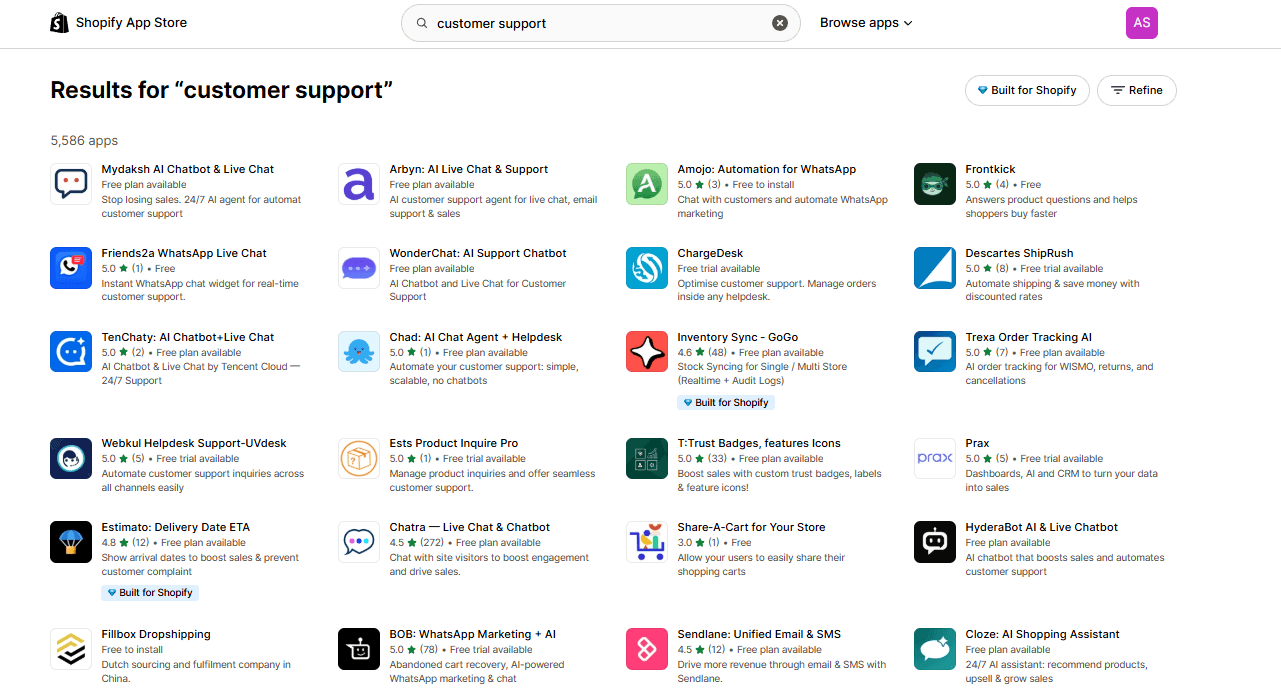
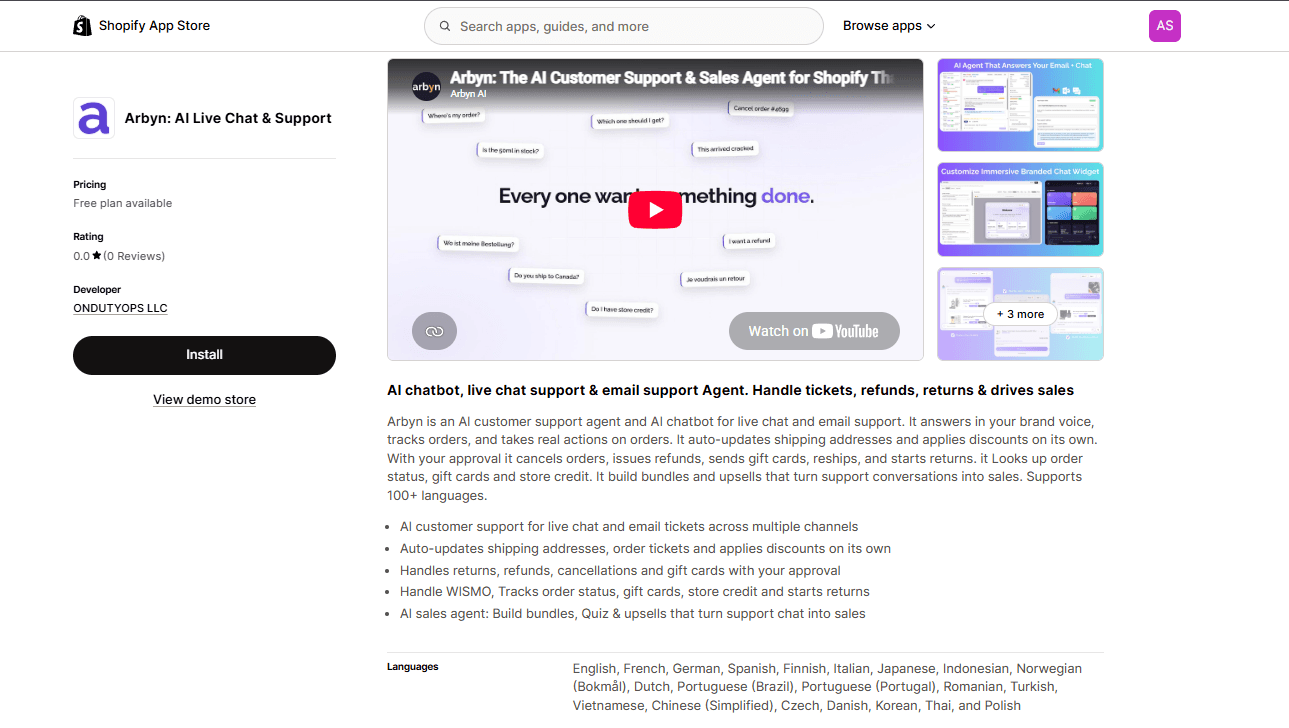
In a sea of apps all claiming to be "AI agents," distinguishing the genuine article from the marketing fluff requires a specific lens. The first place to look is the feature list, but you must read it like a lawyer, paying close attention to the verbs. Vague, passive verbs are a red flag. Phrases like “intelligent responses,” “understands customer intent,” “delightful conversations,” or “automates conversations” are hallmarks of last-generation chatbot technology. They describe the quality of the conversation, not the capability of the tool. A true agentic platform will use strong, active verbs that describe concrete tasks performed within Shopify. Look for explicit claims like “cancels orders,” “issues refunds,” “updates shipping addresses,” “creates returns,” and “applies discounts.” These are not ambiguous; they describe specific write actions that directly impact your store’s data and operations. If an app’s marketing materials are heavy on conversational quality but light on actionable capabilities, it is likely just a chatbot with a new coat of paint.
The second critical signal is the pricing model. This often tells a more honest story than the marketing copy. Many platforms that have rebranded their chatbots as agents still use pricing models that betray their informational nature. A tool that charges per ticket or per resolution is fundamentally built around the concept of a conversation as the unit of value. This is the business model of a helpdesk, not an autonomous agent. Competitors like Gorgias and Intercom Fin have built powerful tools, but their models often center on a per-resolution fee (around $0.90-$1.00) or an outcome-based fee (around $0.99) on top of seat-based plans. This structure can become prohibitively expensive as your volume grows, effectively penalizing you for successful automation. A bill that scales with every conversation the AI handles suggests the tool is still thinking in terms of tickets, not tasks, forcing you to create counter-intuitive rules to limit its usage just to control costs.
In contrast, a flat-rate pricing model suggests a different philosophy. It implies that the AI is a persistent member of your team, an operational asset whose cost does not fluctuate with the number of customers it helps. When a tool offers unlimited conversations and actions for a fixed monthly price, it aligns its success with yours. The vendor is betting that the value delivered by the agent, in terms of tasks completed and labor saved, far exceeds the fixed cost. From a store owner's viewpoint, this pricing structure is a powerful indicator of confidence in the tool’s ability to perform real work. It shifts the focus from counting conversations to measuring impact and encourages you to find more ways to leverage automation, not fewer. When you are evaluating options, ask yourself: does the pricing model encourage me to use the AI more, or does it make me nervous about every interaction? The answer will tell you a great deal about whether you are buying a chatbot or hiring an agent.
The True Cost of Power: Per-Action Fees vs. Flat-Rate Certainty
The financial logic of supporting a growing Shopify store changes dramatically when you move from a traditional helpdesk to an AI-driven one, but the specific AI pricing model is what ultimately determines whether automation becomes a cost center or a competitive advantage. The predominant model, popularized by many leading platforms, is usage-based, typically charging a fee for each "resolution" or "outcome" the AI achieves. On the surface, this seems fair, you pay for what you use. A platform like Intercom, with its well-known $0.99 per-outcome fee, or Gorgias, with its $0.90 per-resolution charge on top of plan limits, exemplifies this approach. The issue arises at scale. For a store handling a few hundred conversations a month, these fees are manageable. But as your business grows to thousands of conversations, that sub-dollar fee multiplies into a significant, unpredictable monthly expense that can easily run into thousands of dollars, creating a financial liability.
This model creates a strange paradox: the more effective your AI agent is, the higher your bill becomes. Every successfully deflected ticket, every autonomously resolved issue, adds another line item to your invoice. This is particularly punishing for brands with seasonal peaks or viral moments. A successful Black Friday weekend could lead to a support software bill that wipes out a substantial portion of the margin gained from the sales spike. The problem is compounded by the often-complex definitions of what constitutes a billable "resolution." Some platforms, like Zendesk, have a multi-layered cost structure involving seat licenses, a $50 per-agent AI add-on, and a per-resolution fee reported to be between $1.50 and $2.00, making budget forecasting a significant challenge. This lack of predictability is a hidden operational tax. It forces store owners to think about containing support volume rather than encouraging customer engagement.
| Platform | Pricing Model | Approximate Cost at 500 AI Resolutions/Month |
|---|---|---|
| Gorgias | Plan Fee + $0.90/resolution + Ticket Overage | ~$810+ ($360 Pro plan + AI fees) |
| Intercom Fin | Seat Fee + $0.99/outcome | ~$665+ (2 seats + AI fees) |
| Zendesk AI | Seat Fee + AI Add-on + $1.50/resolution | ~$1,000+ (2 seats + add-ons + AI fees) |
| Arbyn | Flat Monthly Fee | $59 (up to 500 resolutions) |
The alternative is a move toward simplicity and predictability: the flat-rate model. This approach treats the AI agent as a fixed-cost employee, not a metered utility. For a single monthly fee, the agent handles unlimited conversations and performs unlimited actions. This model fundamentally changes the financial and operational calculus for a store owner. You are no longer penalized for growth. A spike in customer inquiries during a sale doesn't come with the fear of a corresponding spike in your support software bill. This predictability allows for confident budgeting and strategic planning. It encourages you to maximize the use of your AI agent, deploying it across every possible channel and for every possible task, knowing that the cost remains constant. It aligns the incentives of the software provider with the goals of the store owner, to resolve as many issues as possible, as efficiently as possible, without an escalating cost.
This is the philosophy behind Arbyn. We believe that the power of an AI agent should not be a variable expense that you have to constantly monitor and manage. Our pricing is built on a simple premise: predictable, flat-rate plans. Instead of charging per resolution, Arbyn offers tiered plans based on conversation volume. The Arbyn Starter plan is free for up to 150 conversations a month. For stores with higher volume, Arbyn Growth offers 500 conversations for $59/month, while the Arbyn Agent plan provides unlimited conversations for $99/month. This structure ensures you are never penalized for growth or seasonal spikes with overage fees. Arbyn is designed to be a true agentic partner, one that can not only handle conversations but also execute critical Shopify actions, from updating shipping addresses autonomously to processing refunds and cancellations with your approval. By removing the per-resolution meter, we enable you to unlock the full potential of support automation without the risk of runaway costs. If you're ready to move beyond counting tickets and start automating workflows with predictable costs, you can install Arbyn for free from the Shopify App Store and see the difference a flat-rate agent can make.
Ultimately, the "agentic" label is only as valuable as the actions the tool can perform and the fairness of its business model. Choosing the right AI partner is now as critical as choosing the right shipping carrier; it is a core piece of your operational infrastructure. As this technology continues to mature, the platforms that deliver real, task-based automation with simple, predictable pricing will be the ones that provide a lasting strategic advantage. The future of ecommerce support isn't just about better conversations; it's about building a more efficient, autonomous business. That starts with choosing tools that are true partners in your growth, not just another metered utility where you are stuck renting conversations instead of owning your outcomes.
Written by
For seven years I have led customer success and technical support inside high-growth SaaS and e-commerce companies. Customer Support Lead at DripShop.live, a live-commerce SaaS. Technical Support Specialist at Replo (Y...
View full profile