9 Flat-Rate Shopify Support Apps That Don't Charge Per Ticket
Break free from per-ticket fees with nine support apps for Shopify that offer predictable, flat-rate pricing for unlimited conversations or unlimited agents.

A help desk's billing model is not a line item; it is a statement about incentives. When a platform charges per ticket or per resolution, its revenue is directly tied to your support volume. More customer problems mean a larger bill. This model, common across the customer support industry, creates a fundamental conflict of interest: the platform benefits when your support burden grows, while your store's margin shrinks. For a growing Shopify store, especially during peak seasons or after a successful marketing campaign, this can turn success into a liability. The very tools meant to manage customer conversations become a source of unpredictable, escalating costs, punishing you for the growth you worked to achieve.
The alternative is a structural shift toward predictable costs, a model where the price is not a direct function of ticket volume. This is the core idea of flat-rate support. However, "flat-rate" itself has nuances. It can mean a single, fixed price for unlimited conversations and unlimited users, the purest form of this model. It can also mean a predictable per-agent price that allows for unlimited tickets, aligning costs with your team's size rather than your customers' issues. Or it can be a flat fee for a workspace, decoupling the price from both headcount and ticket volume up to a high ceiling. Each of these approaches breaks the direct link between a single customer conversation and a specific charge, giving a store owner the ability to forecast costs and scale operations without fearing a surprise invoice. This article explores nine support apps that have embraced these more predictable models, offering a clear path away from the penalty of per-ticket pricing.
The Per-Ticket Problem: How Usage-Based Billing Undermines Growth
The standard pricing model for many legacy help desks, popularized by platforms like Gorgias and adapted by others, is built on a simple unit: the ticket, or the resolution. On the surface, it seems logical to pay for what you use. In practice, this model creates a series of financial and operational traps for a scaling ecommerce business. The advertised base price for a plan often includes a fixed number of tickets, but the real cost is hidden in the overages. A plan might offer 350 tickets for a monthly fee, but a successful product launch or a seasonal rush can easily push a store past that limit, triggering per-ticket fees that can double or triple the expected bill. This isn't a bug in the model; it is the model. The incentive is to get you on a low-priced plan and then profit from your growth.
This problem is compounded by the introduction of AI. Many platforms that offer AI automation, like Zendesk or Intercom, layer a second usage-based fee on top of the first. You might pay a base fee for the help desk, a per-agent fee for your human team, and an additional fee for every conversation the AI successfully resolves. In some cases, you are billed a separate fee for every conversation the AI successfully resolves. A store handling a few thousand automated inquiries a month can see its bill increase by thousands of dollars, purely from the AI doing its job. This structure fails to deliver on the core promise of automation, which is to reduce operational costs. Instead, it creates a new, variable expense line that scales directly with the volume of work being automated. The store owner is left in a position where they are paying for both human and machine resolutions, with costs that are difficult to forecast and even harder to control.
This billing philosophy fundamentally misaligns the tool provider with the store owner. A store's goal is to resolve customer issues efficiently and, ideally, prevent them from occurring in the first place through better products and clearer information. A per-ticket provider, however, profits from a higher volume of issues. There is little financial incentive for them to build features that genuinely reduce your ticket count. This disconnect creates friction. Store owners become hesitant to promote engagement, worried that more chats and emails will lead to a bigger invoice. Teams may delay hiring a needed support agent because the per-seat cost feels prohibitive. The support tool, which should be a growth enabler, becomes a cost center to be aggressively managed, a paradox that flat-rate models are designed to solve.
Predictable Pricing: Aligning Your Support Costs with Your Business Model
Switching to a flat-rate or predictable pricing model is more than a cost-saving measure; it's a strategic decision to align your operational stack with your growth. The primary advantage is budget certainty. When you pay a fixed price per month, whether for the entire service or per agent, you eliminate the variable of ticket volume from your expense forecasting. A Black Friday sales event that triples your customer inquiries will not triple your help desk bill. This predictability allows for more aggressive planning in marketing and sales, knowing that the operational cost of supporting that growth is fixed. You can run a major promotion or enter a new market with confidence, free from the concern that your support software will penalize you for your success.
This alignment creates healthier incentives for everyone. For the app developer, a flat-rate model means their success is tied to customer retention, not customer problems. They are motivated to build a product so valuable that you never want to leave. This leads to better features, more robust platforms, and a focus on long-term stability over short-term usage spikes. For the store owner, it encourages a proactive support culture. When each new conversation doesn't come with a micro-charge, teams are free to engage with customers more, answer pre-sale questions, and build relationships that lead to higher lifetime value. The support channel transforms from a cost center focused on ticket deflection into a potential revenue driver, where agents can upsell and provide value without watching a meter tick.
There are different flavors of this predictability. A true flat-rate model offers unlimited conversations and unlimited users for one price, representing the simplest and most scalable option. A more common approach is per-agent pricing with unlimited tickets. This model ties cost to headcount, which is a predictable, internally controlled metric, rather than to external, unpredictable customer behavior. Another variant is a workspace-based flat fee, which provides a set number of seats for a fixed price, offering a middle ground that works well for teams of a specific size. All these models share a common, crucial characteristic: they sever the direct financial link to ticket volume, empowering store owners to focus on serving their customers, not managing their software bill.
1. Arbyn: True Flat-Rate AI Support & Sales
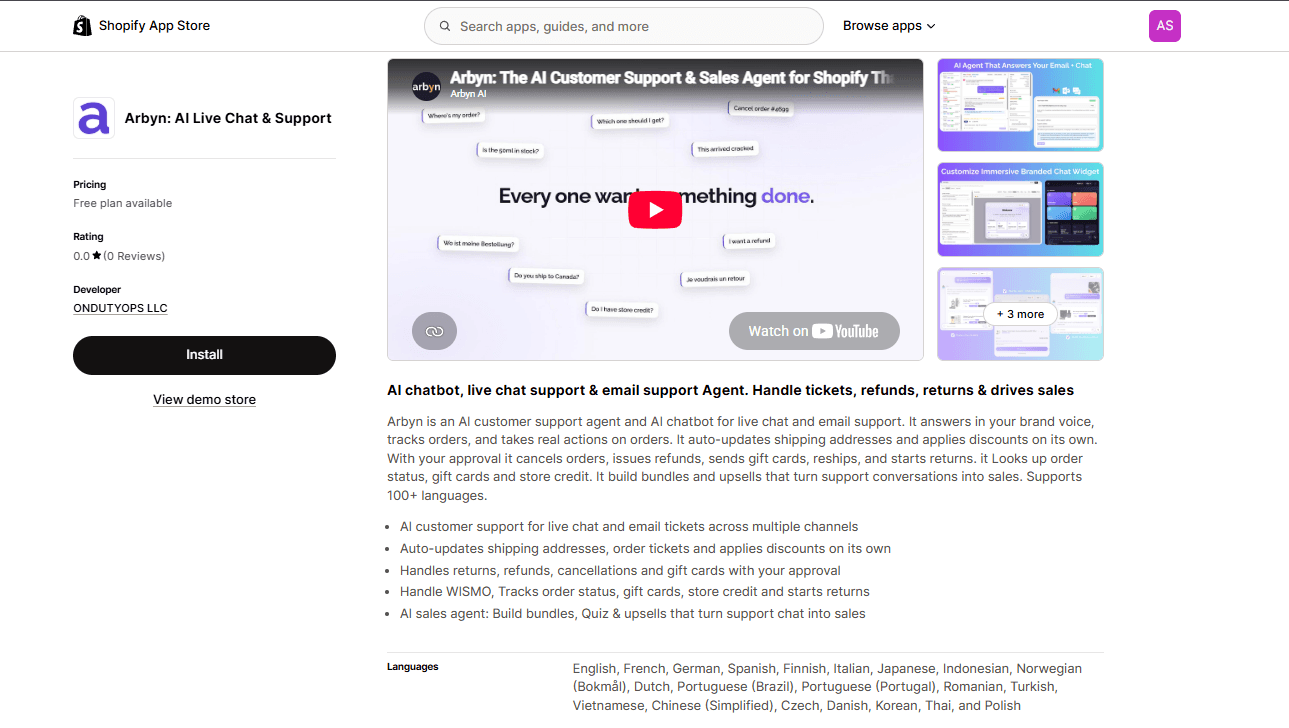
Arbyn represents the purest form of the flat-rate model, built specifically to counteract the per-ticket and per-resolution fees that dominate the Shopify support landscape. The pricing is straightforward: a free plan for stores with low volume (under 150 conversations per month) and a single paid tier, Arbyn Agent, at $99 per month for unlimited conversations. This model fundamentally changes the financial relationship between the support tool and the store. There are no overage fees, no AI resolution charges, and no escalating costs as your team or your ticket volume grows. A store can handle 500 conversations or 50,000, and the price remains the same, offering complete budget predictability.
This billing structure is built on the philosophy that a support tool should be an asset that scales with your business, not an expense that punishes it. Arbyn's AI agent handles customer inquiries across email and live chat, but it goes beyond simply answering questions. It is designed to take action directly within Shopify. With store-owner approval for sensitive operations, the agent can process cancellations, issue refunds, and apply discounts, handling the entire workflow within the chat or email thread. This ability to perform actions, not just provide information, distinguishes it from many chatbots that act primarily as FAQ bots, escalating any request that requires a change in the store's backend. The focus is on resolution, not just response.
The platform is designed for both support and sales. The same AI agent that handles WISMO ("Where Is My Order?") requests can also engage in proactive sales conversations, recommend products based on browsing history, and guide customers through a purchase. By unifying support and sales in a single tool with a single flat price, Arbyn positions itself as a growth engine rather than just a cost center. For Shopify store owners who have been burned by surprise overage charges from their existing help desk or are looking to automate support from day one without facing a climbing bill, Arbyn's "one price, unlimited everything" model offers a structurally different and more scalable solution.
2. Corebee: Flat-Rate AI for Omnichannel Support
Corebee is another strong proponent of the true flat-rate model, offering a direct alternative to platforms with complex, multi-layered pricing. Their model is strikingly simple and similar to Arbyn's core promise: a single flat monthly rate provides unlimited AI conversations, unlimited voice and chat interactions, and unlimited agent seats. This approach immediately removes the two main sources of cost anxiety for growing stores: per-agent fees that scale with headcount and per-resolution fees that scale with automation success. A business can grow its support team from two to ten agents without seeing its help desk bill change, a significant departure from the per-seat model of competitors like Zendesk or Help Scout.
The platform is built as an AI-first, omnichannel solution. It aims to unify voice, chat, email, SMS, and social messaging into a single shared inbox. A key feature is its AI voice agent, which can answer inbound phone calls, provide information, and transcribe calls, treating the phone as a first-class channel rather than a costly add-on. The AI is designed to resolve a high percentage of inquiries automatically by ensuring the AI pulls answers directly from the store's own vetted knowledge base. This ensures that the AI provides answers based on vetted company information, with every action logged and reviewable. When an issue requires human intervention, it is escalated to the shared inbox with full context.
Corebee positions itself explicitly against the "per-seat problem" and "per-resolution" fees charged by incumbents. Their website features calculators showing the cost savings compared to per-agent models, emphasizing that as a team grows, the effective cost per agent drops. For a Shopify store looking for a predictable, all-inclusive price that covers a wide range of channels, including voice, and wants to heavily leverage AI without facing metered usage charges, Corebee presents a compelling and financially stable alternative. The commitment to a single, transparent price for all features and unlimited volume makes it a standout choice in the movement away from usage-based billing.
3. Crisp: Workspace-Centric Flat-Rate Pricing
Crisp offers a unique and compelling variation on the flat-rate model by pricing per workspace rather than per agent. This structure provides a predictable cost for teams up to a certain size, making it an attractive option for startups and SMBs. Their "Essentials" plan, for example, costs a flat monthly fee and includes up to 10 agent seats. This means a team of three, five, or ten pays the same fixed price, a stark contrast to per-agent models where the bill would scale linearly with each new hire. Their "Plus" plan extends this to 20 or more seats for a higher flat fee. This workspace-centric approach allows teams to collaborate freely without worrying that adding a part-time helper or giving the marketing team access will immediately increase their monthly bill.
Crisp bundles a comprehensive feature set into its plans, including a shared omnichannel inbox, a knowledge base, a CRM, and an AI chatbot. A significant advantage is that every plan, including the free tier, offers unlimited conversations. This completely removes the risk of volume-based overage charges, providing peace of mind during high-traffic periods. However, there is an important trade-off to consider: the AI functionality runs on a credit system. While each paid plan includes a monthly allowance of AI credits (for instance, the Essentials plan includes a small credit amount), heavy reliance on the AI chatbot can lead to additional pay-as-you-go costs once the credits are depleted. This is a crucial distinction from a truly unlimited AI model and must be factored into any cost analysis.
For a growing Shopify store, Crisp's model offers a middle path. It provides the budget predictability of a flat monthly fee and protects against ticket volume spikes, which is a massive improvement over per-ticket pricing. The per-workspace pricing is particularly powerful for teams in the 5-10 agent range, where the effective cost per seat becomes highly competitive. However, stores that anticipate very high AI usage need to model the potential cost of AI credits. Ultimately, Crisp stands out as an excellent choice for teams that want the security of a fixed platform fee and predictable headcount costs, even if its AI usage isn't entirely unlimited.
4. HelpCenter.io: Flat-Rate for Proactive Self-Service
HelpCenter.io approaches the support problem from a different angle, focusing on deflecting tickets through a powerful, AI-driven knowledge base. Its pricing model reflects this focus: it charges a flat rate per workspace, completely independent of agent seats or ticket volume. Plans are offered at various flat-rate tiers, with even the top-tier plan offering unlimited team members for a predictable monthly cost. This makes it an exceptionally cost-effective solution for building out the self-service layer of a support strategy. A company can have its entire team, support, marketing, product, collaborate on knowledge base articles without ever affecting the monthly subscription cost. This is a pure flat-rate model applied specifically to the creation and maintenance of help documentation.
The product is not a traditional ticketing system or shared inbox. Instead, it's a purpose-built platform for creating a branded, customer-facing help center that is designed to be easily found via search engines. Its features include a no-code layout editor, customizable themes, and robust analytics on content performance and search queries. A key component is the embeddable AI Widget, which brings the knowledge base directly into a website or app, allowing customers to find answers without leaving the page. Unlike many competitors, HelpCenter.io does not charge a per-resolution fee for its AI. The AI is included in the flat monthly price, reinforcing the goal of maximizing deflection without creating a new variable cost.
For a Shopify store, integrating a tool like HelpCenter.io can be a powerful first step in controlling support costs. By providing customers with effective self-service options, stores can significantly reduce the number of repetitive questions that reach their human agents. This not only lowers the burden on the support team but also directly cuts costs for businesses that are still using a per-ticket help desk for their active conversations. HelpCenter.io can be used as a standalone self-service portal or run in parallel with a ticketing system. Its flat-rate, workspace-based pricing makes it a predictable and scalable investment in proactive support, perfectly aligning its success with the store's ability to empower customers and reduce inbound ticket volume.
5. eDesk: Per-Agent Pricing with Unlimited Tickets
eDesk represents the most common and established form of predictable pricing: a per-agent model that includes unlimited tickets. While the cost scales with headcount, it is entirely decoupled from conversation volume. This is a critical distinction from the per-ticket model of Gorgias. eDesk's own support documentation confirms that all its user-based plans come with "Unlimited tickets," providing a stable cost structure for stores with fluctuating or high conversation volumes. Pricing is tiered based on features and the number of connected sales channels, with plans starting at a competitive per-agent monthly rate and increasing for higher tiers. This model gives store owners budget certainty based on a metric they directly control: the number of support staff they employ.
Built specifically for ecommerce, eDesk's strength lies in its deep integrations with marketplaces like Amazon and eBay, in addition to Shopify. It pulls customer and order data directly into the ticket, giving agents the context they need to resolve issues without switching between systems. This focus on multichannel retail is a key differentiator. The platform includes AI features to assist agents, such as ticket summaries and sentiment classification. However, it's important to note that fully automated AI resolutions are billed as a separate, usage-based add-on, often priced per resolution. This creates a hybrid model where the core help desk cost is predictable per agent, but the cost of full automation is variable.
For a Shopify store that also sells on other platforms, eDesk offers a compelling proposition. The "unlimited tickets" promise on a per-agent plan provides a solid, predictable foundation for support costs. A business can confidently run cross-channel promotions knowing that a surge in customer inquiries won't lead to a surprise bill. While the AI automation fee introduces a variable element, it applies only to fully hands-off resolutions, allowing teams to use agent-assist AI features without incurring extra costs. eDesk is an excellent example of how per-agent pricing, when paired with unlimited conversations, can serve as a powerful and reliable flat-rate alternative to the volatility of per-ticket billing.
6. Reamaze: A Hybrid Model of Per-User and Volume-Based Plans
Reamaze offers a flexible approach to pricing with two distinct models that cater to different types of Shopify stores. Its primary structure is a straightforward per-user model with several tiers at different price points (e.g., Basic, Pro, and Plus). Crucially, these plans all feature unlimited conversations, fitting squarely into the "predictable by headcount" category. A store's bill is determined by the number of agents on the team, not the number of customer inquiries they handle. This provides the budget stability needed to manage growth, making it a strong alternative to platforms that charge for ticket volume. The features scale with the tiers, adding capabilities like multi-brand support and advanced reporting on the Pro and Plus plans.
Where Reamaze gets particularly interesting is with its "Starter" plan. This plan flips the model: it offers unlimited team members for a flat monthly rate but caps usage at a set number of responded conversations. This is ideal for two specific types of stores. First, for new businesses with very low but unpredictable ticket volume, it provides access to a professional toolset for a low, fixed cost. Second, for businesses with a large number of part-time or occasional users (e.g., where developers or marketers jump in to help with support), it avoids the punitive cost of paying a full seat license for each person. It’s a true flat-rate plan with a volume ceiling, after which a store would typically graduate to the per-user plans.
Like some others on this list, Reamaze also has a usage-based component for its AI features. While basic chatbots are included, more advanced AI resolutions are metered, adding a variable cost layer for teams that lean heavily on automation. Despite this, the core pricing structure provides clear, predictable options. A store owner can choose to control costs via headcount on the per-user plans or via conversation volume on the Starter plan. This flexibility, combined with its solid Shopify integration and feature set, makes Reamaze a versatile and popular choice for stores looking to escape the per-ticket trap.
7. The Broader Field: Help Scout, Richpanel, and AllXOne
Beyond the core group, several other platforms offer pricing models that provide a degree of predictability, albeit with different structures and target audiences. These tools demonstrate the growing trend away from pure usage-based billing and offer further options for store owners seeking financial stability in their support stack. Each comes with its own unique approach, from classic per-seat plans to high-end, AI-centric packages, illustrating the diverse ways to solve the same fundamental problem of unpredictable costs.
Help Scout is one of the most established players in the per-agent pricing space, offering a clean, user-friendly help desk that scales with headcount. Its plans are simple and transparent, with several tiers offered on a per-user, per-month basis. Like eDesk and Reamaze, the cost is tied to the number of agents, not the number of tickets, providing clear budget predictability. This makes it a go-to choice for teams that prioritize a simple interface and predictable costs. However, similar to other platforms that are adding AI, Help Scout's automated "AI Answers" feature is a metered add-on, often priced per resolution, creating a hybrid cost structure for those who want full automation.
Richpanel has evolved into a solution for larger, high-volume stores, with a pricing model that is fundamentally different from most help desks. Its current structure is built around a powerful AI agent, which starts at a significant flat monthly rate, supplemented by per-seat fees for human agents. AI usage is then metered through credits. This is not a simple flat-rate model, but its high entry point is a fixed cost for a significant amount of AI capability, with a guarantee of resolving a large percentage of tickets. It's a predictable, albeit premium, investment in automation for stores where the scale of support justifies a dedicated AI-first approach.
At the other end of the spectrum, newer players like AllXOne are entering the market with AI-centric, flat-rate offerings aimed at small businesses. AllXOne markets a plan with a low, flat-rate entry point for a single AI agent that can handle unlimited conversations, designed to capture leads and answer questions 24/7 without staff. While its enterprise offerings move to more complex outcome-based pricing, this low, flat-rate entry point for a dedicated AI agent is a compelling proposition for stores looking to automate on a tight budget. Together, these three platforms show the breadth of the flat-rate landscape, from traditional per-seat models to highly specialized AI packages, all sharing the goal of creating more predictable support costs.
The choice of a support platform is a long-term commitment, and its pricing model is as critical as its feature set. Moving away from per-ticket billing toward a flat-rate structure, whether it's a single price for everything, a cost per agent, or a fee per workspace, is a strategic move to reclaim budget predictability. It aligns the tool's incentives with your own, fostering a partnership where the provider profits from your satisfaction and retention, not your problems. For Shopify stores poised for growth, this alignment isn't just about saving money. It's about building an operational foundation that supports scale, encourages proactive customer engagement, and ultimately allows you to focus on growing your business, not your help desk bill. If you're looking for a true flat-rate model with unlimited conversations and AI built for Shopify, you can install Arbyn for free from the Shopify App Store and see how a predictable cost structure can transform your support operations.
Written by
For seven years I have led customer success and technical support inside high-growth SaaS and e-commerce companies. Customer Support Lead at DripShop.live, a live-commerce SaaS. Technical Support Specialist at Replo (Y...
View full profile