10 Best Tidio Alternatives for Shopify in 2026
Tidio's pricing model, with its separate add-ons for AI and conversation caps, is pushing many Shopify store owners to seek more predictable alternatives.

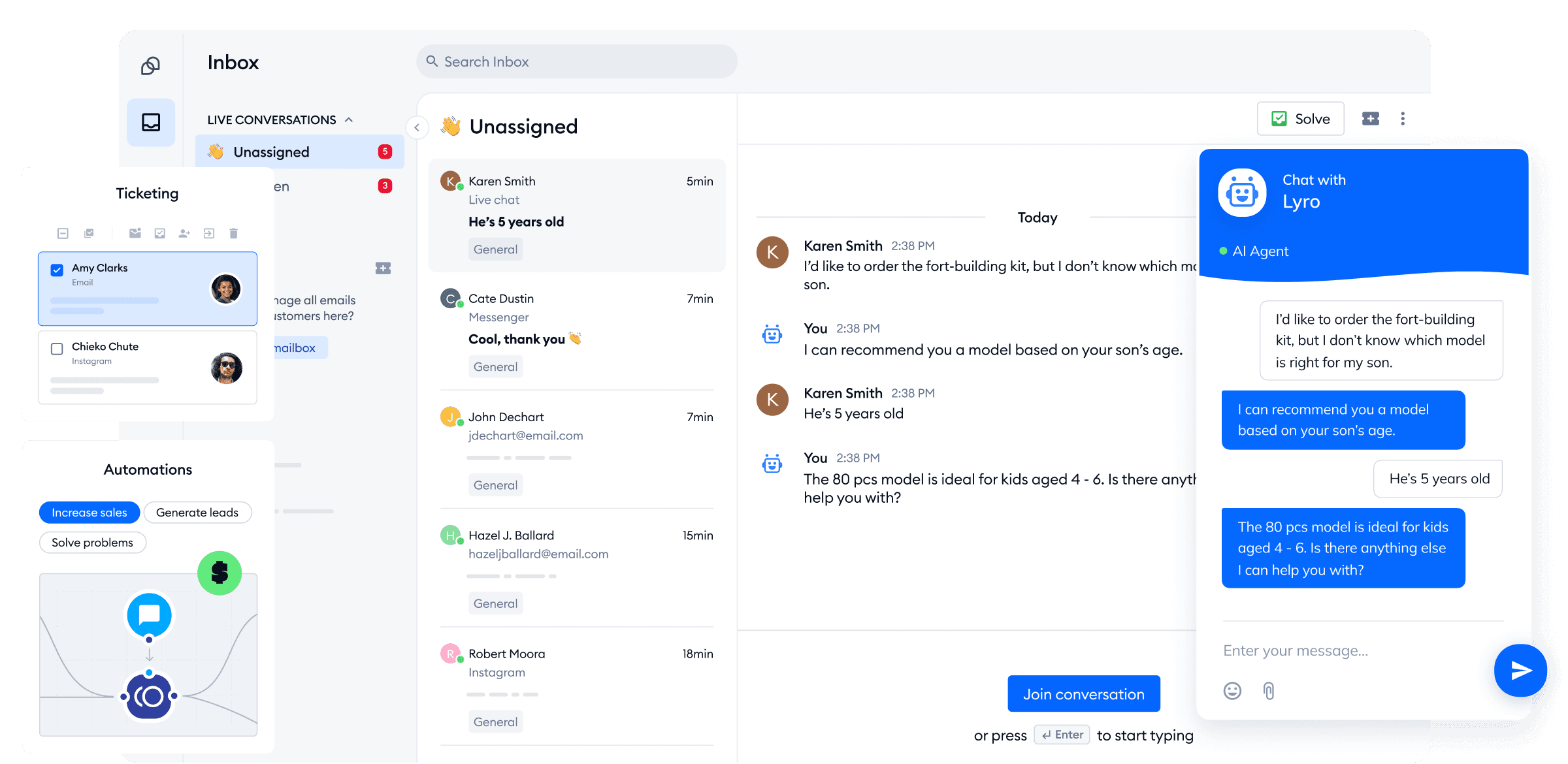
The bill for your customer support platform can feel like a moving target. One month it’s manageable, the next it’s double what you budgeted, with no obvious change in your store’s traffic. This billing volatility is a common experience for Shopify store owners using tools with complex, multi-layered pricing. Tidio, a popular live chat and chatbot tool, has a pricing structure that exemplifies this challenge. While its entry-level plans seem affordable, the total cost often balloons once you factor in necessary add-ons for AI, remove branding, or exceed conversation limits, leaving many to search for the best Tidio alternatives for Shopify. From an store owner's perspective, the promise of AI to reduce support costs by handling routine queries is immense. Industry reports suggest AI can cut operational costs by up to 30% and deflect 25-45% of tickets from human agents. The problem is that the pricing models of many platforms are designed to capture that saved value for themselves, not pass it back to the store owner.
The core issue isn't the quality of the tool itself, but the economic model it's built on. Pricing that separates the base platform from its most powerful features, like the Lyro AI agent, creates a disconnect between the advertised price and the real-world cost. A plan that starts at $59 per month can quickly climb to over $150 once you add the AI conversations and automated flows needed to actually reduce your workload. For a growing store managing thin margins, where every percentage point counts, this unpredictability isn't just an annoyance; it’s a direct hit to your bottom line. The search for an alternative is often a search for predictability: a single, flat fee that covers everything, no matter how many customers you talk to in a month. This guide examines ten leading alternatives, focusing on how their pricing models and feature sets stack up for a Shopify store in 2026, helping you find a solution that supports your growth instead of penalizing it.
Deconstructing Tidio's Real Cost in 2026
To understand why store owners seek alternatives, you first have to dissect what a Tidio bill actually represents. It’s not one number, but a stack of them. The foundation is the base plan, which primarily gates the number of "billable conversations" your human agents can have. The Free plan offers 50 conversations, while the Starter plan at around $29/month allows for 100. The popular Growth plan, starting around $49/month, includes 250 conversations. This seems straightforward, but the complexity begins with the add-ons. The Lyro AI agent, Tidio’s headline feature, is not included. After a small, one-time allotment of 50 AI conversations, Lyro becomes a separate subscription, starting at roughly $39 per month for just 50 more AI-led conversations. For any store serious about leveraging AI to handle volume, this add-on is non-negotiable, effectively making the entry-level price an illusion and nearly doubling the initial monthly cost before the platform has resolved a single new ticket. This initial upsell is a critical friction point for store owners who adopted the tool for its AI promise in the first place.
The financial model is further complicated by other limitations that create a ceiling on growth. Automated "Flows" are also capped and require a separate add-on to scale, introducing another metered variable to track. Removing the Tidio branding from the chat widget costs another $16-$20 per month on the Growth plan, a small but irritating fee for brand-conscious stores. And critically, all self-serve plans are capped at 10 agent seats. If your team grows to 11 people, you face a massive price jump from the ~$59 Growth plan to the Plus plan, which costs $749 per month. This creates a "pricing cliff" that punishes scaling teams. A store handling 1,000 conversations a month, with a few agents and a need for AI to handle 500 of them, could see a real monthly bill of $150-$200, a far cry from the advertised starting rates. This model, forcing an store owner to constantly juggle quotas for human chats, AI chats, and automation triggers, is precisely what drives the search for simpler, more transparent pricing.
1. Gorgias: The Deep Shopify Integration
For many Shopify store owners, Gorgias is one of the first names that comes up when support volume becomes a real concern. Its key strength is an exceptionally deep integration with Shopify, which is its primary market focus. Agents can view order history, issue refunds, cancel orders, and apply discounts directly from the support ticket, eliminating the need to switch between multiple browser tabs. This workflow efficiency is a significant advantage, as saving 30-60 seconds per interaction adds up to hours of saved agent time each week. However, Gorgias's pricing model shares some of the same complexities as Tidio's, albeit structured differently. Instead of charging per agent, Gorgias bills based on the number of "billable tickets" per month. Plans range from a Starter tier at $10 for 50 tickets to an Advanced tier at $900 for 5,000 tickets. Most growing stores land on the Pro plan, which costs around $300-$360 per month for 2,000 tickets, a price point that positions it as a serious investment for a scaling business.
The major hidden cost with Gorgias, and a frequent source of surprise for new users, is how it bills for AI. Like Tidio, its AI Agent is a powerful add-on, but it's priced per automated resolution, at a rate of about $0.90 to $1.00 each. The critical detail that often surprises store owners is that each AI resolution also consumes one of the billable tickets from your monthly plan. This means you are effectively billed twice for every automated interaction: once for the AI fee and once against your plan's ticket limit. A store with 2,000 tickets on the Pro plan, where AI resolves 60% of them (1,200 tickets), could see their monthly bill climb to over $1,440, the $360 base plan plus $1,080 in AI fees (1,200 resolutions x $0.90). While powerful, Gorgias demands careful monitoring of both ticket volume and AI usage to avoid significant and unexpected overages. It’s an excellent tool for stores that can leverage its deep Shopify actions and have the budget to accommodate a usage-based model where value is directly tied to cost.
2. Intercom: The Premium AI Experience
Intercom has long been positioned as a premium player in the customer communication space, known for its polished user interface and powerful automation capabilities. With the introduction of its AI agent, Fin, it has doubled down on providing a sophisticated, AI-first support experience, even rebranding around the agent. Intercom’s model is fundamentally different from Tidio’s conversation limits or Gorgias’s ticket caps. It is primarily a seat-based platform, with plans like Essential starting at $29 per agent/month, Advanced at $85, and Expert at $132 (with annual billing). This makes it predictable for human teams, but the total cost is layered. The main driver of expense is the same as with Gorgias: a per-resolution fee for the AI. Every conversation resolved by Fin without human intervention costs an additional $0.99. This model turns every automated resolution into a micro-transaction, forcing a constant cost-benefit analysis on a core support function.
This per-resolution model means that for a support-heavy business, the AI costs can easily eclipse the seat fees. A small team of three agents on the Advanced plan ($255/month for seats) handling 2,000 conversations, with a 60% AI resolution rate (1,200 resolutions), would incur an additional $1,188 in Fin fees, for a total monthly cost over $1,443. Unlike Tidio, Intercom does not have a permanently free plan, making it less accessible for new stores just starting out. Intercom is a strong Tidio alternative for well-funded businesses that prioritize a best-in-class agent and customer experience and are willing to pay a premium for it. Its strength lies in robust workflows, detailed reporting, and an AI that is deeply integrated into the platform, but its total cost of ownership is significantly higher than many other options on this list, placing it firmly in the upper echelon of the market for mature companies.
3. Zendesk: The Enterprise-Grade Helpdesk
Zendesk is one of the oldest and most established names in customer service software, offering a comprehensive suite that goes far beyond live chat. It’s a full-fledged omnichannel helpdesk, capable of managing email, phone, social media, and chat within a single ecosystem. For stores graduating from simpler tools, Zendesk represents a step up in structure, process, and corporate philosophy. Like Intercom, Zendesk uses a per-agent pricing model. Its Suite Team plan starts at $55 per agent/month, with the popular Suite Professional plan at $115 per agent/month (annual billing). These plans provide a robust ticketing system, knowledge base, and analytics. However, similar to its high-end competitors, the sticker price is only the beginning. The most powerful AI features come with a stack of additional costs, making the initial seat price a fraction of the final bill.
Zendesk’s pricing structure is a masterclass in complexity, with three distinct layers. First, you pay for the seats. Second, the main AI add-on, Copilot, which assists human agents, costs an extra $50 per agent per month. A team on Suite Professional with Copilot is already at $165 per agent. Third, Zendesk has also moved towards an outcome-based model for its automated resolutions, with overages billed at a rate that is not publicly published but is estimated by third parties to be around $1.50 to $2.00 per resolution. This combination of seat-based plans, paid AI add-ons, and metered resolution billing makes forecasting the true cost of Zendesk notoriously difficult. A 10-agent team on the Suite Professional plan with Copilot could see a base cost of $1,650/month just for seats and the add-on, before any AI resolution fees are even considered. Zendesk is a viable Tidio alternative for large, complex organizations that require enterprise-grade security, compliance, and advanced workflow customization, and have a dedicated team to manage the platform itself.
4. Help Scout: Simplicity and Customer Focus
In a market increasingly defined by complex, multi-layered AI billing, Help Scout stands out for its commitment to simplicity and a human-centric approach. It offers a shared inbox that feels like a clean, collaborative email client, making it intuitive for teams to adopt with minimal training. The platform combines email and live chat into a single queue, supported by a built-in knowledge base (Docs) and a simple embeddable widget (Beacon) for on-site help. Help Scout's pricing is a refreshingly straightforward per-user model, with a generous free plan for up to 5 users. Paid plans include Standard at $25/user/month and Plus at $45/user/month, with annual discounts available. This predictability is a core part of its appeal for small to medium-sized businesses that want to avoid the bill shock associated with the usage-based plans of its competitors. It's a tool designed for clarity, both in its interface and its invoice.
However, even Help Scout has not been entirely immune to the trend of metered AI billing, a sign of how deeply this model has penetrated the market. While it offers AI-assist features for agents within its plans, its customer-facing AI chatbot, "AI Answers," is billed separately at $0.75 per resolution. This creates a similar dynamic to Gorgias and Intercom, where high AI usage can become a significant portion of the monthly bill. A five-person team on the Plus plan would pay $225/month for seats, but if they rely on AI to resolve 1,000 chats, that adds another $750, bringing the total to nearly $1,000. To its credit, Help Scout allows you to set a spending cap on AI resolutions to prevent runaway costs, a crucial feature for budget-conscious teams. Help Scout remains an excellent Tidio alternative for teams that value a clean interface, predictable seat-based pricing for human agents, and want to keep their support interactions feeling personal, while having the option to layer in a customer-facing AI with a controllable budget.
5. Freshchat (Freshworks): The All-in-One Suite
Freshchat, part of the broader Freshworks ecosystem, is a strong contender for businesses looking for a modern messaging and chatbot solution that can grow with them. It offers a well-designed interface and a feature set that competes directly with the likes of Tidio and Intercom, often at a more accessible price point. One of its most compelling features is a generous free plan that supports up to 10 agents, making it highly attractive for new and small teams looking to establish a support function without upfront costs. Paid plans are also competitively priced on a per-agent basis, with the Growth plan at around $19/agent/month and the popular Pro plan at $49/agent/month. These plans progressively add more channels, like WhatsApp and Facebook Messenger, along with more advanced reporting and routing capabilities, providing a clear and logical upgrade path for scaling teams.
Like most modern platforms, Freshchat's AI capabilities, branded as "Freddy AI," are separated into different products with their own pricing structures, which can be a source of confusion. The Freddy AI Copilot, which assists human agents with summaries and drafts, is an add-on costing around $29/agent/month. The Freddy AI Agent, which provides autonomous resolutions to customers, is a usage-based add-on that starts at $49 for 100 "sessions," a metric that differs from the per-resolution billing of competitors. This creates a similar, albeit slightly more convoluted, billing structure. You pay for seats, then you pay again for agent-assist AI, and then you pay a third time for customer-facing AI. Despite this, Freshchat’s strong free tier and competitive entry-level pricing for paid plans make it a very attractive Tidio alternative for small and medium-sized businesses. It allows teams to adopt more advanced features and AI as their budget and needs expand, without the steep initial investment required by platforms like Intercom or Zendesk.
6. A Field of Niche Competitors
Beyond the big helpdesk suites, a number of focused competitors offer compelling alternatives to Tidio, each with a unique strength. LiveChat, one of the pioneers in the space, offers a rock-solid, reliable live chat tool praised for its stability and ease of use. Its pricing is a straightforward per-agent model, starting around $19-$25/month and scaling to a Business plan at $79-$89/month. Its main drawback is that its powerful AI chatbot is a separate product, requiring an additional subscription and setup, a legacy of its long history in the market. Re:amaze is built specifically for ecommerce and boasts deep integrations with Shopify and other platforms. It uses a per-user pricing model ($29/$49/$69 per user/month), but also offers a unique "Starter" plan at a flat $59/month for unlimited users, capped at 500 conversations, perfect for a seasonal business with many part-time agents who only work during peak periods. However, its AI resolutions are also metered at $0.85 each beyond a small monthly allowance, falling into the same usage-based trap.
For those prioritizing simplicity over feature depth, Chatra offers a simple, elegant chat widget with a free plan for one agent and paid plans starting at just $21/agent/month. It focuses on the core live chat experience and is less centered on complex AI automation, making it a great choice for businesses that want to prioritize direct human interaction and a personal touch. Finally, Shopify Inbox is the default free option for any store on the platform. It's a capable, no-cost tool for managing customer conversations and creating basic automated responses. While it lacks the advanced AI, ticketing, and automation features of paid alternatives, its native integration and $0 price tag make it an unbeatable starting point. From an store owner's perspective, Shopify Inbox acts as a crucial baseline; the question isn't if it's as good as Gorgias, but at what point the pain of its limitations exceeds the $300+ monthly cost of a more powerful, paid tool.
7. Arbyn: The Flat-Rate AI Agent
The common thread among many Tidio alternatives is the move toward complex, multi-layered billing. You pay for seats, then you pay again per AI resolution, and sometimes again for specific add-ons. This is the exact problem Arbyn was built to solve. It offers a fundamentally different pricing model designed for predictability and simplicity, directly addressing the budget volatility that plagues so many Shopify stores. There are only two plans: a free Starter plan that includes 150 full AI conversations per month, and the Arbyn Agent plan at a flat $99 per month for unlimited conversations and unlimited seats. This model completely eliminates the per-resolution fees, overage charges, and surprise bills that are characteristic of usage-based platforms. For a store owner, this means your customer support software bill is a fixed, predictable operating expense, not a variable cost that spikes during your busiest seasons.
Arbyn functions as a true support and sales agent, not just a chatbot that deflects simple questions. It integrates deeply with Shopify to take action, handling common "Where Is My Order?" (WISMO) requests by pulling live tracking data, processing address changes, and even initiating returns or issuing refunds with a store owner's one-click approval. It's designed to resolve the entire conversation from start to finish without needing a human agent to step in, a critical distinction from tools that merely answer one question before escalating. By focusing on a simple, all-inclusive price, Arbyn allows store owners to budget for their support costs with absolute certainty. As your store grows and conversation volume doubles during a Black Friday sale, your bill stays exactly the same. For Shopify stores tired of juggling quotas and deciphering complex invoices, this radical simplicity is the core value proposition. If you're looking for a powerful AI agent without the unpredictable costs, you can install Arbyn for free on the Shopify App Store and handle your first 150 conversations each month at no cost.
The market for customer communication tools is crowded, but a clear pattern has emerged in 2026. The most powerful platforms are increasingly adopting complex, usage-based billing for their AI features, which puts the financial risk of high volume and automation success squarely on the store owner. While these tools are incredibly capable, their unpredictable costs are a significant liability for growing businesses that need to manage cash flow carefully. The decision for a Shopify store owner comes down to a fundamental choice between the deep, expansive feature sets of these metered platforms and the financial predictability of a flat-rate alternative. Evaluating your store's specific needs, your tolerance for budget variance, and the true cost of your team's time is the first step to choosing a partner that will help you scale efficiently and profitably.
Written by
For seven years I have led customer success and technical support inside high-growth SaaS and e-commerce companies. Customer Support Lead at DripShop.live, a live-commerce SaaS. Technical Support Specialist at Replo (Y...
View full profile