What Is 'Agentic Commerce' in Plain English for a Shopify Owner?
Agentic commerce is not just another AI buzzword; it's a fundamental shift where AI agents shop on behalf of customers, and your Shopify store needs to be ready.

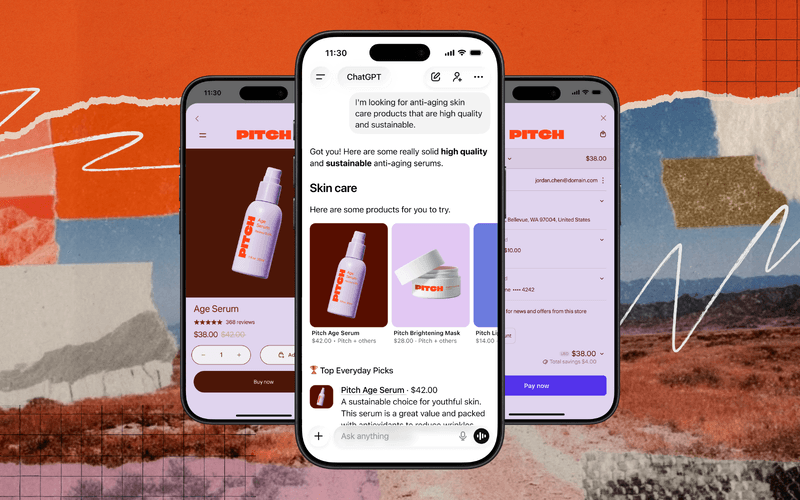
You check your Shopify analytics on a Tuesday morning and see a handful of sales with a referral source you don’t recognize: “AI Shopping Assistant.” There was no campaign, no ad spend, and no link from a blog. The sales simply appeared, driven by a machine that decided your product was the single best answer to a person’s request. This isn’t a scene from the distant future; for a growing number of store owners, it’s already happening. For instance, 59% of consumers have already used a generative AI tool for shopping tasks, and one report showed AI-driven traffic to retail sites grew 4,700% year-over-year as of July 2025. This new reality is called agentic commerce, a term that describes what happens when AI agents stop just answering questions and start actively shopping for consumers. For a Shopify owner, this represents one of the most significant shifts since the rise of social media marketing, and understanding it is not optional. It’s a change that redefines what it means for a product to be “discoverable” and threatens to make entire brands invisible if they fail to adapt.
The Fundamental Shift from Active Searching to Delegated Shopping
For two decades, the core loop of ecommerce has been consistent. A person has a need, they translate that need into a set of keywords, and they type those keywords into a search bar. Google, Amazon, or your own storefront search returns a list of ten blue links or a grid of product thumbnails, and the human begins the manual work of filtering, comparing, and evaluating the options. They open multiple tabs, scrutinize product photos, read reviews, and hunt for shipping policies, with one survey finding that 57% of online shoppers want more convenience when comparing prices and reviews. The customer does all the cognitive labor. Agentic commerce fundamentally breaks this loop. Instead of a human doing the work, they delegate the goal to a piece of software, an AI agent. The prompt is no longer a few keywords like “linen shirt men”; it’s a natural language command: “Find me a breathable, white linen shirt for a beach wedding in Sicily next month, under $100, that can be delivered to New York in three days.” The agent’s job is not to return a list of links for the user to sift through. Its job is to return the single best answer, or a very short list of finalists, and in many cases, to execute the purchase directly.
This transition from active, human-led searching to delegated, AI-executed shopping is the core of the agentic model. Consumers are increasingly using these tools not just for research but for the entire purchasing journey, with projections from Morgan Stanley estimating agentic commerce could account for $190 billion to $385 billion of U.S. retail revenue by 2030. AI platforms are evolving from informational chatbots into transactional assistants. They can interpret complex user intent, identify potential products across millions of online stores, retrieve and parse the necessary data, and reason against a set of criteria to make a decision. The agent compares materials, checks inventory, verifies shipping times, cross-references reviews, and finds the best price, all without human intervention. This is not a theoretical concept; protocols like the Agentic Commerce Protocol (ACP) are already live, standardizing how these agents communicate with businesses to complete transactions entirely within the AI interface. For a store owner, this means the new customer isn't a person browsing your site, but a machine programmatically assessing your products.
This shift has profound implications. Your beautifully designed landing pages, compelling brand storytelling, and carefully crafted marketing copy become less important in the initial discovery phase. The AI agent doesn't get persuaded by your brand's aesthetic or the emotional connection you've tried to build. It operates on a colder, more logical level, focused entirely on specifications, structured data, price, and operational reliability. The shopping journey is compressed from hours of browsing into a few seconds of an agent’s processing time. The agents act as gatekeepers, filtering the overwhelming noise of the internet down to a single, trusted recommendation. While many consumers report using AI tools, one 2026 survey found that 86% of shoppers who used AI for product research still felt they had to verify the recommendation through another source, underscoring the agent's reliance on verifiable, accurate data to build trust. If your store provides the right signals, you can win high-intent customers you never would have reached. If you don't, you risk becoming completely invisible to this rapidly growing channel of commerce.
What Agentic Commerce Actually Means for a Shopify Business
Stripped of the jargon, agentic commerce means your products will be discovered, evaluated, and purchased by automated software acting on a customer's behalf. It’s a move from human-to-business commerce to a model that is increasingly agent-to-business. This is not about the AI chatbots you can install on your own website; those are tools that serve customers who have already found you. Agentic commerce is about the external AI assistants that customers use to decide where to shop in the first place. These agents are becoming the primary discovery layer for a significant segment of online shoppers, and they operate by a completely different set of rules than traditional search engines or social media algorithms, with 58% of consumers now using Gen AI tools for recommendations instead of traditional search. The process, sometimes called "agentic discovery," relies on reasoning over structured data, not just matching keywords.
Imagine an AI tasked with finding "a durable, waterproof hiking boot available in a size 11 wide that has at least 50 reviews with an average rating of 4.5 stars or higher." The agent doesn't just search for those terms. It formulates a plan: identify businesses selling hiking boots, query their inventory for size 11 wide, filter for products with a "waterproof" attribute, and then parse review data to check the rating and volume criteria. It will likely do this by calling on APIs, reading product data feeds like Google store owner Center, and parsing structured data (like Schema.org markup) embedded in your product pages. If your boot's waterproofing is only mentioned in a descriptive paragraph, or if its size availability isn't in a machine-readable format, your product is disqualified. The agent doesn't guess; it moves on to the next business whose data is clean, complete, and explicit, as its core function is to reduce ambiguity and act with confidence.
This creates a new, urgent priority for Shopify store owners: making your entire catalog machine-readable. Your product pages must be designed not just for human eyes but for algorithmic interpretation. The agent is your new, ruthlessly efficient customer. It doesn't care about your brand's vibe. It cares about facts. What is the material composition? What are the exact dimensions? What is the Global Trade Item Number (GTIN)? What is the return policy, and is it stated clearly on a dedicated page? Is the inventory level accurate in real-time? These details, often overlooked in favor of marketing copy, are now the primary drivers of visibility and conversion in the agentic ecosystem, as one report found that 40% of consumers have returned an online purchase specifically due to inaccurate product content. Stores that have invested in detailed product attributes, clean data feeds, and comprehensive structured data will be the ones whose products are surfaced by these AI shopping assistants. Those who have buried crucial details in unstructured paragraphs or inconsistent tags will simply be ignored.
How AI Shopping Agents Will Discover and Judge Your Products
An AI shopping agent’s evaluation of your Shopify store is a deeply technical audit, not a casual browse. It judges your products based on the quality, completeness, and accessibility of your data. The first and most critical element is structured data. This is information formatted in a standardized way, like JSON-LD or Schema.org markup, that explicitly tells machines what your product is. A `
` tag containing the sentence "This shirt is 100% organic cotton" is human-readable. A structured data field that explicitly states `"material": "Organic Cotton"` is machine-readable. AI agents overwhelmingly prefer the latter because it removes ambiguity and allows for direct comparison against other products. Key data points like price, availability, brand, SKU, and GTINs must be present and accurate in this format. Without this foundation, your product is a black box to an agent, effectively invisible to its queries.
Beyond basic product schema, agents look for semantic and operational depth. This means going further with your data to describe not just what the product *is*, but what it’s *for*. Using Shopify metafields to specify attributes like "use case" (e.g., trail running vs. road running), "compatibility" (e.g., "fits 15-inch laptop"), or "certifications" (e.g., "GOTS Certified") provides the rich, filterable data that agents need to make qualified recommendations. A human can infer that a certain backpack is good for hiking, but an agent needs an explicit field to confirm it. This level of detail directly impacts sales, as shoppers consistently rate detailed product content as a key factor in their decision. Similarly, your product variants must be clear and logical. Vague variant names like "Style A" are useless to an agent; descriptive names like "Color: Midnight Blue / Size: Large" are essential. Every piece of information that a discerning customer might use to make a decision should be translated into a discrete, structured data field.
Operational signals are the next layer of judgment. These signals tell an agent whether you are a reliable business. Can it get a real-time inventory count? Is your shipping policy clearly stated on its own page, with delivery timeframes and costs that can be parsed? Is your return policy equally transparent? These are not just trust signals for humans; for an AI agent, they are go/no-go criteria. An agent tasked with finding a product delivered by Friday will disqualify any store where it cannot programmatically confirm the shipping speed, and the impact is significant, as 53% of U.S. consumers will abandon their cart and shop elsewhere if an item is unexpectedly out of stock. Finally, the agent will look for social proof in a machine-readable format. This means having a review system that exposes ratings and review counts through structured data. An agent can't be swayed by a glowing testimonial embedded in an image, but it can parse a field that says `"reviewCount": 257` and `"ratingValue": 4.8`. In this new paradigm, trust is built through verifiable data, not just brand reputation.
The New Rules of Branding and Visibility in an AI-Driven World
The rise of agentic commerce presents a double-edged sword for brand building. On one hand, it creates the potential for a pure meritocracy where the objectively best product can win, regardless of the brand's marketing budget. If your product has the best specifications, the most competitive price, the fastest shipping, and the highest-rated reviews, an AI agent is likely to recommend it even if you're a small, unknown brand. This opens up a powerful new channel for customer acquisition that is based on product quality and operational excellence, not advertising spend. It allows small stores to compete directly with retail giants on a level playing field, provided their data is immaculate and their value proposition is clear. This is a massive opportunity for store owners who have focused relentlessly on creating a superior product and a seamless customer experience.
On the other hand, this same dynamic poses a significant threat to brands that rely heavily on storytelling, emotional connection, and aesthetic appeal to drive sales. When an AI agent is the intermediary, it bypasses all the carefully crafted branding that you've built. The beautiful photography on your homepage, the compelling "About Us" story, the aspirational lifestyle portrayed on your Instagram feed, the agent sees none of it. It is making a recommendation based on a cold, hard comparison of data points. This can lead to what some are calling the "invisibling" of brands, where the consumer's loyalty shifts from the brand they are buying from to the AI agent that recommended the product. The convenience of receiving a perfect, vetted recommendation may outweigh the desire to browse and discover brands on their own, especially since one survey found that 77% of U.S. consumers cite convenience as a key factor in their purchasing decisions.
This forces a strategic re-evaluation of what a "brand" is in the age of AI. The new form of branding is trust and reliability, demonstrated through data. Your brand becomes synonymous with your operational competence: consistently accurate inventory, lightning-fast shipping, transparent policies, and a product that lives up to its structured data specifications. Customer loyalty will be earned not just through emotional affinity, but through the repeated success of an AI agent recommending your product because it is, algorithmically, the best choice. In fact, one study on loyalty found that more than half of repeat purchases are driven by factors like routine and convenience, not active brand preference. This doesn't mean traditional branding is dead, but its role changes. It becomes crucial for retention and for the post-purchase experience, the moment after the agent has made the introduction. The agent might win you the first sale, but your brand's quality and service are what will earn the second, and what will generate the positive review data that feeds back into the agentic ecosystem for the next customer.
How to Prepare Your Shopify Store for the Agentic Future
Making your Shopify store "agent-ready" is not a futuristic exercise; it's an urgent, practical task that aligns directly with existing best practices for SEO and user experience. The work you do to prepare for AI agents will also make your store better for human customers and traditional search engines, potentially boosting conversion rates by creating a more confident buying experience. The first step is to conduct a thorough audit of your product data. Move critical information out of long, unstructured description paragraphs and into specific, structured fields using Shopify's native metafield capabilities. For every product, ask yourself: if an AI needed to filter by this attribute, could it? Information like dimensions, weight, material, compatibility, and intended use should all have their own dedicated fields. Use Shopify's Category metafields to classify your products with Google's detailed Product Taxonomy, which provides a standardized vocabulary that agents understand.
Next, focus on your identifiers and operational data. Ensure every product that should have one has a Global Trade Item Number (GTIN), Manufacturer Part Number (MPN), and brand associated with it. These universal identifiers are crucial for agents to disambiguate your products from others across the web and are often required by major ad platforms. Clean up your policy pages. Don't bury your shipping or return information on a generic FAQ page. Create dedicated pages for "Shipping Policy" and "Return Policy" with clear, parsable text that outlines timeframes, costs, and conditions. Set up real-time inventory synchronization to ensure the availability data you expose is always accurate. An agent that recommends an out-of-stock product will learn not to trust your store's data in the future, damaging your reliability score. This also extends to your product variant naming; ensure they are descriptive and consistent, combining attributes like color, size, or material in a predictable pattern.
Finally, implement robust structured data using JSON-LD. While many Shopify themes have basic schema markup built-in, you should enhance it to be as comprehensive as possible. Use the `Product`, `Offer`, and `ProductGroup` schema types to clearly define your products, their pricing, and their relationship to other variants. Ensure your customer reviews are also marked up with `Review` and `AggregateRating` schema so that agents can parse your social proof. You can use Google's Rich Results Test to validate your markup and identify errors. This work is technical, but it is the absolute foundation for being visible in an agentic commerce landscape. The stores that treat their product catalog as a structured database for machines, not just a visual gallery for humans, will be the ones that thrive. Businesses that properly structure their data can see a significantly faster decision-making process in AI systems.
Completing the Circle: Your Store's Own AI Agent
While external AI agents are fundamentally changing how customers discover your store, that is only one half of the equation. Once a high-intent shopper is sent to your site by a recommendation engine, the experience they have determines whether the sale is won or lost. This is where the other side of agentic commerce comes into play: the AI agent that works for you, on your own store. If a customer arrives with a final clarifying question before purchasing, making them wait for a human response is a recipe for a lost sale. The expectation set by the instant, conversational nature of external agents is that they will be met with an equally intelligent and responsive experience when they arrive. An AI agent on your site acts as the perfect sales associate, ready 24/7 to instantly handle any query, confirm product details, and guide the customer to checkout.
This is the role that an AI support and sales agent like Arbyn is built for. It acts on behalf of your store, representing the flip side of the agentic coin. While a customer's personal AI finds the right product, Arbyn is there to close the deal. It can answer nuanced questions about your products by drawing directly from your catalog data, the same structured data you prepared for external agents. It can clarify shipping policies, handle requests for order status, and even make personalized recommendations for upsells or cross-sells within the conversation. For example, multiple analyses have found that shoppers who engage with an on-site AI are about four times more likely to complete a purchase, converting at a rate of 12.3% compared to 3.1% for unassisted shoppers. Crucially, it ensures that the momentum and high intent generated by an external agent's recommendation isn't lost to friction or delay at the final step of the journey.
Ultimately, a complete agentic commerce strategy involves preparing for agents on both sides of the transaction. First, you structure your store's data so that external shopping agents can discover and recommend your products. This gets you the at-bat. Second, you deploy your own AI agent to handle the sales and support conversations that happen once that traffic arrives. This ensures you make the most of every opportunity. As AI agents become the primary shoppers for more consumers, the stores that succeed will be those that are not only machine-readable but also machine-conversational. The future of commerce isn't just about being found by an algorithm; it's about being able to sell to the customer that algorithm brings you. You can prepare your store for this future today by ensuring you have an agent ready to engage every customer, instantly and intelligently. If you're ready to complete your agentic strategy, you can install Arbyn from the Shopify App Store and have your own AI agent working for you in minutes.
Written by
For seven years I have led customer success and technical support inside high-growth SaaS and e-commerce companies. Customer Support Lead at DripShop.live, a live-commerce SaaS. Technical Support Specialist at Replo (Y...
View full profileKeep reading
View all posts
What Happens to Customer Trust When AI Handles Both Discovery and Support
Odera Joseph · 9 min

How AI Search Engines Cite Shopify Stores: An Early Look at Answer Engine Visibility
Odera Joseph · 8 min

The Difference Between an AI Chatbot and an AI Commerce Agent, Explained
Odera Joseph · 8 min