What Happens When You Hit 150 Conversations on Arbyn Starter
Hitting the Arbyn Starter 150 conversation limit isn't a penalty, it's a sign your store is growing, and here’s exactly what comes next.

It’s Tuesday morning and you’re reviewing the weekend’s sales on Shopify, the fresh coffee next to your laptop barely touched. Between fulfilling new orders from a surprisingly successful weekend flash sale that delivered a major lift in revenue and exporting shipping confirmations, you glance at your Arbyn dashboard. The number is climbing with the morning rush: 124 conversations. Then 131. You launched your online store six months ago, and what started as a hesitant trickle of customer questions about your handmade leather goods has now become a steady, predictable stream. The free Arbyn Starter plan has been an absolute lifesaver, flawlessly handling dozens of “where is my order?” queries, questions about your return policy, and even pre-sale inquiries like “Does the weekender bag fit a 15-inch laptop?” while you sleep. But as you watch that number edge closer to the cap, a familiar, low-grade anxiety begins to creep in. What happens when you hit the arbyn starter 150 conversation limit? Does the entire system just stop? Is there a surprise overage bill waiting to detonate your monthly budget? This is a moment every growing store owner faces: the critical point where a free tool has proven its value so completely that you can’t imagine operating without it, and now a decision is looming on the horizon.
The Milestone Disguised as a Limit
Let’s reframe the conversation around usage caps, because it’s a concept that the software industry has largely gotten wrong. In the world of software-as-a-service, a limit is often perceived as a punitive barrier, a frustrating wall intentionally designed to force an upgrade at the most inconvenient time. But in the context of your store’s customer support, that number represents something much more positive and powerful: tangible growth. Each one of those 150 conversations is a real customer engaging with your brand, a person who cares enough about their purchase to ask a question, track an order, or consider a future purchase. Your support conversation volume is a direct, real-time indicator of your business health and market traction, telling a story that is just as important as your sales velocity. It’s a metric that tells you precisely how many people are interacting with your business, providing invaluable insights into your team's workload, your marketing campaign effectiveness, and the overall customer experience. When that volume grows to the point of hitting a 150-conversation ceiling, it’s not a failure. It is the clearest possible signal that your business is successfully scaling, moving from a side project into a legitimate operation.
This perspective is critical because the anxiety surrounding software limits is often born from bad experiences with other platforms whose business models prey on this exact fear. Many SaaS pricing models, particularly in the e-commerce support space, are intentionally opaque and complex. They use confusing tiers, hidden per-interaction fees, and punitive overage charges that create immense financial uncertainty for small, growing businesses. For example, a platform like Gorgias structures its plans around a set number of "billable tickets" per month. A ticket becomes billable the moment it receives any kind of reply, whether from a human or an automation. Furthermore, their AI add-on often involves a separate per-resolution fee that *also* consumes one of your plan's billable tickets, a form of double-billing that can be easy to miss. This can lead to a store owner being on a plan that seems affordable, only to be hit with a shockingly high bill after a successful sales weekend drove a spike in customer questions. This approach creates budget chaos and makes strategic financial planning feel reactive rather than intentional. For a growing store where managing cash flow is paramount to survival, such unpredictable expenses are a significant threat. This financial instability is why many store owners view any usage cap with deep suspicion; they’ve been conditioned by the industry to expect a catch, a surprise bill that derails their carefully planned budget. The fear isn’t about paying for a tool, it’s about losing control over the cost of that tool.
The core issue is a fundamental misalignment between how the software company prices its service and how the store owner experiences value and growth. A pricing model based on punishing you for your own success is fundamentally broken and creates a needlessly adversarial relationship. Hitting a usage limit should feel like graduating from one grade to the next, not getting a detention for being too active in class. It is a natural moment to evaluate the clear return on investment you've already received and make a conscious, empowered decision to invest further in a system that is clearly working for your business. The arbyn starter 150 conversation limit isn't a wall designed to stop you; it's a yardstick meticulously measuring your progress from day one. If the agent handled most of your conversations this month, and each would have taken you several minutes to resolve, that adds up to hours of your time reclaimed. That’s significant time that you were able to spend on product photography, writing email campaigns, or sourcing new suppliers instead of answering repetitive questions. Now, with a proven system and growing customer demand, you’re simply entering the next phase of your store’s operational maturity.
What Actually Happens When You Reach 150 Conversations
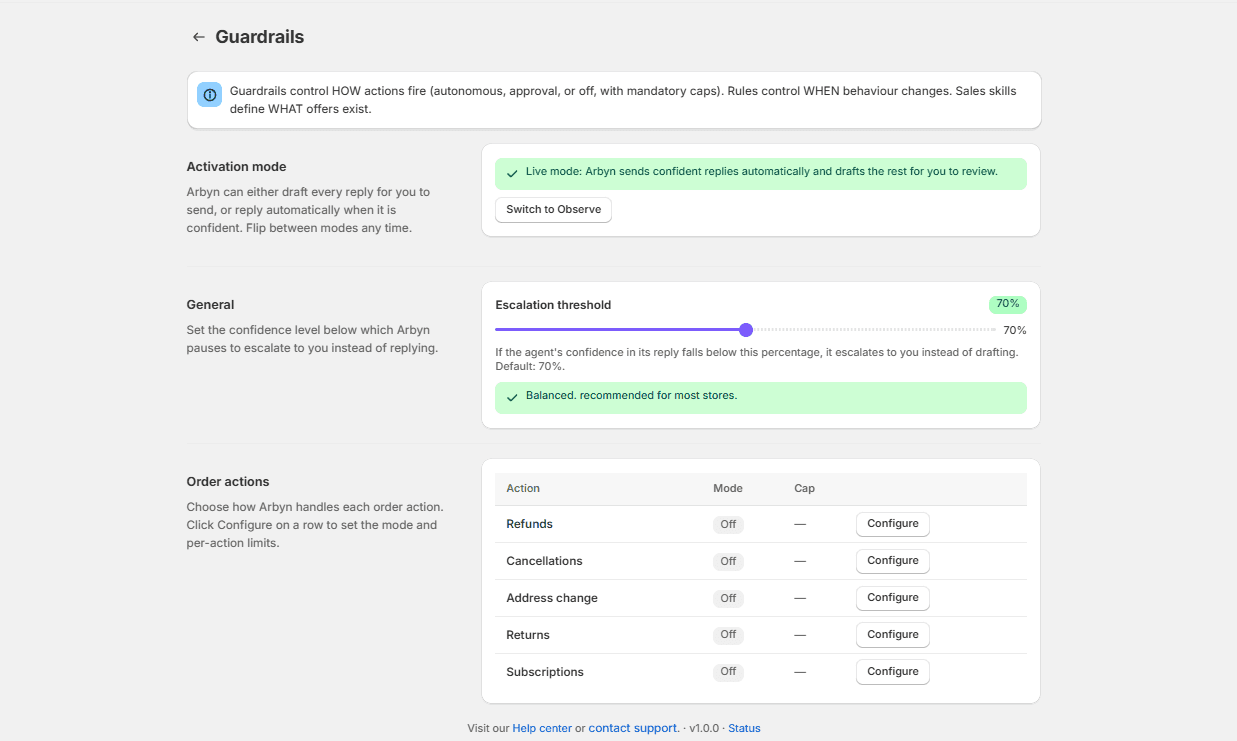
Let’s be perfectly clear, because this is the most important point: there is no surprise. There are no hidden fees or punitive charges. When your store reaches its 150th conversation for the calendar month on the Arbyn Starter plan, the AI agent simply and quietly stops handling new, incoming conversations automatically. It does not shut down your store, it does not lock you out of your account, and it absolutely does not generate a surprise bill for overages. The agent doesn't vanish; it just pauses its automated responses. The conversations that have already been handled remain in your records for analysis, and your access to the Arbyn dashboard is completely unchanged. The only change is functional: new inbound messages from customers will no longer receive an instant, automated answer. They will instead need to be handled manually by you or your team, reverting to the way things were before you had an AI agent installed. It’s a clean, simple, and predictable stop, a deliberate design choice intended to provide absolute clarity and prevent the kind of "surprise" expenses that plague so many other platforms and erode trust between a tool and its users.
Another critical detail makes this limit exceptionally fair and manageable for a growing store. The conversation count resets automatically and predictably. On the first day of every calendar month, your counter goes back to zero and the agent resumes normal function. This is not a confusing rolling 30-day window that’s difficult to track; it is a hard, predictable reset that simplifies your planning. So, if you happen to hit the limit on the 25th of the month after a strong sales week, you only have a few days of manual coverage to worry about before the free plan is fully active again for the next month.
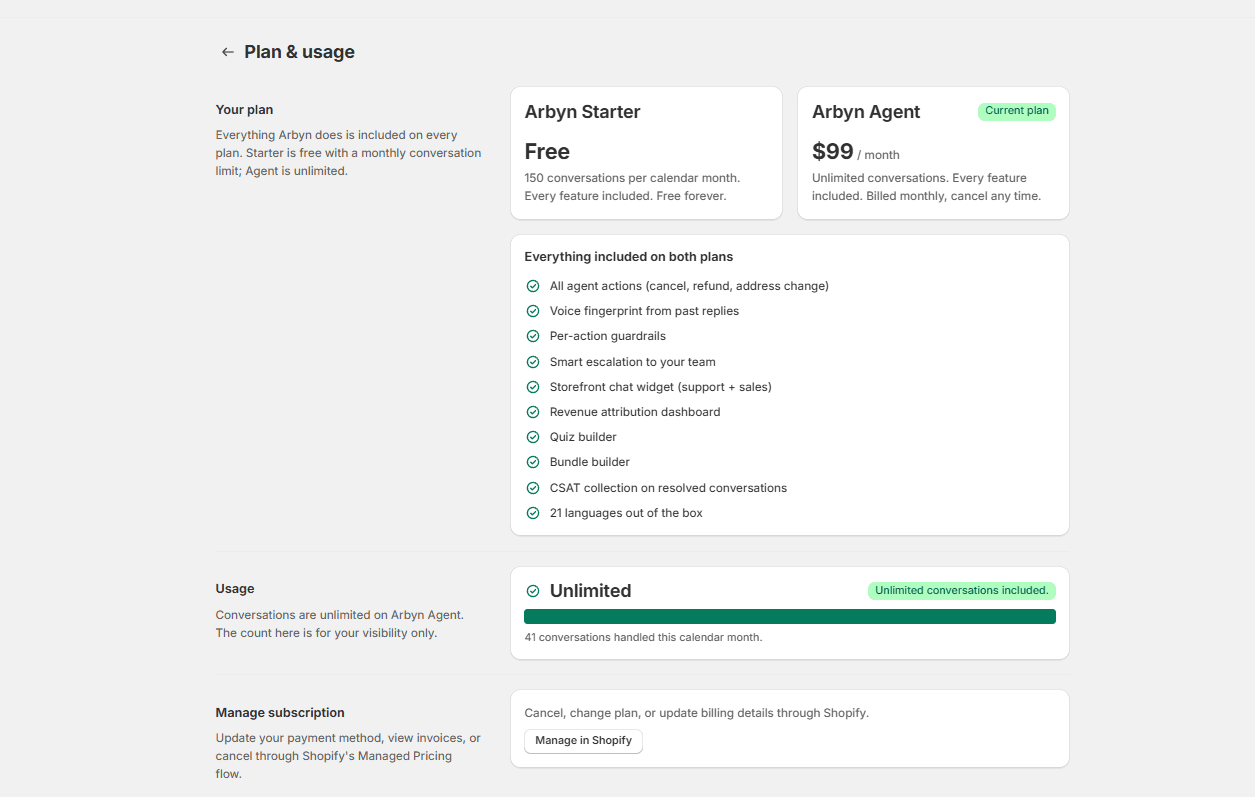
Once you hit that 150-conversation limit for the month, you are presented with a straightforward, transparent choice. You can wait for the first of the next month when the free plan automatically resets, or you can upgrade to the Arbyn Agent plan. There is no middle ground, no complex negotiation, and no confusing array of multiple tiers designed to upsell you on features you do not yet need. The Arbyn Agent plan costs a flat $99 per month for unlimited conversations, period. The upgrade path is a single click within your Shopify admin, and the billing is handled directly through your existing Shopify account, meaning you have no new invoice or payment method to manage. This is the entire model: start for free with a generous allowance, and only when your store's growth makes that allowance insufficient, move to a single, flat-rate plan for infinite scale. This approach is built on the principle of pricing transparency, a factor that leading venture capital firms like OpenView have identified as critical for building trust and reducing friction in the purchasing cycle. It’s a direct response to the industry-wide frustration with variable, usage-based billing that makes it impossible to forecast costs accurately.
The Math of a Flat-Rate Plan
For a store owner staring at the 150-conversation limit, the decision to upgrade to the $99 Arbyn Agent plan isn't just about turning the AI back on; it's a clear-cut financial calculation with compelling logic. The alternative isn't zero cost, which is a common misconception. The alternative is either handling the overflow of conversations yourself or paying someone else to do it. Let’s first consider the cost of your own time. If an average manual support interaction takes several minutes to resolve (looking up the order, finding the tracking number, pasting it into a polite email), then handling the next hundred conversations manually will consume hours of your work week. What is the opportunity cost of that time? For most founders, their time is by far the most valuable and limited resource. Spending it on repetitive "where is my order?" questions is a direct drain on growth-focused activities like A/B testing ad creative or filming new product videos. According to Forrester, 53% of consumers are likely to abandon a purchase if they can't find a quick answer, so the cost of a delayed manual response can be the entire sale itself.
The comparison becomes even more stark when measured against other support tools or hiring a human agent. Competing AI support platforms frequently rely on complex, usage-based pricing that penalizes scale. It is common to see a model that includes a monthly base fee plus a per-resolution charge. With such a model, handling hundreds of conversations a month could lead to significant usage fees on top of any base plan cost. That number could easily scale much higher for thousands of conversations during a busy season like Black Friday. With the Arbyn Agent plan, whether your store has 200 conversations or 2,000 conversations during a holiday sale, the price remains fixed at $99. This absolute cost predictability is a massive strategic advantage for a scaling business. It transforms a dangerously variable operational expense into a fixed, manageable line item, which is critical for accurate budgeting and long-term financial planning. Knowing your support costs are permanently capped allows you to focus entirely on scaling revenue without the fear that your success will be punished with a proportionally higher bill.
This stability is the core of the value proposition, a direct antidote to the chaos of unpredictable expenses. Volatile costs create risk and hesitation, forcing business owners to be reactive and conservative rather than strategic and aggressive in their growth efforts. By moving to a flat-rate model, you completely eliminate the financial rollercoaster of support spending. This provides high "operating leverage," a business term for a cost structure where fixed costs are high relative to variable costs, allowing profit margins to expand rapidly with each new sale. You can confidently run a major flash sale or launch a large-scale marketing campaign that you know will drive a significant spike in customer inquiries, without simultaneously dreading the four-figure support bill that might follow on another platform. The decision to move from Arbyn Starter to Arbyn Agent is therefore less of an "upgrade" and more of a strategic transition in your business's lifecycle. It’s the moment a store owner decides to cap their support costs permanently, thereby enabling unconstrained growth in customer engagement. It is a powerful investment in operational stability that pays dividends in both time saved and invaluable financial peace of mind.
Viewing Conversation Volume as a Key Performance Indicator
Instead of seeing the arbyn starter 150 conversation limit as a barrier to be avoided, savvy store owners learn to treat their support conversation volume as a vital business metric. Just like you meticulously track your conversion rate, average order value, or customer acquisition cost, your total number of support interactions is a powerful leading indicator of what’s happening in your business right now. Customer service analytics is a crucial form of business intelligence. A sudden spike in ticket volume, for example, might instantly signal a problem with a recent product launch, a broken link in your automated shipping notifications, or a checkout bug affecting a certain browser. A slow and steady increase in conversation volume, on the other hand, is often a direct and satisfying reflection of successful marketing campaigns and growing brand awareness. By monitoring these trends within your Arbyn dashboard, you can gain profound, real-time insights into the health of your products and the effectiveness of your end-to-end operations, allowing you to fix problems before they escalate.
When you're on the Arbyn Starter plan, the 150-conversation mark serves as an excellent, tangible benchmark for performance. Are you consistently hitting that limit early in the month, say by the 18th? That's a strong, undeniable signal that your traffic and customer base are robust and that it's time to invest in scalable infrastructure. Are you barely reaching 50 conversations by the end of the month? That might suggest your primary focus should be less on support automation and more on top-of-funnel marketing activities to drive more traffic and initial engagement. The limit provides a concrete data point to anchor your strategic thinking. It helps you understand the unique rhythm of your customer interactions, such as discovering your peak volume is actually Sunday evening as people check on weekend orders, an insight that could change when you schedule social media posts. This data is invaluable for resource planning, whether that resource is your own time, your marketing budget, or a future employee's schedule. It turns your support channel into a source of business intelligence.
Embracing conversation volume as a key performance indicator shifts your entire perspective on customer service. You stop trying to merely *reduce* the number of conversations and start focusing on handling them more efficiently while extracting more value from each one. Every inbound question is an opportunity. A question about order status is an opportunity for a perfect, instant answer that builds immense brand trust and encourages a repeat purchase. A pre-sale question about product specifications is an opportunity for an intelligent in-chat upsell or a cross-sell recommendation. Studies show that customers who engage with a chat function are significantly more likely to make a purchase, with some businesses seeing conversion rate improvements when chat is used to assist customers. When you upgrade to the unlimited Arbyn Agent plan, you unlock the ability to pursue these revenue-generating opportunities at scale without ever worrying about a usage meter ticking in the background. The goal is no longer to stay under a limit, but to maximize the value of every single customer touchpoint, transforming your support function from a necessary cost center into a powerful engine for customer retention and new revenue.
The Upgrade Is a Graduation, Not a Penalty
Hitting the 150-conversation limit on Arbyn Starter is a significant and positive moment for any Shopify store. It is the definitive point where your brand has grown beyond the uncertain initial launch phase and now has a consistent, measurable, and predictable stream of customer engagement. Think back to the very beginning: packing the first ten orders on your kitchen table, agonizing over the right shade of blue for your logo. The journey from that point to having 150 customer interactions in a single month is monumental. It proves that people are not just buying from you one time, but are actively interacting with your brand post-purchase, a key indicator of a healthy business. This is the moment to shed the anxiety that other software platforms have conditioned you to feel and recognize this milestone for what it truly is: a graduation ceremony. You have successfully implemented an automated support system, proven its value with zero financial risk, and are now ready to scale it. The free plan has done its job perfectly by getting you to this exact point, validating the need for automation before you ever had to spend a dime.
The choice you face is not a punishment for your success but a simple, transparent business decision about your store's future. The path forward is not a confusing maze of feature-gated tiers or complex usage-based pricing models designed to trip you up or extract maximum revenue. It is a single, clear step. You can continue manually handling conversations for a few days until the counter resets, or you can make a small investment in a predictable, flat-rate solution that removes the concept of limits entirely. By choosing to upgrade, you are not just buying more capacity; you are buying financial predictability and operational peace of mind. You are making a powerful strategic choice to cap your support costs forever, regardless of how quickly or how large your business grows. This crucial step allows you to decouple your store's growth from your operational costs, a key move in building a truly scalable and resilient enterprise that achieves high operating leverage.
So when you see that conversation counter in your Arbyn dashboard approaching 150, don’t feel a sense of dread. Feel a distinct sense of accomplishment. Your store is working. Your marketing is resonating. Your customers are engaged and care about their orders. You’ve reached a milestone that many new stores strive for but never see. Now, you can make a simple, informed decision to move to the next level of operational maturity. It's a sign that you're ready for the next chapter of your growth story, one where your support costs are fixed and your potential for engaging customers is limitless. Research shows that customers are far more likely to return to a site that offers live chat and that fast response times are critical to securing sales. Moving to an unlimited plan ensures you can always provide that instant experience. Ready to handle unlimited conversations for one flat fee? You can install Arbyn from the Shopify App Store and transition to the Agent plan in minutes, ensuring your customers never experience a disruption and you can get back to focusing on what you do best: growing your business.
Written by
For seven years I have led customer success and technical support inside high-growth SaaS and e-commerce companies. Customer Support Lead at DripShop.live, a live-commerce SaaS. Technical Support Specialist at Replo (Y...
View full profile