What Arbyn Writes to the Shopify Order Timeline, and Why It Matters
Every action an AI agent takes in your store should leave a clear, permanent record; Arbyn's comprehensive order timeline logging provides exactly that.

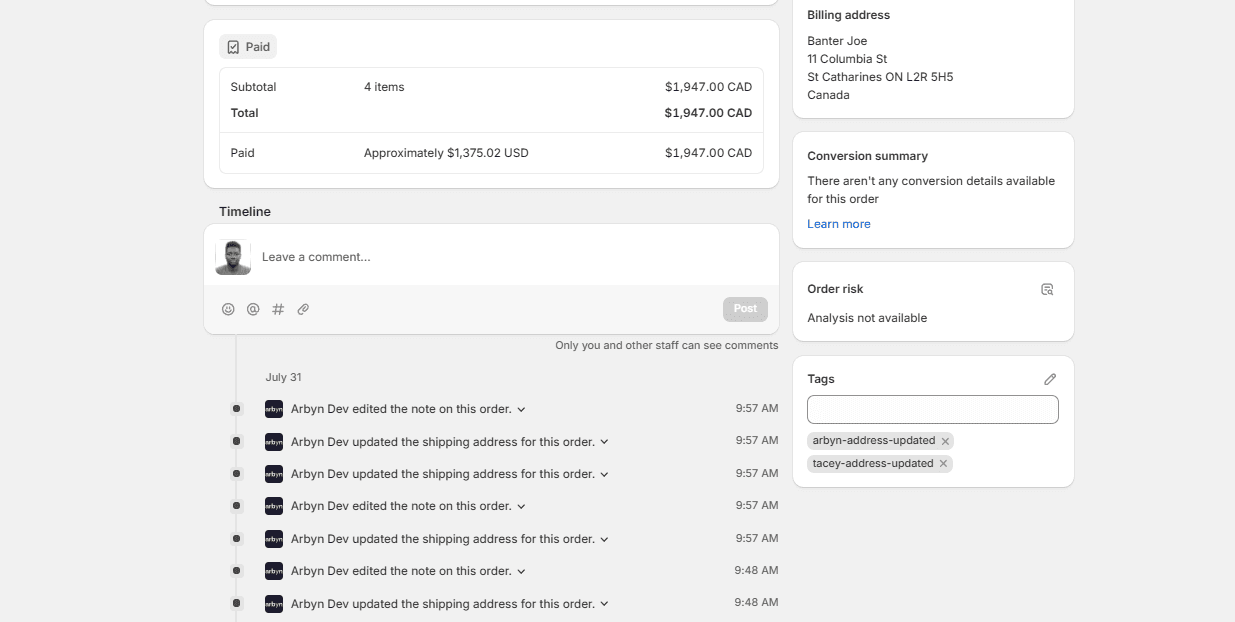
An order inside Shopify is more than its current status or a simple line item in your reporting. Beneath the surface of "Fulfilled" or "Paid" lies a detailed, second-by-second history of every event that shaped its journey, from the customer’s first click to the final delivery scan. This internal ledger, the order timeline, is the central nervous system of your operation, tracking payment gateway responses, fraud analysis flags, fulfillment updates from your warehouse, and internal staff notes to create a complete, chronological record. For most stores, this timeline is a straightforward history of human actions and system events. But when third-party applications, especially AI agents, begin to operate on your behalf, this timeline takes on a new and critical importance. An app that can change a shipping address, cancel an order, or issue a discount without leaving a clear, attributable footprint in this central ledger creates a dangerous blind spot, turning a transparent record into a source of confusion. Understanding what your tools are doing, and what record they leave behind, is fundamental to maintaining control over your own operations.
The core issue is one of accountability and, by extension, trust. When an AI agent acts, who is the witness? If a customer's order is incorrectly modified and the app that did it leaves no trace, your support team is left guessing in a high-stakes moment. They are forced to navigate multiple app dashboards, cross-reference time stamps, and attempt to reconstruct a sequence of events that should have been clear from the start, all while a frustrated customer waits. This operational friction is more than an inconvenience; it directly erodes trust, both from your customers and within your own team. The danger is real and quantifiable; according to a 2024 analysis by SecurityScorecard, a staggering 35.5% of all data breaches originated from compromises at third-party vendors and applications. While not all unlogged actions are malicious, the principle holds: an unlogged action is an unaccountable one. This lack of a unified audit trail turns your Shopify admin from a single source of truth into a fragmented system where critical information is missing, forcing your team to piece together a story that the platform was designed to tell coherently.
This is why Arbyn’s approach to arbyn order timeline logging is a foundational element of its design, not an afterthought tacked on to a feature list. The principle is simple yet powerful: every single action Arbyn performs on an order is written directly to that order's timeline as a permanent, timestamped comment. Whether the AI autonomously updates a shipping address based on a customer email or processes a cancellation after you approve it with a single click, the action is recorded in the same place your team would leave a manual note. The entry clearly states what was done and that Arbyn did it, using plain English. This transforms the AI from a black box into a transparent team member, whose work is fully audited and visible within the native Shopify environment you use every day. This isn't about adding more notifications or another dashboard to check; it's about deeply integrating AI actions into the authoritative system of record that store owners already rely on, ensuring there is never a question of who did what, or when.
The Hidden Risks of Unrecorded App Actions
In the bustling ecosystem of the Shopify App Store, where store owners can choose from thousands of applications, tools are installed to automate tasks, enhance marketing, and streamline operations. Yet, this convenience comes with inherent risks, particularly when apps are granted permissions to modify core business data like orders and customer information. A primary danger lies in the lack of visibility. When an app makes a change, for example, automatically swapping an out-of-stock item for a similar one, without logging that action to a central, immutable record, it creates an operational black hole. Your team, looking at the order, sees a state but not the event that led to it. This obscurity is a breeding ground for costly errors, customer frustration, and hours of wasted investigative work. A customer might complain they received the wrong product, and without a clear log, your support agent sees the swapped item on the order and assumes the customer made a mistake, leading to a frustrating standoff that damages brand credibility and likely ends in a costly appeasement like a refund or free replacement.
This lack of integrated logging is more than just a support headache; it's a significant security and compliance vulnerability. Regulations like GDPR and PCI DSS demand strict control and traceability of data handling, meaning you must be able to demonstrate who accessed or modified sensitive information and when. An app that modifies customer or order data without leaving a clear audit trail can put a store in a precarious compliance position during an audit. This risk is not theoretical. Industry analyses consistently show that third-party vendors are a major vector for security incidents. A 2024 report from SecurityScorecard found that third-party compromises were the root cause of 35.5% of all data breaches, an increase from the prior year. When an app has `write_orders` permissions, it holds the keys to a critical part of your kingdom. If its actions are not meticulously recorded within Shopify's own audit trail, you have no way to effectively monitor its behavior, detect anomalies, or provide evidence to regulators about how and when data was changed, creating a scenario where you are responsible for the actions of a tool whose work you cannot fully supervise.
Furthermore, the operational cost of this information gap is substantial and erodes margins daily. Consider the time your team spends trying to reconcile an order's state with a customer's complaint. Every minute spent toggling between the Shopify admin and an external app's dashboard is a minute not spent helping another customer. Research shows that this "context switching" can significantly slash productivity as the brain struggles to re-engage with a new task. This inefficiency scales directly with order volume. If an agent wastes just three minutes per ticket on five tickets a day, that’s over an hour of lost productivity per week. For a support team of five people, you are losing over a full workday of productivity every single week just to informational scavenger hunts. With support team salaries representing a major expense, this hidden cost quickly runs into tens of thousands of dollars annually. Without a single, unified timeline that records every touchpoint, your business lacks a definitive system of record, forcing your team to rely on fragile and unscalable solutions like institutional memory and guesswork.
How Arbyn Logs Every Action to the Order Timeline
Arbyn was built on the premise that an AI agent should function as a transparent and accountable member of your team, not as an opaque external service. This philosophy is directly implemented in its rigorous, non-negotiable approach to logging. For every order-related task it executes, Arbyn writes a clear, human-readable comment directly to that specific order's timeline within the Shopify admin. This is not a separate log file hosted on an external server or a proprietary activity feed you have to hunt for within the Arbyn app itself. It's a native Shopify timeline comment, identical in format to one a human staff member would post. This deliberate design choice ensures that the complete history of every order, including all AI interventions, lives in one consolidated, chronological, and authoritative place. There is no ambiguity. The timeline becomes the single source of truth for your entire team, radically simplifying diagnostics, enhancing collaboration, and eliminating the "who did what?" confusion that plagues stores using less integrated tools.
The scope of this logging is comprehensive, covering every capability where Arbyn interacts with the Shopify Order API and leaving no room for guesswork. This includes both fully autonomous actions and those that require store owner approval for an added layer of security. For instance, when a customer emails to correct a typo in their shipping address, Arbyn can parse the unstructured request and update the address on the order automatically. The moment it does, a comment is posted to the timeline: "Shipping address updated by Arbyn AI." The same rigorous process applies to actions that are gated by your approval for financial security. If Arbyn identifies a request to cancel an order, issue a partial refund for a damaged item, or create a unique discount code as an apology, it will present it to you for a one-click approval. Once you approve it, Arbyn executes the action and immediately logs it with precision: "Order canceled by Arbyn AI upon approval. Reason: Customer request," or "Refund of $24.50 issued by Arbyn AI upon approval for damaged item." This two-step approve-and-log process ensures you retain full control over money-moving actions while still benefiting from a complete and transparent audit trail.
This detailed, native logging serves a critical diagnostic and operational purpose, especially as your team grows. Suppose a customer inquiry is more complex than it first appears, requiring an escalation from a junior to a senior support agent. The senior agent can instantly review the order timeline in Shopify and see every action Arbyn has already taken, providing immediate and complete context. They don't need to ask the customer to repeat themselves or switch to another application to understand the history; they can see that Arbyn already updated the address, started a return, or processed an approved cancellation. This seamless handover of context is crucial for operational efficiency and for providing a coherent, professional customer experience. The log entry itself is designed for maximum clarity, stating the action taken in plain English and attributing it to "Arbyn AI." This deliberate choice demystifies the AI's role, treating it not as an opaque external force but as an integral part of the operational workflow, subject to the same standards of documentation and accountability as any human employee.
The Operational Payoff: A Single Source of Truth
Adopting a tool with meticulous, native logging practices delivers immediate and compounding benefits to a store's day-to-day operations. The most significant payoff is the establishment of a single, unimpeachable source of truth for every order. When your AI agent, your support staff, and your fulfillment team all reference and contribute to the same Shopify order timeline, ambiguity evaporates. Imagine a customer contacts you, confused about why their order was partially refunded. Instead of a frantic search through your payment gateway, your support desk's private notes, and a separate app's dashboard, your agent simply opens the order in Shopify. They immediately see a timeline entry: "Partial refund of $15.99 for 'Blue T-Shirt - Large' issued by Arbyn AI upon approval. Reason: Item out of stock." The what, why, who, and when are all present in one place. This enables the agent to give a confident, accurate response in seconds, not minutes, which is critical when research shows many consumers will leave for a competitor after just one bad service experience.
This level of clarity directly translates into heightened accountability for the entire operation, creating a culture of ownership rather than finger-pointing. It becomes trivially easy to distinguish between an action taken autonomously by AI, an action approved by a specific team member, and a manual change made by another. This is invaluable for training, quality assurance, and process improvement. If a pattern of unnecessary discounts is emerging, the timeline provides the data to see if they are being initiated by the AI or approved too liberally by a new staff member, turning subjective performance reviews into objective, data-driven conversations. This accountability extends to the AI itself. By reviewing the timeline, store owners can get a clear, unbiased view of the decisions Arbyn is making and the actions it's taking on their behalf. This transparency builds trust in the automation, allowing you to confidently expand its responsibilities over time because you have a complete and verifiable record of its performance, turning the AI from a tool you "set and forget" into one you can actively manage and optimize.
Ultimately, this unified approach fosters a more efficient and less stressful work environment for your human team. The cognitive load of remembering which app does what, and where to find its logs, is eliminated. New hires can onboard faster because the central workflow they need to learn is the Shopify admin itself, not a constellation of third-party interfaces with different logins and layouts. The time saved from hunting down information is reallocated to higher-value tasks: providing empathetic customer support, identifying cross-sell opportunities in customer conversations, or improving internal processes based on recurring issues. When your systems are transparent and your data is consolidated, your team is empowered to be proactive rather than reactive. They can solve problems at their root instead of constantly fighting fires sparked by informational gaps. A commitment to comprehensive arbyn order timeline logging is therefore not just a technical feature; it is a strategic investment in operational stability, team efficiency, and the long-term scalability of your customer experience.
From Theory to Practice: What Logging Looks Like
To move from the abstract benefit to the concrete reality, let's walk through two common scenarios where Arbyn’s timeline logging provides indisputable clarity. These examples illustrate how the feature functions in both fully autonomous and approval-gated situations, demonstrating the consistent transparency that underpins the entire system. In both cases, the result is a permanent, easily understood entry in the one place your team already works: the Shopify order timeline. This practical application is what separates a theoretical benefit from a tool that genuinely simplifies your daily operations. It provides a clear audit trail that requires no extra effort from you or your team to maintain, because the system is designed to surface crucial information automatically, embedding a rigorous standard of accountability directly into your existing workflow and providing the documentation you need to resolve any future dispute with confidence.
First, consider a fully autonomous action: a shipping address update. A customer places an order but quickly realizes they mistyped their street number in a moment of haste. They reply to their order confirmation email, writing, "Hi, I messed up my address! Can you please change it to 123 Main Street, not 132 Main Street?" Arbyn, monitoring the support inbox, understands the intent. Because changing a shipping address is not a money-moving action, it can proceed without manual approval. The AI validates the new address format and executes the change directly on the Shopify order object using the API. Instantly, two things happen. The customer receives an email confirming the address has been corrected. Simultaneously, a new entry appears on that order's timeline inside your Shopify admin. It reads: Comment posted by Arbyn AI. Shipping address updated from 132 Main Street to 123 Main Street based on customer request. Your team, without lifting a finger, now has a permanent, timestamped record of exactly what was changed, why it was changed, and who made the change. If that package goes missing weeks later, there is zero ambiguity about which address it was sent to, protecting you from claims of mis-shipment.
Now, let's examine an approval-gated action: an order cancellation. A customer emails, "I'd like to cancel my order #54321, please." Arbyn understands the request and sees that the order has not yet been fulfilled. Because canceling an order has direct financial implications, it is automatically flagged for human approval as a critical safeguard. In your Arbyn dashboard, you see a clear, low-friction prompt: "Cancel Order #54321 and issue a full refund?" You click "Approve." Arbyn then immediately performs two actions via the Shopify API: it cancels the order and processes the full refund through your configured payment gateway. As soon as the API calls complete successfully, a definitive comment is written to the timeline for order #54321: Comment posted by Arbyn AI. Order canceled and a full refund of $89.50 was issued upon approval. Reason: Customer request. This simple, clear log entry is the final word on the matter. It prevents any possibility of the order being accidentally fulfilled by your warehouse team and provides your finance team with a clear, unambiguous record for reconciliation, eliminating inter-departmental confusion.
Beyond Automation: Building Trust Through Transparency
The conversation around AI in commerce often centers exclusively on efficiency, speed, and cost reduction. While these are crucial benefits, they overlook a more fundamental element required for sustainable success: trust. Store owners are not just handing over repetitive tasks; they are entrusting significant parts of their business and their hard-won customer relationships to a third-party application. This requires a profound level of confidence, a confidence that cannot be built on marketing claims or feature lists alone. It must be earned through demonstrable transparency and unwavering accountability in every action. This is where a feature like comprehensive order timeline logging transcends its practical utility. It becomes a statement of principle. It signals that the AI is not a mysterious black box but a tool designed to operate in the open, subject to the same scrutiny and standards as any other part of your operation, including your human team members.
This radical transparency is the antidote to the legitimate anxieties many store owners feel about deploying AI. The fear of an autonomous agent "going rogue", issuing unauthorized refunds, changing orders incorrectly, or communicating off-brand messages to customers, is a significant and rational barrier to adoption. A system that logs every single action directly into the Shopify admin provides a powerful and intuitive check and balance. It gives the store owner a simple, effective way to supervise the AI's work without needing to become an expert in API calls or log parsing. A quick scan of recent order timelines provides a complete, unbiased picture of the AI's activity. This continuous, passive oversight builds confidence and allows for a gradual, controlled expansion of the AI's role. You can start with simple, non-financial tasks and, as you verify its reliability through the timeline logs, progressively grant it more responsibility, building trust not in a single leap of faith, but through the accumulation of positive, verifiable evidence day after day.
Ultimately, the goal of a tool like Arbyn is not to replace the human element of your business, but to augment it and make it more effective. A transparent AI frees up your team from the repetitive, low-value tasks that cause burnout, so they can focus on the uniquely human aspects of commerce: building relationships, creative problem-solving, and driving strategic growth. But this can only happen if the team trusts the tool they are working alongside. When your support staff knows they can rely on the order timeline for a complete and accurate history, they can collaborate with the AI instead of second-guessing it. This fosters a healthier, more efficient operational culture where technology serves people, not the other way around. The decision to write every action into the permanent record is therefore a decision to prioritize the human experience, both for your customers and for your own team. It's an understanding that the best automation doesn't just make things faster; it makes things clearer. If you're ready to see how a truly transparent AI can fit into your operations, you can install Arbyn from the Shopify App Store and see the clarity for yourself.
Written by
For seven years I have led customer success and technical support inside high-growth SaaS and e-commerce companies. Customer Support Lead at DripShop.live, a live-commerce SaaS. Technical Support Specialist at Replo (Y...
View full profile