What AI Support Tool Should a Small Shopify Store Use? An Honest Rundown
For a small Shopify store, the wrong AI support tool can quietly become your biggest unexpected expense; here’s how to choose the right one without getting burned by hidden fees.


It’s the end of the month, and you’re methodically reviewing invoices, ticking off the expected costs of running your business. The Shopify bill is what it is, a fixed and familiar line item. The Klaviyo bill, scaling predictably with your subscriber list, is understandable. Then you open the invoice for your customer support platform, and you notice an unexpected financial hit. The base fee is there, as expected, a comfortable number you budgeted for. But stacked on top is a bewildering list of overages, per-resolution charges, and usage fees that has doubled, or even tripled, the cost you thought you were paying. This moment is a quiet, frustrating rite of passage for thousands of store owners. You invested in a tool to make life easier and more efficient, but its very business model seems designed to punish you for every bit of success you have. If you’re looking for a recommendation for an AI support tool for your small Shopify store that doesn’t hide its real cost in the fine print, you’re asking the right, and increasingly urgent, question. The answer isn’t about finding more bells and whistles; it’s about finding a more honest business model that treats your growth as a shared goal, not a billing opportunity.
The Hidden World of Per-Resolution Pricing
When you start shopping for an AI support tool, the marketing promises a utopian world of automated efficiency and effortless customer delight. What this glossy presentation often obscures is a pricing model engineered to grow erratically and unpredictably with your business, turning a tool of efficiency into a source of financial stress. The most common structure you'll encounter is a combination of a monthly base fee and a usage-based component, a model that sounds perfectly reasonable on the surface. However, the devil is buried deep in the details of what "usage" actually means. For many of the biggest names in the space, your final bill is a complex and volatile cocktail of tiered plans, strict ticket limits, and, most elusively, per-resolution fees. This structure creates a direct and unavoidable conflict of interest: the better the AI performs at its core job of resolving customer issues, the higher your invoice climbs. It’s a fundamentally misaligned system where your tool’s success becomes your budget’s problem, a harsh reality that catches countless dedicated store owners completely by surprise, turning their peak sales months into periods of financial anxiety.
Let's look at the real, concrete numbers that illustrate this problem. Gorgias, a dominant and powerful player in the Shopify ecosystem, structures its pricing around a finite number of "billable tickets." A plan like their Pro tier might cost around $300 per month for what seems like a generous 2,000 tickets. However, the automation and AI features are a separate, additional charge. Gorgias' own pricing page prices this as an "automated interaction": each plan includes an allowance (30 on Starter and Basic, 190 on Pro, 530 on Advanced) and every one past it costs $1.50. Rates read on gorgias.com/pricing on 27 July 2026. Crucially, that AI resolution often also counts as one of your billable tickets, a "double-billing" mechanic where you pay for the AI's work and it consumes the ticket allowance you already paid for, causing costs to spiral faster than anticipated. Go over your included ticket limit during a successful promotion, and you face punitive overage charges of around $36 to $40 per 100 extra tickets. A sudden, positive spike in customer questions during a flash sale doesn’t just mean more revenue; it means a punishing support bill is waiting on the other side, transforming a business win into a budget crisis. This is precisely how a store owner expecting a $300 bill can suddenly face an invoice for hundreds more, leaving them feeling penalized for their own growth.
This frustrating model isn't unique to a single platform; it's an industry trend. Intercom, with its powerful AI agent, charges a widely advertised price of $0.99 per resolution, a fee that applies after a small number of initial resolutions. This is on top of their seat-based plans, which start at $39 per seat and can require a significant upfront platform fee. Zendesk operates with even more convoluted layers; a store owner pays for the base plan per agent (e.g., Suite Team at $55/agent/mo), a mandatory AI add-on (like their Advanced AI for $50/agent/mo), and then a per-resolution fee on top of all that, which multiple sources report is around $1.50 per AI resolution. For a small team of two, this can mean over $200 per month before a single customer has even been helped. Tidio, another popular choice, presents an affordable entry point with plans around $29/month, but its AI is a separate add-on. This add-on starts at around $39 per month for a mere 50 AI conversations, a limit a growing store could burn through in a single weekend. The pattern is painfully clear: the advertised price is rarely, if ever, the real price. The true cost is a volatile, variable figure that scales in ways that are difficult to forecast and even harder to control, undermining the very stability that small businesses need.
Why Free Native Tools Don't Solve the Core Problem
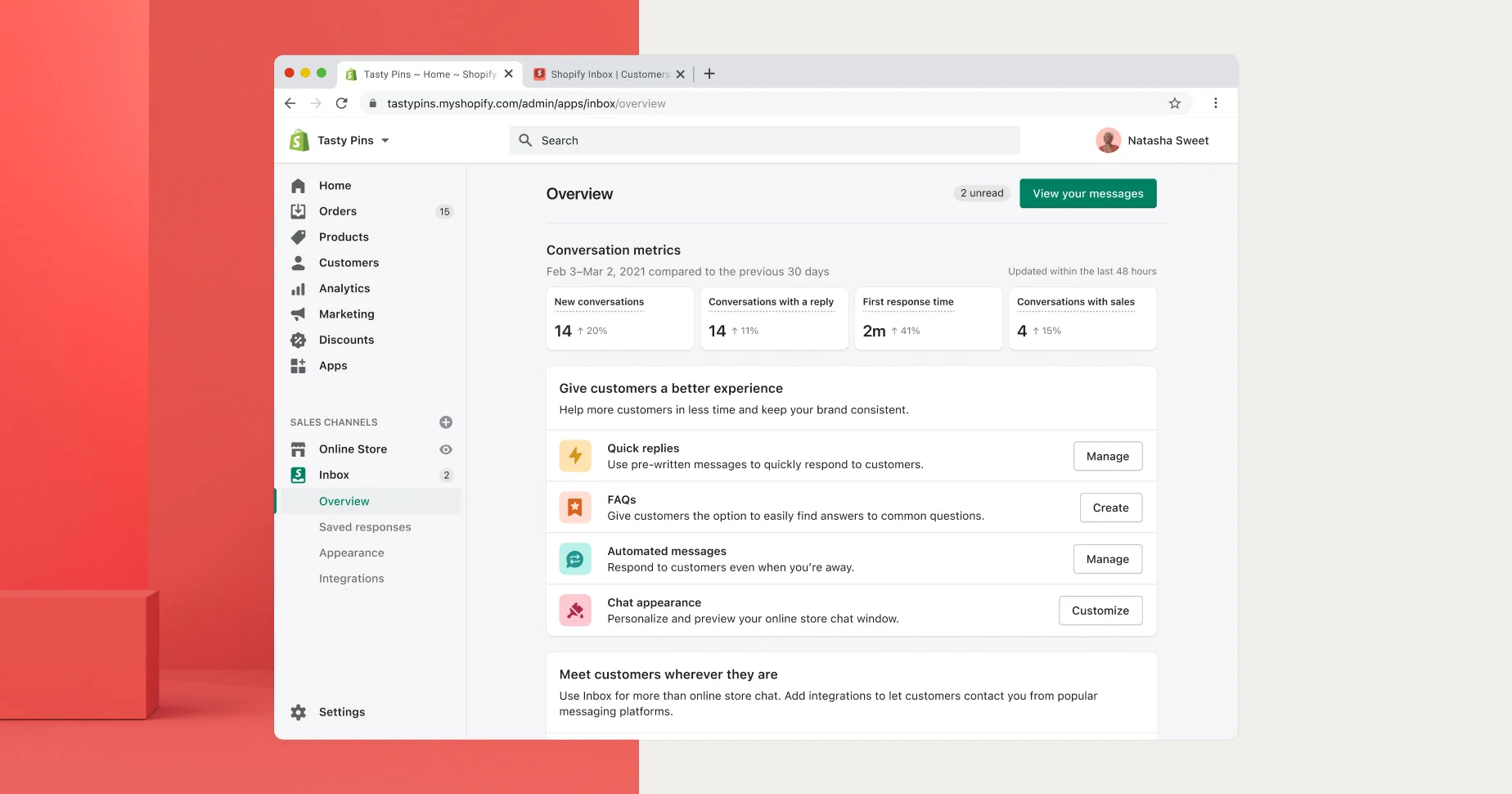
Faced with the unpredictable costs and complex billing of advanced helpdesks, many small store owners understandably turn to the tools that are already built into their world, chief among them Shopify Inbox. It’s free, it’s seamlessly integrated, and it’s available with a single click right within the familiar Shopify admin environment. For a brand just starting out and shipping its first hundred orders, it feels like the obvious, financially prudent choice. It allows you to chat with customers in real-time, see what’s in their cart, and even send product links or discount codes directly in the conversation without leaving the page. For basic, one-on-one conversations about product details or shipping times, it absolutely works and provides a crucial layer of professionalism. It’s a massive and necessary improvement over handling all customer support from a personal Gmail or Hotmail account, providing a degree of organization that is essential in the early days of building a business and establishing trust.
However, as a store grows from a side project into a real business, the inherent limitations of a tool like Shopify Inbox become a significant operational bottleneck, capping your efficiency. The core issue is that it's fundamentally a messaging app, not a true automation engine designed to reduce your workload. While it has some basic automated greetings and can leverage its AI to generate instant answers from your FAQs or provide suggested replies to common questions, it crucially cannot take independent action on behalf of the customer. It can’t process a return, cancel a pending order, apply a discount to an existing order, or update a shipping address. Every single one of those requests, which make up a huge percentage of the day-to-day support volume for any e-commerce store, still requires direct, manual intervention from you or your staff. The AI can suggest what to say, but you still have to navigate to a different part of the Shopify admin and perform the task yourself. This creates a hard ceiling on efficiency; you’re not truly automating support, you’re just getting a slightly faster way to handle it manually, which isn't a scalable solution.
Furthermore, the channel limitations of a free tool like Shopify Inbox inevitably create fragmentation and a disjointed workflow. It capably handles live chats originating from your website and messages from Facebook Messenger, but it does not integrate support emails, Instagram DMs, or product questions from other social platforms into a single, unified inbox. This forces your team to constantly switch between browser tabs, email clients, and various social media apps, attempting to piece together a customer's history and prior interactions. This isn't just inefficient; it's a proven recipe for slow responses, inconsistent service, and frustrating customer experiences where they have to repeat their issue multiple times. The lack of robust reporting also means you have no real data on your team's performance or customer satisfaction. You're flying blind, unable to track metrics like first-response time, resolution time, or common issue types. The "free" tool saves you money on a software subscription, but it costs you dearly in your most valuable and finite asset: your time. You remain the essential human-in-the-loop for every meaningful action, which is precisely the problem that powerful AI support tools are supposed to solve.
The store owner's Consensus: What Reddit Threads Actually Recommend
When you move past the polished marketing websites and venture into the digital trenches where actual store owners trade unfiltered advice, places like Reddit's r/Shopify and r/ecommerce, a dramatically different picture emerges. Here, the conversation isn't about flashy feature lists, animated demos, or abstract AI hype. It’s about the gritty reality of total cost of ownership, budget predictability, and whether a tool genuinely reduces an owner's workload or just creates a new, more expensive kind of busywork. The recurring, dominant theme in thread after thread is a deep-seated frustration with billing models that actively penalize growth and success. A store owner will post a screenshot of their shock at a massive Gorgias overage bill after a holiday sale, and the comments will immediately fill with dozens of others sharing similar experiences with different platforms. The store owner consensus is clear: the advertised base prices for many popular helpdesks are a fiction once you cross a certain threshold of monthly customer conversations, serving more as a marketing lure than a realistic budget estimate.
The practical advice that surfaces from these candid, hard-won discussions is remarkably consistent and focused on financial self-preservation. First, experienced store owners passionately recommend looking past the headline monthly plan price and taking the time to calculate the "all-in" cost at a realistic future scale. They advise against using your current, quiet-month numbers. Instead, ask: what does this tool actually cost at 500 conversations a month? At 2,000? At 5,000, during my Black Friday peak? This requires digging into the fine print on support documents to find the exact overage fees and per-resolution charges. The community wisdom is to model your costs based on your busiest month, not your average one, because that’s when punitive, usage-based pricing models do the most financial damage. The goal universally shared by seasoned owners is budget predictability. The overwhelming sentiment is that they would rather pay a slightly higher, flat monthly fee that they can count on than be subjected to a low-entry, variable bill that can explode without warning and erase their profit margins.
Second, the community of store owners strongly and consistently advocates for tools that can perform real, tangible actions within the Shopify admin. There's a deep and earned skepticism toward "AI" that only answers basic "Where is my order?" (WISMO) questions or pulls generic answers from a knowledge base. The real value, as echoed in these store owner-to-store owner discussions, comes from an AI agent that can actually process a return request based on your store's policy, issue a refund (with your one-click approval), or change a shipping address for a customer. This is the critical dividing line between a simple FAQ chatbot and a true automated support agent. A tool that just escalates every action-oriented request to a human isn't seen as a solution; it's just a more sophisticated and expensive triage system. The core recommendation is to find an AI that meaningfully reduces the number of tasks in your own personal to-do list, not just the number of unread messages in your support inbox. The ultimate goal is to buy back your time.
A Framework for Choosing the Right AI Support Tool
Navigating the crowded and often confusing market for an AI support tool requires a clear-eyed, disciplined strategy, not a demo-driven impulse decision. Instead of getting dazzled by long feature lists or slick user interfaces, you must ground your evaluation in the operational and financial reality of running your small Shopify store. The right tool isn't just about what it can do in a perfect demo environment; it's about how its business model aligns with yours when the pressure is on. You need to use a framework of critical questions to cut through the marketing noise and find a genuine partner that will help you scale efficiently, not penalize you for it. This isn't a simple checklist of features, but a tough-minded lens through which to view any potential solution, ensuring you make a choice that serves your business for the long haul by protecting both your time and your profit margins.
First, and most critically, you must build a total cost model for any tool you consider. Completely ignore the headline price on the main pricing page, as it is often misleading. Demand the full, detailed cost structure. What is the base fee? What are the exact conversation or ticket limits for that fee? What is the precise cost of each ticket or conversation that goes over that limit? Is there a separate, additional fee for AI-resolved conversations? If so, does that AI resolution also consume one of the precious tickets from your base plan allowance? Model this out in a spreadsheet for your current average volume, your projected volume in six months, and, most importantly, the actual customer support volume from your last Black Friday or major sales event. The goal is to uncover the true, all-in cost per conversation. An established industry benchmark for the average e-commerce support interaction is between $2.70 and $5.60 when handled by a human. If your all-in cost with an AI tool approaches or exceeds this range, you are losing the entire financial argument for automation. A predictable, flat-rate price, even if it seems higher initially, is almost always superior to a low entry price with volatile, usage-based overages that create budgetary chaos.
Second, you must rigorously interrogate the vendor's definition of "automation" and "resolution." When a salesperson claims their AI can "resolve" a customer's issue, you need to ask what that specifically means in practice. Does it mean the AI provides an answer from a help document and closes the ticket, or does it mean the AI performs a tangible, administrative action in your Shopify store admin? Can the tool, with your explicit, one-click approval, actually process a refund, cancel an unshipped order, or start a return process by generating a label? Many tools deceptively use the term "resolution" to describe a simple informational response, leaving all the actual administrative work on your plate. This is the most critical distinction you need to clarify. You are not looking for a glorified FAQ bot. You need an operational partner that reduces your workload. Demand to see a list of the specific Shopify actions the agent can perform, and clarify which of those are fully autonomous versus which ones wisely require a one-click approval from you. The latter is not a weakness; for money-moving actions, an approval gate is a critical safety feature that demonstrates a mature platform. The real weakness is a tool that can only escalate, leaving you to do the real work.
Arbyn’s Answer: A Flat Rate for Unlimited Conversations
The overwhelming complexity and fundamental unpredictability of prevailing pricing models are the exact problems we built Arbyn to solve. We are store owners ourselves, and we saw a landscape where our peers were being systematically punished for their own growth, where the very tools meant to save them money were becoming a primary source of financial anxiety and frustration. Our approach starts with a simple, store owner-first premise: your support costs should be as predictable as your Shopify subscription. That’s why we offer two straightforward, transparent plans. The Arbyn Starter plan is permanently free, giving you up to 150 full AI conversations per month with every single feature included. It’s designed for new stores or those with lower volume to get powerful, action-oriented support automation from day one, without any upfront investment or risk. You get a real AI agent that does more than just chat; it learns your unique brand voice from your site and past conversations, and it handles customer issues completely across both email and live chat.
When your store’s growth accelerates and you surpass 150 conversations a month, you don't hit a wall of confusing overage calculations or punitive per-resolution fees. You simply and seamlessly move to a single, clear plan: Arbyn Agent. For a flat, consistent rate of $99 per month, you get unlimited conversations and unlimited seats for your team. That’s it. Whether you have 200 customer conversations or 20,000 during a record-breaking holiday season, the price does not change. There are no hidden fees, no ticket caps, no AI resolution surcharges, and absolutely no penalties for being successful. This model fundamentally aligns our business with yours in a true partnership. We only succeed if you grow to a scale where paying a predictable flat monthly fee makes obvious financial sense for your operation. We don't profit from your peak season traffic spikes or from our own AI's efficiency. The price is the price, full stop. This provides the budget predictability and peace of mind that growing stores so desperately need to manage their cash flow and invest confidently in their future.
Critically, Arbyn is designed from the ground up to take real, meaningful action within your store, moving beyond just answering basic questions. For routine but time-consuming tasks like updating a customer's shipping address before an order is fulfilled, Arbyn can handle it autonomously based on your preset rules. For more sensitive, money-moving actions like issuing a refund, processing an order cancellation, or starting a return, Arbyn intelligently queues up the proposed action for your direct approval. With a single click in your dashboard, "Approve", you give the green light, and Arbyn instantly performs the action within Shopify and confirms it to the customer automatically. You don't have to go into your admin, find the order, and do it yourself. This workflow provides the crucial middle ground between risky, full autonomy and inefficient, manual escalation. It keeps you in complete control of your money while still removing the actual administrative work from your plate. It’s an AI support and sales agent that handles the complete task, built on a business model you can actually understand and trust. You can install it for free directly from the Shopify App Store and see the difference for yourself.
Ultimately, the decision of which AI tool to use rests on a simple but profound question of alignment. Does the tool’s success contribute directly to your bottom line, or does it actively detract from it? The right AI support tool for a small but ambitious Shopify store is not the one with the longest feature list, the biggest marketing budget, or the most aggressive sales team. It is the one with the most honest, transparent, and predictable pricing model that fosters a true partnership. Your support platform should be a fixed, reliable cost that empowers your growth and frees up your time, not a volatile, variable expense that complicates your finances and punishes your success. The right tool allows you to focus on what you do best: building an incredible brand that customers love.
Written by
For seven years I have led customer success and technical support inside high-growth SaaS and e-commerce companies. Customer Support Lead at DripShop.live, a live-commerce SaaS. Technical Support Specialist at Replo (Y...
View full profile