Visual Search on Shopify: How Shop-by-Photo Turns a Screenshot Into a Sale
A customer's screenshot is a high-intent search query that most stores can't answer, but visual search turns that lost signal into a direct sale.

A customer is scrolling through their social feed on a Tuesday morning and sees it: the perfect armchair. It’s in a high-resolution photo of a stranger’s beautifully curated living room, a space that feels both aspirational and achievable, but it has no shopping tags, no brand mentions, and no helpful links. They immediately take a screenshot. That single image file on their phone represents a clear, powerful, and specific moment of peak purchase intent. It’s a direct signal from a motivated buyer saying, “I want to buy something that looks exactly like this, and I am ready to pay for it now.” They remember your store sells high-quality home goods, so they navigate to your site, screenshot in hand, ready to give you their money. On your homepage, they’re met with a search bar and a blinking cursor, a tool from a different era. What do they type? “Mid-century modern armchair with light wood and grey upholstery”? “Retro-inspired lounge chair with curved arms”? “Cozy Scandinavian reading chair for a small apartment”? The vocabulary gap between their visual desire and the required text input is immense and frustrating. After a few attempts that yield hundreds of vaguely related products, they bounce, likely for good. The screenshot remains on their phone, a digital ghost of a sale that never happened. For most Shopify store owners, this is a daily, invisible, and deeply costly loss of revenue. That high-intent signal from the screenshot vanishes into the ether because traditional, text-based search is fundamentally mismatched with how modern customers discover and desire products. This is the costly chasm that visual search on Shopify is designed to close, turning a simple photograph into your most effective and profitable search query.
The Fundamental Mismatch: Visual Inspiration in a Text-Based World
The modern path to purchase no longer begins on a product page or even a search engine; it begins with an image that sparks a desire. Whether on Pinterest, Instagram, TikTok, or a friend’s photo stream, product discovery is an overwhelmingly visual and social activity that happens organically in the flow of daily life. Customers see things they want in the wild, in their intended context, and their first instinct is to capture that moment visually for future reference. The numbers confirm this shift is not a niche behavior but a mainstream expectation that has been solidified. As of mid-2026, Google Lens is already processing nearly 20 billion visual searches every single month, with a quarter of those having clear commercial intent, meaning billions of searches are from people looking to buy. Likewise, Pinterest’s own Lens feature fields hundreds of millions of visual queries monthly from a user base actively looking for inspiration and products to purchase. This behavior is not confined to tech giants; it’s a learned instinct that customers now bring to every digital interaction. They have been trained by the internet’s largest players to believe that if they can see it, they should be able to search for it with a picture. When they arrive at your Shopify store, they expect that same intuitive capability, and a growing number of consumers now consider it a standard feature, not a novelty.
The core problem is that for decades, ecommerce has been built around a text-based paradigm that is now obsolete. It assumes a customer can and will articulate their complex visual needs using a specific set of keywords that perfectly match the product data. This antiquated process forces the shopper to become a translator, attempting to convert a rich, nuanced visual idea into a crude string of text. This translation is fraught with friction and failure. Words are ambiguous and deeply personal. Is it a "blouse" or a "top"? "Cerulean" or "sky blue"? "Paisley" or "boho floral"? This is what is known as the 'keyword gap', the struggle to describe something you can see but cannot name. This gap is especially pronounced in visually complex categories like fashion, home decor, and jewelry, where attributes like pattern, texture, silhouette, and style are difficult to verbalize but instantly recognizable to the human eye. According to product marketing platform Justuno, an overwhelming 93% of consumers consider visual appearance to be the key deciding factor in a purchasing decision. When your store’s primary discovery tool, the search bar, ignores the visual information that customers value most, it creates a frustrating experience that leads directly to abandoned sessions and lost sales. The customer isn't just browsing; they are on a specific hunt, and a text box is an inadequate tool for the job.
How Visual Search Bridges the Chasm from Photo to Product
Visual search technology directly resolves the friction of the keyword gap by changing the nature of the question. Instead of asking a customer to describe an image with clumsy words, it allows them to use the image itself as the query, communicating their exact intent with perfect fidelity. From the user’s perspective, the experience is simple, intuitive, and feels almost magical. They tap a camera icon next to the search bar, upload their screenshot or snap a photo, and are instantly presented with a grid of visually similar products from your catalog. This process is powered by a sophisticated pipeline of artificial intelligence technologies, primarily computer vision and deep learning. When an image is uploaded, it isn’t being matched based on file names or manual tags. Instead, a complex neural network analyzes the image at a pixel level. This model, which has been trained on millions of images to understand aesthetics, breaks the image down into its core components, identifying the precise curve of a chair leg, the specific knit of a sweater, the exact shade of blue in a rug, and the overall distribution of colors and shapes. It then converts this complex visual information into a high-dimensional numerical vector, a piece of data known as an "embedding." This embedding is a unique mathematical representation of the image's aesthetic DNA.
The real power of the system lies in the next step, which happens before a customer ever visits your site. The visual search engine has already performed this same intensive analysis for every single product image in your store's catalog, creating a searchable database of these vector embeddings. When a customer uploads their inspiration photo, the system computes its vector and then performs a similarity search across your entire catalog's vector space, a process that happens in less than a second. Using highly efficient algorithms like approximate nearest neighbor search, it finds the product vectors that are mathematically closest to the query vector. The products corresponding to these "closest" vectors are the ones that are most visually similar to the item in the customer's photo. This is fundamentally different and superior to a system based on manually entered tags, which could never capture the full nuance of an image and are impossible to scale. A human would have to write dozens of tags to describe a single chair, yet they would still miss the subtle interplay of texture, light, and form. The result is a page of products that don’t just match a keyword, but match a feeling, a style, and a specific visual intent. It’s the difference between asking “Do you have any blue floral dresses?” and showing a photo of the exact dress and asking, “Do you have this?” The latter is a far more powerful and direct path to a sale.
From "That's Cool" to "That's Profitable": The Measurable Impact of Visual Search
Implementing a new technology can often feel like a speculative bet, but the business case for visual search is grounded in hard metrics and measurable improvements across the entire ecommerce funnel. Store owners who adopt visual search are not just adding a novelty feature; they are deploying a proven revenue-driving tool that directly impacts the bottom line. The data consistently shows that when you reduce friction in product discovery, you increase conversions. Multiple analyses and datasets from across the industry converge on this point: retailers who implement visual search see their conversion rates increase significantly. According to a case study with fashion giant PrettyLittleThing, implementing Syte's visual search technology resulted in an 11% increase in overall conversion rate. This lift isn't surprising when you consider the user's intent. A person uploading a specific image is not casually browsing; they are on a mission to find a particular product or style, and they have declared exactly what they want. By providing an immediate and accurate match, you are capturing that high intent at its absolute peak, turning a motivated shopper into a satisfied customer.
The benefits extend far beyond just the final conversion, creating positive ripple effects throughout the shopping experience that lead to higher engagement and larger order values. A core principle of user experience design is that speed and accuracy lead to satisfaction. By allowing customers to find what they want faster, visual search dramatically improves the shopping journey. This speed and accuracy translate directly to a lower bounce rate and longer session durations. Instead of getting frustrated by irrelevant keyword results and leaving, shoppers get immediate, relevant options that encourage them to stay and explore your catalog more deeply. Furthermore, the technology excels at surfacing long-tail products that might otherwise remain buried. A shopper looking for a specific chair might not only find it but also be shown a dozen visually similar options they never would have discovered through keyword filtering. This enhanced discovery process often leads to a significant increase in Average Order Value (AOV). For instance, a case study with clothing brand Joules showed that shoppers who used ViSenze's visual search tools had an AOV that was 26.6% higher than other shoppers. By making your entire catalog more discoverable, visual search ensures that you are maximizing the value of every visitor and every product you sell.
Putting Visual Search to Work on Your Shopify Store
Not long ago, implementing visual search required an enterprise-level budget, a dedicated team of AI engineers, and a multi-quarter project plan. It was a complex, expensive undertaking reserved for the largest players in retail who could afford to build or license the technology at great cost. This involved massive infrastructure for model training, complex data pipelines, and lengthy integration cycles. Today, however, a growing ecosystem of Shopify apps has democratized this power, making this cutting-edge technology accessible to store owners of all sizes. These apps handle the heavy lifting of AI modeling, image indexing, and front-end integration, often with a setup process that takes less than an hour and requires no custom code. When evaluating options, you'll find a range of solutions, from simple, plug-and-play widgets to more comprehensive product discovery platforms. While enterprise solutions from giants like Syte and ViSenze offer deep customization and analytics, they often come with custom, quote-based pricing that is more suitable for large-scale retailers with complex needs and the resources for a more involved integration.
For most Shopify store owners, the best and most efficient starting point is the Shopify App Store, where a number of capable and affordable solutions are available. These apps typically operate on a monthly subscription model, with pricing tiers often based on the number of products in your catalog or the volume of searches performed. It's crucial to look beyond the base price and understand the entire model and the full feature set to ensure it aligns with your growth. Does the app charge per search, which could become costly during peak seasons, or are searches unlimited? Is there a cap on the number of products you can index? Does it offer analytics to show you what your customers are searching for, providing valuable insight into market trends? Critically, does it also offer features like "shop the look" or "shop similar" recommendations on product pages, which leverage the same core technology to further boost sales and AOV? Asking these questions will help you find the right partner for your specific business needs and ensure you are choosing a tool that will scale with you.
| Shopify App | Pricing Model | Key Features |
|---|---|---|
| Visual Search by Vajro | Free plan available, with paid tiers offering unlimited usage. | Unlimited products and searches on the paid plan, widget customization, analytics, mobile app integration. |
| BIRSE: Visual Search | Free plan for small catalogs; paid tiers are based on product count. | Combines image search with keyword predictions, "shop the look" recommendations, and a built-in wishlist feature. |
| Impresee Smart Search Bar | Free plan available for small catalogs, with paid tiers based on product count. | Offers search by image, text, and even by sketch, with unlimited searches across all plans and advanced analytics. |
| Smart Visual Search | Low-cost paid plans based on product count. | Focuses on a simple, one-click setup with a customizable widget and automatic catalog synchronization. |
Choosing the right app depends entirely on your specific needs, catalog size, and strategic goals. A boutique with a small, highly curated catalog might find a simple, low-cost solution to be perfectly adequate for their needs. A larger apparel brand, however, might prioritize features like "Shop the Look" recommendations and detailed analytics on search trends, making a more robust platform a worthwhile investment that pays for itself in increased sales. The critical step is to recognize that not offering a visual search option is quickly becoming a significant competitive disadvantage. The technology is here, it's accessible, and your customers are increasingly expecting it. According to research from the Intent Lab, a majority of Gen Z and Millennial consumers, 62%, want visual search capabilities more than any other new technology. The question is no longer if you should implement visual search, but which solution is the right fit to start turning those screenshots into sales today.
Beyond the Search Bar: Visual AI as a Merchandising Engine
Thinking of visual search as merely a replacement for the text-based search bar is to dramatically underestimate its strategic value for your business. The same underlying AI that powers shop-by-photo can be deployed across your entire storefront to create a more dynamic, responsive, and profitable merchandising strategy. Once the AI understands the visual DNA of your products, it can act as a tireless automated merchandiser, personalizing the shopping experience for every single visitor in real time. This begins on the product detail page, a critical decision point for customers. When a shopper is looking at a specific dress, a "Shop Similar" widget powered by visual AI can instantly display a carousel of other dresses from your catalog that share the same style, pattern, or silhouette. This is a powerful tool for preventing dead ends and reducing bounce rates. If the initial product isn't quite right, perhaps the size is wrong or the customer prefers a slightly different color, you are immediately offering visually relevant alternatives, keeping them engaged and moving them towards a purchase rather than back to Google to start their search over again.
This powerful capability extends throughout the entire customer journey, creating a cohesive and intelligent shopping experience. You can use visual AI to power recommendation carousels on your homepage that are personalized based on a user’s browsing history. Imagine a customer who has been looking at oak-finished furniture seeing a "You Might Also Like" section filled with other products that share that same visual characteristic, from coffee tables to picture frames. The technology can also assemble "Shop the Look" or "Complete the Room" suggestions, bundling a hero product with visually compatible accessories to increase AOV. Instead of relying on manual merchandising rules that are difficult to create and maintain, the AI can generate these bundles dynamically based on what items are aesthetically and contextually complementary. The insights gleaned from visual search data are also a goldmine for your buying and product teams. Analyzing what your customers are uploading reveals unmet demand and trend signals faster than any market report. If dozens of shoppers are uploading screenshots of a particular style of handbag that you don't carry, that's a direct, data-driven signal to inform your next purchasing order, allowing you to respond to trends in real-time.
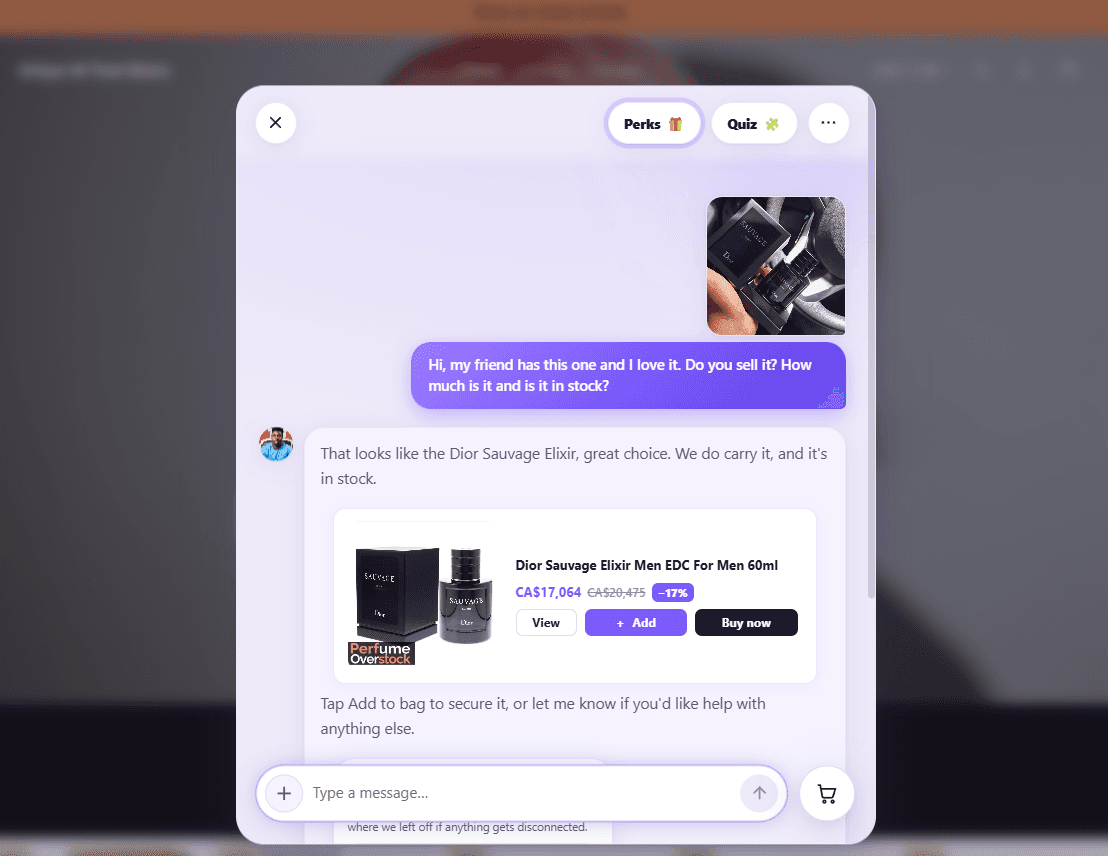
Ultimately, integrating visual AI is about shifting from a static, one-size-fits-all storefront to a fluid, personalized discovery engine that anticipates and responds to customer needs. Finding the product is the critical first step in this new journey. Closing the sale, handling the last-minute questions about shipping or sizing, and even upselling within the conversation is the next logical phase. That’s where modern conversational sales tools like Arbyn can take the baton from the visual search engine. Once a customer has used an image to find the exact item they were hunting for, any lingering practical questions about material durability, delivery times, or return policies can be resolved instantly in a chat window. This turns that visually-discovered interest into a completed order with zero friction. Arbyn acts as a 24/7 sales associate that closes the small gap between "I found it" and "I bought it." By combining best-in-class visual discovery with frictionless conversational commerce, you create an end-to-end experience that captures intent the moment it appears. You can add Arbyn to your store and see how it works to convert high-intent interest into tangible revenue.
The screenshot that started on a customer's phone is no longer a dead end or a source of frustration. It is now the beginning of a seamless, satisfying journey that leads directly to a purchase on your store. In the past, the burden was on the customer to translate their visual desire into your store's limited language of keywords, a task at which they often failed. Now, the burden is on the store owner to adopt the tools that can understand the customer's native language: the language of images. Failing to offer a visual search option is no longer a neutral choice; it is an active decision to provide a subpar user experience compared to your competitors. Text-only search is rapidly becoming a liability, a relic of a previous era of ecommerce. The stores that thrive in the coming years will be the ones that recognize this fundamental shift and re-orient their entire discovery experience around the powerful, undeniable, and profitable signal contained in a single customer photo. They will meet the customer where they are, with the query they already have in their camera roll, and make the sale that their competitors, stuck in a text-based world, will continue to invisibly and needlessly lose.
Written by
For seven years I have led customer success and technical support inside high-growth SaaS and e-commerce companies. Customer Support Lead at DripShop.live, a live-commerce SaaS. Technical Support Specialist at Replo (Y...
View full profileKeep reading
View all posts
Shopify Abandoned Cart Emails Not Working? Why a Chat Agent Is Your Next Best Bet
Odera Joseph · 6 min

Shopify Cart Abandonment: What to Add Alongside Email Recovery Flows
Odera Joseph · 8 min

How Proactive Chat Triggers Lift Shopify Conversion Rate
Odera Joseph · 8 min