Subscription Support Benchmarks
A cancellation is not a lost customer; it is a piece of data telling you exactly how to improve your subscription business.

A subscription cancellation is not a lost customer; it is a piece of data. It carries a specific, actionable reason for leaving that is often entirely preventable. For Shopify store owners building a recurring revenue stream, the gap between a thriving subscription program and a leaky bucket is not the quality of the product, but the quality of the response to that single click. Understanding the normal Shopify subscription cancel rate benchmark is the first step. The second is realizing that the cancellation itself is the start of a conversation, not the end of one. Most brands treat churn as a judgment on their product. The data shows it is almost always a logistics problem in disguise: a mismatch in timing, price sensitivity, or product accumulation that had a solution other than leaving for good.
The most common reasons for leaving have nothing to do with product quality. One comprehensive analysis found that 31% of subscribers cancel due to price pressure, 16% because they have too much product accumulated, and 15% simply want to try something different from your catalog. These are not angry customers. They are customers whose needs have temporarily changed. Another major factor is involuntary churn, where a subscription ends due to a failed payment, not a conscious decision by the customer. This silent killer can account for 20-40% of all churn for direct-to-consumer brands, meaning up to two out of every five lost subscribers never intended to leave at all. The critical insight here is that these are solvable issues. A customer with too much product does not need to cancel; they need the ability to easily skip a month. A price-sensitive customer may not need to leave forever; they might just need a temporary reprieve. The challenge is that most subscription experiences are binary: you are either in or you are out. This leaves no room for the nuance of real life, forcing customers into a permanent solution for a temporary problem.
This is where the concept of a pause becomes so critical. Offering customers the ability to pause their subscription instead of canceling is not a minor feature; it is a fundamental shift in strategy. It acknowledges that customer circumstances change and provides a flexible middle ground. Research shows that a significant majority of customers, 67% in one study, prefer pausing over canceling when given the choice. More importantly, customers who pause have a much higher likelihood of reactivating and exhibit two to three times the lifetime value of those who cancel and are later won back. This is the difference between keeping a customer in your ecosystem and trying to re-acquire them from scratch. The data is clear: stores that implement a pause option see a meaningful reduction in their overall churn numbers, with some platforms reporting an average save rate of nearly 10% from the pause feature alone. It transforms the cancellation moment from a final transaction into a temporary break, preserving the customer relationship and the future revenue it represents.
What a 'Normal' Shopify Subscription Cancel Rate Looks Like
Defining a single "good" Shopify subscription cancel rate benchmark is difficult because the number is highly dependent on the product category, business model, and customer base. However, broad consensus from multiple data sources provides a reliable range. For most direct-to-consumer subscription businesses on Shopify, a healthy monthly churn rate falls between 5% and 8%. Some sources place the average slightly higher, around 7-12%, but agree that top-quartile performers consistently operate in the 3-6% range. Anything below 5% is generally considered excellent, while a rate consistently above 10% suggests a significant retention problem that needs immediate attention. It is also crucial to understand how this monthly rate compounds. A seemingly small 5% monthly churn translates to a 46% annual churn rate, meaning nearly half of your subscriber base is lost within a year. This illustrates why even small improvements in monthly retention have a dramatic impact on long-term growth.
The benchmark becomes more useful when broken down by industry vertical. Different products create different user behaviors and loyalty patterns. Replenishment-based subscriptions, such as vitamins, coffee, or pet food, tend to have the lowest churn rates, often below 4% and with a target range of 5-8%. These products integrate into a customer's daily routine, creating a strong habit loop. DTC consumer goods land in the middle, typically seeing monthly churn between 6-7%. The highest churn rates are consistently found in curation or discovery-based subscription boxes, which can range from 10% to as high as 15% monthly. This is driven by factors like product fatigue, a desire for novelty, and the discretionary nature of the purchase. For these businesses, a 12% churn rate might be average, whereas for a coffee subscription, it would be a major red flag.
Furthermore, churn is not evenly distributed across the subscriber lifecycle. The first 90 days are the most critical and highest-risk period. Data shows that up to 44% of all cancellations can occur within this initial three-month window. First-month churn is particularly brutal, with benchmarks ranging from 12% to as high as 30% depending on the industry. This early churn is often a sign of a weak onboarding process or a mismatch in expectations set during acquisition. A customer who makes it past the third renewal is significantly more likely to become a long-term subscriber. This is why a separate benchmark for early-stage churn is so important. If your first-month churn exceeds 20%, the problem is less about your product and more about your failure to properly onboard and demonstrate value to new subscribers. The final piece of the puzzle is distinguishing between voluntary and involuntary churn. Across most e-commerce businesses, involuntary churn from failed payments accounts for a substantial 25-40% of the total churn rate. This is, in effect, unearned churn. These are customers you are losing not by choice, but due to a fixable mechanical failure in the payment process.
The Anatomy of a Cancellation: Why Your Best Customers Leave
Understanding the reasons behind a cancellation is the first step toward preventing it. The data consistently shows that customers rarely leave because they dislike a product. They leave because of specific, addressable circumstances. The single most cited reason for voluntary cancellation is price, accounting for 31% of departures. This is not a judgment on the product's inherent value, but a reflection of the customer's current budget and perceived value-for-money. In an environment of rising costs and subscription fatigue, consumers are actively auditing their monthly expenses. An increase in your own prices can be a major trigger, so any price change must be accompanied by a clear communication of increased value. However, "too expensive" often means "not worth it right now," a temporary state that can be bridged with offers short of a full cancellation.
The second most common reason, and perhaps the most frustrating for store owners, is product accumulation. Roughly 16% of customers cancel because they have "too much product." This is a classic cadence mismatch. The customer likes what you sell, but they are not using it as fast as you are sending it. Their pantry is overflowing, and the arrival of another box creates stress, not delight. This is a pure logistics problem. The customer does not want to end the relationship, but they feel they have no other way to stop the deluge. Without an easy, self-service way to skip a shipment, adjust the delivery frequency, or swap for a different item, cancellation becomes the path of least resistance. This type of churn is almost entirely preventable with flexible subscription management options.
A third cluster of reasons revolves around a desire for variety or changing needs, which together account for another 30% of cancellations (15% for "I want something different" and 15% for "I don't need it anymore"). A customer subscribed to a coffee delivery might want to try a different blend, or someone on a skincare regimen might find their skin concerns have changed. This is not a rejection of your brand, but a natural evolution of their preferences. If the subscription feels rigid and locks them into one product, they will cancel to seek variety elsewhere. Similarly, a life change, a move, a new diet, a change in routine, can make the current subscription obsolete. These customers are not lost forever. Research shows nearly one in four new subscriptions come from previously canceled customers, indicating a willingness to return when circumstances change. The key is to provide an off-ramp, like a long-term pause, that keeps them within your brand's orbit instead of pushing them out completely.
The Power of the Pause: A Better Metric Than Cancellation
Focusing solely on the Shopify subscription cancel rate benchmark provides an incomplete picture of subscriber health. A more telling metric, and a more powerful retention tool, is the subscription pause. Offering customers the ability to temporarily suspend their subscription is not just a feature; it is a strategic decision to prioritize long-term relationships over short-term revenue. The psychological impact is profound. It gives the customer a sense of control and respects their changing needs, which builds trust and enhances their perception of your brand. In a world of rigid commitments, this flexibility is a significant differentiator. The data strongly supports this: 79% of consumers state they want the option to pause a subscription when they are deciding whether to sign up in the first place. It reduces the perceived risk of a long-term commitment, making the initial conversion easier.
The impact on churn is direct and measurable. When presented with the option, a large number of customers who intended to cancel will choose to pause instead. One study found that 58% of people had paused a subscription instead of canceling in the past year. Companies that strategically introduce a pause option into their cancellation flow can convert 10-20% of cancellation attempts into pauses. Another analysis found that store owners who implemented a pause feature saw an average subscription "save rate" of 9.6%, representing customers who would have otherwise been lost. This is not just delaying the inevitable. A paused subscriber is fundamentally different from a canceled one. They remain in your ecosystem, their payment information is stored, and their account data is intact, making reactivation seamless. Compare this to the win-back rate for a fully canceled customer, which hovers around a meager 10-15%. For paused customers, resumption rates are dramatically higher, often between 40-60%.
This is why some in the industry argue that finance departments have historically resisted pause features; a cancellation is a clean, measurable event, while a pause introduces uncertainty into revenue forecasting. But this is a shortsighted view. A pause preserves the customer relationship and, with it, their future lifetime value. It acknowledges the reality that life happens. Customers go on vacation, face temporary financial constraints, or simply need a break. Forcing them to make a binary cancel-or-continue decision in these moments is a guaranteed way to lose them forever. By offering a pause, you are providing a solution that matches their temporary situation. It is a customer-centric approach that pays dividends, transforming a potential churn event into an opportunity to strengthen loyalty. Ultimately, a high pause rate is a sign of a healthy, flexible subscription program that customers value enough to want to return to.
From Benchmark to Dialogue: How to Talk to a Canceling Customer
Knowing your Shopify subscription cancel rate benchmark is for scoring; knowing *why* individual customers cancel is for winning. The moment a customer clicks "cancel" is the single most valuable feedback opportunity you will ever get. They are actively engaging with your brand and are about to articulate a pain point. Most stores squander this moment with a generic "Are you sure?" message. A data-driven approach treats this as the start of a critical conversation. The goal is not to trap the customer, but to understand their reason for leaving and present a specific, relevant alternative that solves their actual problem. This process, often called a cancellation flow or save offer, can be remarkably effective, with well-designed flows saving 20-35% of subscribers who would have otherwise churned.
The key is to match the solution to the problem. If a customer indicates the reason for cancellation is "It's too expensive," a generic offer to pause is irrelevant. The correct response is a temporary discount, bridging the value gap without permanently devaluing your product. If the reason is "I have too much product," a discount is equally useless. The solution is to offer a skip on the next shipment or an easy way to change the delivery frequency. For the customer who wants "something different," the answer is a product swap. Each reason has a corresponding "save offer" that directly addresses the issue. This requires, at a minimum, a simple exit survey that captures the cancellation reason. Without this piece of data, any attempt to save the customer is a blind guess.
This is where the operational capability to act on this information in real-time becomes paramount. To effectively offer a product swap, your support agent, whether human or AI, needs to know what the customer is currently subscribed to and what other products are available. To offer a change in delivery cadence, the system needs access to their current schedule. This is not about a complex algorithm, but about having the basic customer and subscription data available at the point of interaction. An AI agent like Arbyn, for example, can handle these conversations by looking up the customer's subscription details in the moment. When a customer expresses a desire to cancel in a chat or email, the agent can access their subscription history, understand the context, and facilitate a conversation about pausing or swapping products instead. The agent doesn't make the decision, but it provides the conversational bridge and the data access required to turn a cancellation request into a retention success.
The brands that don't are spending money acquiring subscribers they'll lose for reasons they'll never understand.
The conversation must be handled with care. The goal is a dialogue, not a hostage negotiation. If, after presenting a relevant alternative, the customer still wishes to cancel, the process should be frictionless. Making cancellation difficult creates resentment and guarantees they will never return. The entire exchange is an investment in the long-term relationship. Even if they leave, a positive, respectful off-boarding experience leaves the door open for their return. They are more likely to remember the brand fondly and consider re-subscribing when their circumstances change. The data from the exit survey, aggregated over time, then becomes a strategic asset, informing everything from product development and pricing strategy to the cadence options you offer. It closes the loop, turning the pain of individual cancellations into the intelligence that makes your entire subscription program stronger.
Building a Resilient Subscription Business
Achieving a best-in-class Shopify subscription cancel rate benchmark is not the end goal. It is the output of a resilient, customer-centric subscription model. True resilience is built by shifting focus from reactively saving churning customers to proactively creating an experience they do not want to leave. This starts with a deep, ongoing analysis of why customers pause, cancel, or skip. The reasons are a direct roadmap for improvement. If a large percentage of customers are canceling due to product accumulation, it is a clear signal to rethink your default delivery frequencies or to more prominently feature the "skip" option in your customer portal. If price sensitivity is a recurring theme, it may be time to explore offering a lower-tiered version of your subscription or adding more perceived value to justify the current price.
The most critical period for building this resilience is during the first 90 days of a new subscription. As data shows, this is when the highest rate of churn occurs. A successful onboarding process is therefore not a "nice to have"; it is the single most important retention activity. This goes far beyond a simple order confirmation email. A world-class onboarding sequence educates the customer, reinforces the value of their purchase, and builds anticipation for their next delivery. It could include guides on how to get the most out of the product, testimonials from long-term subscribers, or exclusive content that makes them feel like part of a community. The goal is to bridge the gap between purchase and habit formation, ensuring the customer is fully engaged and seeing value long before their first renewal decision comes up.
Flexibility is the other pillar of a resilient model. Customers today expect to be in control. Rigid subscription plans are a relic of a past era. A modern subscription portal should empower customers to easily manage every aspect of their subscription without needing to contact support. This includes changing delivery dates, swapping products, updating payment information, and, yes, pausing their subscription. Every support ticket asking to "skip this month" is a sign that your self-service options are failing. This level of control reduces friction and accommodates the natural variability of a customer's life. It treats the subscriber as a partner in the relationship, not just a recurring credit card charge. This philosophy extends to the technology you use. Your support tools need to be able to handle these nuanced conversations, providing the data and action-taking capabilities to make flexibility a reality.
Ultimately, a subscription is a promise of ongoing value. The store owners who succeed are the ones who obsess over delivering on that promise month after month. They use churn data not as a measure of failure, but as a guide for innovation. They see a pause not as lost revenue, but as a testament to a relationship worth preserving. If you have built a subscription business that is leaking customers, the first step is to understand what 'normal' looks like. The next is to build the systems to talk to those customers, understand their needs, and provide the flexibility they demand. For store owners who have outgrown the basic toolset and need an agent that can handle these critical retention conversations across chat and email, you can install Arbyn for free on the Shopify App Store and see how a dedicated AI agent can turn cancellation requests into saved customers.
Written by
For seven years I have led customer success and technical support inside high-growth SaaS and e-commerce companies. Customer Support Lead at DripShop.live, a live-commerce SaaS. Technical Support Specialist at Replo (Y...
View full profileKeep reading
View all posts
What Customers Actually Ask When They Want to Skip a Subscription Shipment
Odera Joseph · 8 min

How to Write a Subscription Pause Policy That Actually Reduces Cancellations
Odera Joseph · 8 min
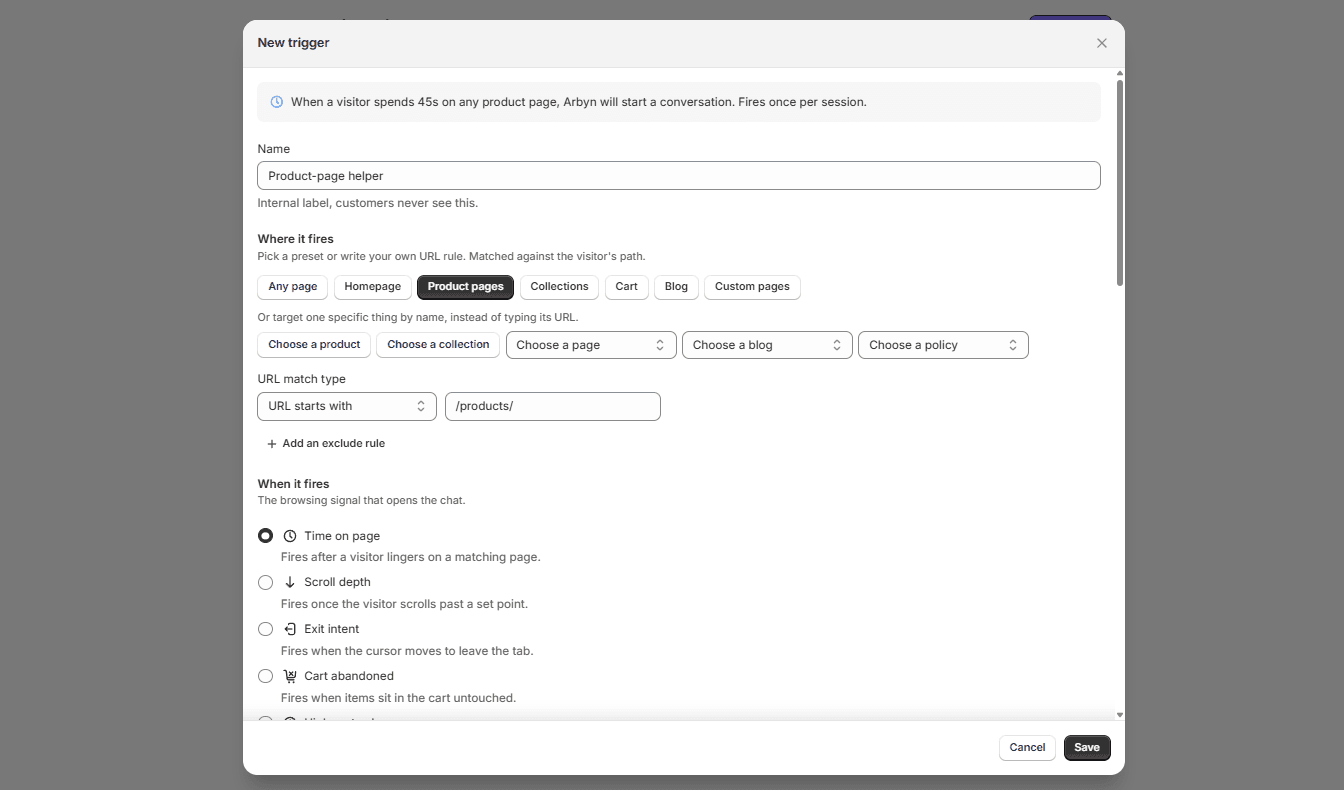
Product-Page Dwell Triggers: Turning a Long Look Into a Chat Conversation on Shopify
Odera Joseph · 8 min