Setting Up Arbyn on Shopify: What Happens in Your First 10 Conversations
You just installed Arbyn on your Shopify store, here’s exactly what to expect as your new AI agent handles its first customer conversations and begins to learn your brand.

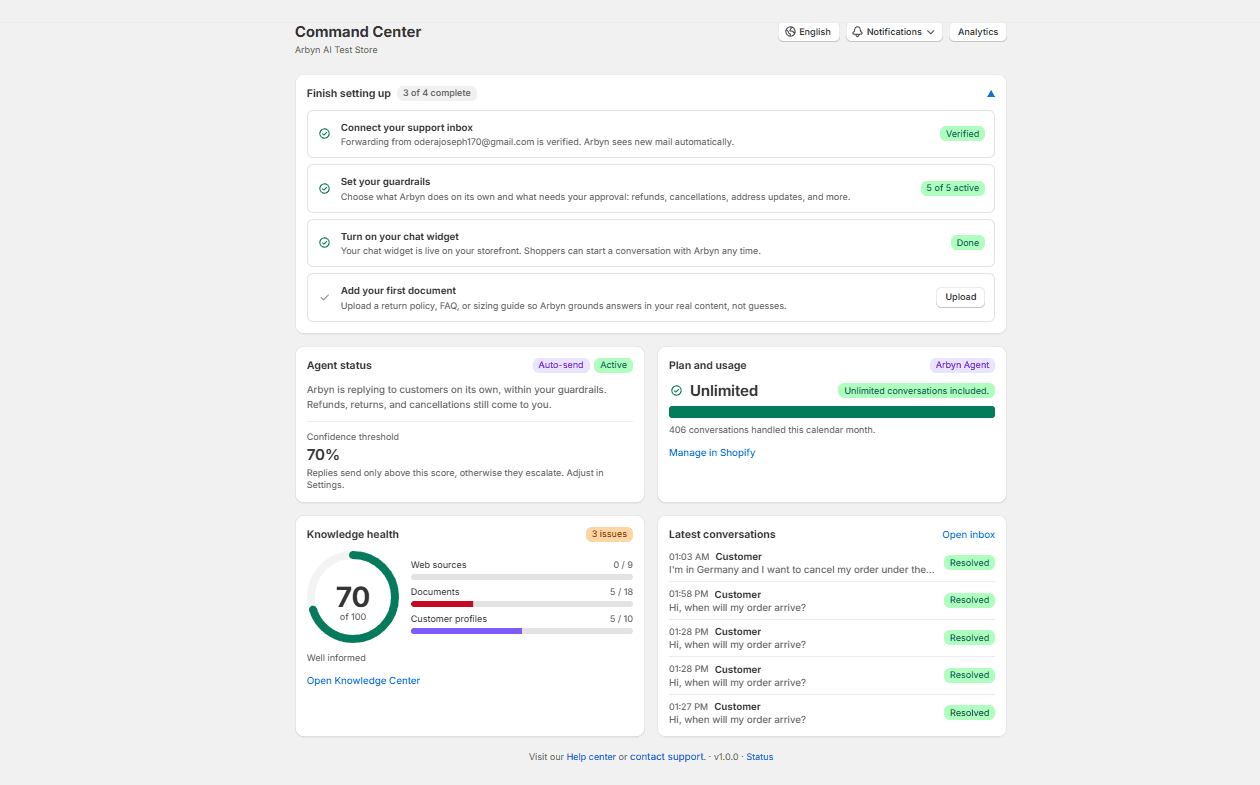
You just installed Arbyn on your Shopify store. The app is connected, the chat widget is live, and a new team member is waiting for its first assignment. It’s a familiar feeling for any store owner who has navigated the vast Shopify ecosystem: a mix of anticipation and a slight sense of unease. You’ve seen countless apps promise the world, only to end up in a digital graveyard of unused tools that added complexity without delivering value. You’ve been promised automation, efficiency, and maybe even a new revenue stream, but the immediate reality is a quiet dashboard and a blinking cursor. What happens now? This isn't just about another chatbot. The initial moments of the Arbyn first conversations setup are fundamentally different from activating a simple, rule-based tool that requires weeks of manual flowcharting. You are not just turning on a piece of software; you are beginning a digital apprenticeship with a new agent, one that needs to learn the unique rhythms and unwritten rules of your specific business. The first handful of customer interactions are not a test you pass or fail; they are the foundational lessons that determine the agent's effectiveness and autonomy for months and years to come.
The First Message: Instant Gratification Through Integration
Within hours, or perhaps minutes, of going live, the first conversation begins. It will almost certainly be a WISMO, "Where Is My Order?", request, a query type that can account for a huge volume of support tickets for many online stores, and can spike even higher after a busy sales weekend. A customer, let's call her Sarah, who is accustomed to the instant gratification of modern ecommerce, types, "any update on my order #7834?" into the chat widget on your site. Before your phone can even buzz with a notification from the Shopify app, Arbyn has already answered. This is not a vague, canned response like, "We'll look into it and get back to you," which only breeds customer anxiety. Because Arbyn is a native Shopify app, it has direct, real-time API access to your store's order management system. The agent instantly cross-references Sarah's identity with her order history, retrieves the latest tracking information directly from the carrier's system, and provides a clear, concise, and impressively detailed status update: "Hi Sarah! Your order is currently out for delivery with UPS and is expected to arrive today. You can follow along live with tracking number 1Z9999W99999999999." The entire exchange takes seconds, and it happens without any human intervention whatsoever, exceeding Sarah's expectations and reinforcing her confidence in your brand.
This first interaction is deceptively simple but reveals a core principle of effective AI support. The primary value is not in mimicking human conversation; it's in leveraging deep system integrations to deliver accurate data faster than a human ever could. A human agent, upon seeing Sarah's request, would need to engage in a multi-step, tab-switching dance: open a new browser tab, log into the Shopify admin, search for the customer's name, locate the correct order among potentially dozens, copy the tracking number, praying not to make a copy-paste error, open another tab for the carrier's website, paste the number, interpret the status, and then finally tab back to the chat window to type out a response. This multi-step process, while straightforward, can take several minutes. Industry benchmarks from sources like Zendesk place average handle times for such tickets between 3 and 5 minutes, especially if the agent is juggling multiple conversations or is new to the role. At a significant loaded cost per support ticket, this manual work adds up to a major operational expense. Arbyn does it instantly for a fraction of the cost. This first conversation is a quiet, immediate success. The customer is satisfied, and a support ticket that would have created work and cost you time has been completely deflected, freeing your focus for strategic growth.
What's happening under the hood is far more sophisticated than a simple data lookup, and it forms the bedrock of the agent's intelligence. Arbyn is logging this entire interaction, the timestamps, the customer's exact phrasing, the data retrieved, and the successful, autonomous resolution, as a foundational data point. It notes Sarah's colloquial phrasing ("any update on my order?") and begins to form a rich semantic pattern. The agent learns that this phrase, along with "where's my package?," "shipping status," or even a typo-laden "wheres my stuff," all map to the same fundamental WISMO intent. This initial success dramatically boosts the agent's internal confidence score for handling this query type autonomously, ensuring it can resolve the next one with even greater certainty and speed. The power demonstrated in this first chat isn't just about answering one question; it's about the deep, native integration with Shopify that makes such a fast and accurate answer possible, creating the first memory in a long-term learning process that is unique to your store.
Conversations 2-5: The Calibration Engine Engages
The next few conversations mark the most critical phase of the Arbyn first conversations setup: calibration. This is where Arbyn’s approach fundamentally diverges from traditional chatbots that rely on rigid, pre-programmed scripts that you have to build and maintain yourself. The agent is actively learning from every single interaction, using these initial chats to build a unique operational model of your business, your products, and your voice. It is crucial to understand that this is a core product mechanic. This initial learning is a direct investment in the long-term intelligence and autonomy of your agent. During this period, the agent is in a heightened state of learning, analyzing not just the customer's query but also the rich context surrounding it. It's reading your entire product catalog, SKUs, inventory data, descriptions, tags, and metadata, and ingesting the specific details of your shipping and return policies to build its initial knowledge base from the ground up.
Imagine the next few inquiries that arrive, each one more complex than the last. One customer asks, "Will the medium in the 'Evergreen' Arbor-Tech Hoodie be back in stock soon?" Another asks, "I have an APO address, do you ship to military bases?" A third wants to know, "What is your return policy for items in the 'Final Sale' section?" A simple, rule-based chatbot would likely fail at all three, frustrating the customer and escalating them immediately because they do not match a pre-built rule. Arbyn, however, treats these as vital learning opportunities. For the inventory question, it doesn't just see "out of stock"; it parses the specific variant, "medium" and "Evergreen", and queries your Shopify Inventory API for restock dates. If no date is set, it can offer to take the customer's email for a back-in-stock notification, turning a lost opportunity into a captured lead. For the shipping question, it performs a semantic search on your store's policy pages for keywords like "APO," "FPO," "military," and "PO Box" to find the correct policy. For the return question, it cross-references the "Final Sale" product tag with the text on your refund policy page to find the specific nuance, perhaps discovering that sale items can be exchanged for store credit but not refunded.
During this essential calibration phase, Arbyn is constructing a detailed knowledge graph exclusively for your store, a sort of digital twin of your business logic. Every product, every policy, every variant, and every past support conversation becomes an interconnected node in this graph. For example, the "Arbor-Tech Hoodie" node connects to its "inventory levels" node, its "sizing chart" node, its "material composition" node from the description, and its "related products" node for the matching joggers. When a new question arrives, the agent isn't just matching keywords; it's navigating this complex map to find the most relevant and accurate information. This is why these first conversations are so vital. You are, in effect, co-creating your agent's brain. If the agent escalates a question because its confidence is low, the way you answer it is observed, recorded, and used to create a new, heavily weighted connection in the graph. Your response becomes the new gold standard for how to handle that query in the future, turning unwritten tribal knowledge into learned, scalable logic.
Conversations 6-8: Navigating Ambiguity and Approving Actions
As the agent becomes more confident with factual, information-based queries, it will inevitably encounter conversations that require judgment or the authority to take direct action on your store. A customer might report that their package was marked as delivered but is nowhere to be found, or they might ask for a price adjustment on an item that went on sale the day after they bought it. These scenarios move beyond simple information retrieval and into the realm of problem-solving and store operations. This is where Arbyn's two-layer action system and built-in escalation guardrails become visible. The system is designed from the ground up for safety and control, ensuring that the agent can solve complex customer problems without creating new ones for you. It fundamentally understands the difference between providing information (low risk) and making a change to an order or issuing a refund (high risk). For any issue that is sensitive or requires a financial decision, Arbyn doesn't go rogue; it brings you into the loop for a simple approval, maintaining your authority over all operations.
Consider a customer who messages, "My order #12345 arrived but the ceramic mug inside is shattered." This is a complex situation that requires empathy, an understanding of your replacement policy, and the ability to execute a solution. A basic chatbot would hit a wall and escalate the entire conversation to you, leaving you to handle the frustrating back-and-forth. Arbyn, however, begins by gathering information just as a top-tier human agent would. It first offers an empathetic response like, "I'm so sorry to hear that. That is definitely not the experience we aim to provide." It then asks, "Could you please upload a quick photo of the damage so I can process a replacement for you?" Once the situation is confirmed, it consults your policies and prepares a solution. It won't unilaterally issue a refund or create a new shipment. Instead, a notification for your approval appears in your Arbyn dashboard. This notification clearly states the customer, the issue, and the proposed solution, such as "Customer: Jane Doe. Issue: Damaged Item (Ceramic Mug). Proposed Solution: Reship 1x 'Morning Ritual' Mug." As the store owner, you retain full control. With a single click, you can approve the decision, and Arbyn executes the task by generating the new draft order via the Shopify API and communicating the positive resolution back to Jane.
This model of approved autonomy is central to building trust during the Arbyn first conversations setup and beyond. The agent handles the entire conversational workload, the frustrating back-and-forth with the customer, the gathering of evidence, the confirmation of policy, and the creation of the draft order, and distills what could be a 10-minute task into a single, clear business decision for you. This same workflow applies to a wide range of money-moving actions: issuing a partial refund for a late delivery, canceling an unfulfilled order at a customer's request, or sending a gift card as a gesture of goodwill for a negative experience. The agent proposes the action based on the context and your policies, and you approve it. This ensures you never have to worry about an AI giving away free products or issuing refunds without your explicit consent. Over time, as you build confidence in the agent's judgment, you can adjust these guardrails, but in these early, critical conversations, this partnership between AI-driven conversation and human-approved action is what allows you to handle complex support issues with the same efficiency as simple WISMO requests.
Conversation 9: The First Sales Opportunity Emerges
Up to this point, the focus has been on reactive support, efficiently solving problems and answering questions that customers bring to you. But Arbyn is designed as both a support and sales agent, and that second part is not an afterthought. Around the ninth or tenth conversation, you are likely to witness the agent's proactive, revenue-generating capabilities for the first time. This transition from a cost-saving tool to a revenue-driving one is a pivotal moment. It demonstrates that the same AI that handles your WISMO tickets can also understand customer intent, make intelligent product recommendations, and actively sell for you. This is not about spamming customers with generic pop-ups; it is about using the deep context of the conversation to provide genuine value that also leads to a sale. This conversational approach to commerce can significantly increase conversion rates. It effectively turns a support channel, traditionally viewed as a cost center, into a dynamic and highly effective profit center.
The scenario might unfold in a few different ways, often starting with a pre-purchase question that signals high intent. A customer might be asking, "I love the 'Admiral' Navy Blazer, but I'm 6'2" and 190 lbs. Your size guide says L or XL. What do you recommend?" Arbyn can access your product descriptions and any linked sizing guides, but its intelligence goes deeper. Having analyzed past returns and sizing-related queries during calibration, it might respond with data-driven advice: "Great question. Based on feedback from customers with similar measurements, the XL offers a more comfortable fit in the shoulders without being too loose in the body. We see a much lower return rate on the XL for customers over 6 feet tall." After helping the customer choose the right fit, it doesn't just stop. It might add, "Excellent choice. To complete the outfit shown on the product page, many customers also purchase the 'Stanton' White Linen Shirt and the 'Cognac' Leather Belt. I can add all three to your cart now in the right sizes for a complete look." This is not a random upsell; it's a contextually relevant bundle suggestion that feels helpful, not pushy, and can significantly increase Average Order Value (AOV). Indeed, data shows that shoppers who engage with smart, relevant recommendations are more likely to complete a purchase.
Alternatively, the sales opportunity could be triggered entirely by customer behavior, showcasing the agent's proactive side. Arbyn can be configured with proactive triggers, such as identifying a customer who has been lingering on a high-intent product page for several minutes or who has added items to their cart but not checked out. The agent can then initiate a conversation, not with a generic "Can I help you?" but with a specific, helpful prompt. For example, it sees a customer with a tent and a sleeping bag in their cart and messages them: "Hi there! I noticed you're putting together some gear for an adventure. Just so you know, we have a promotion this week where buying any tent and sleeping bag together gets you a free 'Pathfinder' headlamp. Shall I add that to your order?" This hyper-relevant engagement can be the exact nudge a customer needs to complete their purchase. The agent can even run a conversational product quiz for complex categories like skincare or supplements, asking a series of guided questions to help a customer find the perfect item for their specific needs, acting as a 24/7 personal shopper and product expert for every single visitor on your site.
Conversation 10 and Beyond: Partnering with Your Agent
The tenth conversation is not an end point but a new beginning, a graduation from basic training into a full-fledged operational role. By now, you have witnessed the core capabilities of your new AI agent. You've seen it deflect the most common and repetitive ticket in ecommerce, you've watched it learn the specific nuances of your product catalog and policies, you've experienced the safety and control of its approved-action workflow, and you've seen its potential to actively generate new revenue for your store. The initial, and most intensive, phase of the Arbyn first conversations setup is complete. The agent has built a foundational understanding of your business that is unique and proprietary. From this point forward, your relationship with the agent evolves from one of intensive training to one of ongoing partnership and optimization. The goal now is to build on this foundation, continuously refining the agent's behavior and gradually increasing its autonomy as you build unshakable trust in its performance.
Your role as the store owner now shifts to that of a manager and coach, guiding a capable digital assistant rather than tediously programming a rigid tool. You can periodically review the agent's conversation logs in the Arbyn dashboard, which are filterable by outcome: 'Resolved by AI,' 'Escalated,' 'Sale Assisted.' Pay close attention to the interactions it chose to escalate. Each escalation is a valuable learning opportunity, not a failure. It's the agent intelligently signaling a gap in its knowledge or a situation that falls outside its current confidence threshold. When you step in to handle an escalated chat about a new wholesale inquiry, for example, your response provides the blueprint. Afterwards, you can use the simple knowledge base tools to add this information, ensuring it can handle that same question autonomously next time. This continuous feedback loop is what ensures the agent becomes progressively more valuable over time, turning today's exceptions into tomorrow's expertise.
This is also the point where you can begin to think strategically about the agent's role in your growth. You can fine-tune its tone of voice by providing new core instructions, adjusting it to sound more casual and witty or more formal and professional to perfectly match your brand's personality. You can analyze the performance of its proactive sales triggers in the dashboard and expand the most successful ones to new product collections or different customer segments. As your business grows, your product line changes, and your policies evolve, your Arbyn agent grows with you, learning from new products and updated policy pages automatically. This entire process, from the first WISMO request to ongoing optimization and scaling, is enabled by simple, predictable pricing. This frees you to fully leverage the agent's capabilities without ever worrying about per-ticket fees or resolution charges that penalize you for success. To get started, you can install Arbyn for free from the Shopify App Store and begin the journey with your own first conversation today.
Written by
For seven years I have led customer success and technical support inside high-growth SaaS and e-commerce companies. Customer Support Lead at DripShop.live, a live-commerce SaaS. Technical Support Specialist at Replo (Y...
View full profileKeep reading
View all posts
How Arbyn's Calibration Period Works: Teaching Your Agent Your Voice
Odera Joseph · 9 min

From Zero to AI Agent: Setting Up Your Free Arbyn Plan in Under 10 Minutes
Odera Joseph · 8 min

Shopify Abandoned Cart Emails Not Working? Why a Chat Agent Is Your Next Best Bet
Odera Joseph · 6 min