MCP and Shopify: What the Model Context Protocol Means for AI Shopping Agents
The Model Context Protocol (MCP) is a new open standard that gives AI shopping agents a universal language to connect with your Shopify store's data, moving them from simple chatbots to true sales agents.

An AI shopping assistant suggests a product. The customer asks if it comes in a different color. The agent, having completely forgotten the original product, asks, "What item are you referring to?" This frustrating loop is the quiet failure behind thousands of AI implementations in commerce today, a systemic issue that research indicates leaves over half of consumers feeling that chatbot interactions are a source of frustration rather than help. Recent studies confirm this, with one finding that 46% of consumers actively hate chatbots, viewing them as an instant dealbreaker that kills trust. This conversational amnesia, where the agent feels intelligent for one turn before revealing it has no memory, actively erodes brand trust with every reset. In fact, research from PwC shows up to 32% of consumers will abandon a brand after just one bad service experience. It's not a flaw in the AI's core reasoning; it is a structural problem of communication, a broken link between the model and the world it is supposed to understand. The concept of an open standard, a model context protocol (MCP), is designed to solve this very problem, and its potential integration with Shopify, a platform hosting millions of storefronts, is poised to fundamentally change what an AI agent can do. This is not just an incremental update for chatbots; it is the technical foundation for the next era of agentic commerce.
The Memory Problem: Why AI Shopping Agents Feel So Brittle
For years, the promise of AI in commerce has been a personalized, automated assistant that can guide customers and resolve issues, a market projected to grow into a multi-hundred-billion-dollar industry by offering unprecedented efficiency and personalization. The reality, however, has often been a glorified search bar, capable of handling simple, one-shot queries like "Where is my order?" but failing at any task requiring sequential steps or conversational memory. A customer asking, "I'd like to exchange this for a size large," is met with a contextless "What is the order number and item you are referring to?". This brittleness stems from a core technical challenge: state management. In AI agent development, this refers to the system's ability to track and remember information across interactions. Without a robust state management system, every message is a new event, disconnected from what came before. It is the digital equivalent of a service agent who takes no notes and, upon being called back, has no recollection of the prior conversation, forcing the customer to start over. This is precisely the experience that erodes trust, damages brand perception, and contributes to customer churn, a problem that can cost a business dearly, as research pioneered by Bain & Company found that a mere 5% increase in retention can boost profits by 25% to 95%.
This "forgetfulness" is not a choice but a default condition, an architectural limitation of early AI tools that operate in a stateless manner. You provide a prompt, they generate a response, and the context is immediately discarded to conserve resources and prepare for the next, unrelated query. To overcome this, developers have been forced into a corner, building complex, expensive, and inefficient workarounds. They resort to stuffing the entire chat history back into the AI's limited context window with every turn, a technique that can increase processing costs by an order of magnitude, turning an inexpensive query into a costly one over just a handful of interactions. They design elaborate backend databases to track conversational state, adding significant latency that makes the agent feel slow and unresponsive. They also build custom API connectors for every single tool the AI might need, a process that can consume significant engineering hours per integration and is prone to breaking. This entire approach is not only expensive and slow, but it is also incredibly fragile. A slightly longer conversation can exceed the AI's context limit, causing it to abruptly lose the thread. A custom integration can break when a third-party API changes without warning. Most importantly, this method creates closed-off data silos where the context and knowledge gained in one interaction are not portable to any other system, trapping valuable customer insight within a single, proprietary application and preventing a unified view of the customer journey.
Hacking Context: How Today's Platforms Work Around the Problem
In the absence of a universal standard, every platform has been forced to invent its own expensive solution to the context problem. Helpdesks and AI agent providers have invested immense engineering effort into building deep, proprietary integrations that serve as the agent's memory and action layer. Platforms like Gorgias or Zendesk, for example, create highly integrated environments for Shopify by ingesting and indexing vast amounts of store data into their own systems via webhooks and frequent API polling. Their agents can view order history, access customer profiles, and even initiate actions like refunds because they have built custom, point-to-point connections directly into Shopify's administrative backend. These systems work, but they represent a brute-force, "walled garden" solution. They solve the problem for their own ecosystem but create data latency, where an agent might recommend a product that went out of stock five minutes ago. More critically, the context gathered by one vendor's AI is not accessible to another's, and the store owner becomes locked into a single provider's feature roadmap and pricing structure, which can become a significant monthly cost for a growing business, with migration costs to a new platform representing a significant financial and operational barrier.
This proprietary approach leads directly to what engineers call the "N×M integration problem," a combinatorial explosion of complexity and cost. For every N number of AI clients (like a chatbot, a voice assistant, or an IDE), you need to build a custom integration for every M number of tools (like a database, a CRM, or a Shopify store). If an ecosystem has just 20 promising AI agent providers and 100 essential commerce tools for functions like loyalty programs (e.g., Smile.io), product reviews (e.g., Yotpo), and shipping carriers (e.g., ShipStation), it would require building and maintaining 2,000 individual, brittle connections. This is not scalable. It stifles innovation by making it prohibitively expensive for new, potentially superior AI startups to enter the market, as they must first spend significant capital on engineering an integration library before they can even compete on the quality of their AI. This centralizes power with the incumbent platforms that can afford the massive engineering teams needed to build the most comprehensive integration libraries, creating a competitive moat built on repetitive grunt work, not AI excellence. The core issue is the lack of a common language for tool use. Each system speaks its own dialect, and the store owner, or their developer, is left to pay for the constant, expensive translation.
A Lingua Franca for AI: The Model Context Protocol (MCP) Explained
The solution to this fragmentation is a conceptual open standard that can be called a Model Context Protocol (MCP). An MCP is designed to be a universal language for AI agents to communicate with external tools and data sources. Think of it as a USB-C port for artificial intelligence. Just as USB-C standardized how physical devices from different manufacturers connect to exchange power and data with a single cable, an MCP would standardize how AI models discover, connect to, and interact with the outside world using a single protocol. Instead of building countless custom integrations, a tool provider would only need to expose a single "MCP server." Any "MCP client" could then instantly connect to it, ask for its capabilities, and start using its tools securely and programmatically. This elegantly solves the N×M problem by reducing the required integrations from N×M to a much more manageable N+M, as each tool connects to the protocol once and each agent connects to the protocol once. Because it would be an open standard, it would foster a playing field where innovation can flourish, preventing any single company from owning the rails of AI communication and promoting the kind of ecosystem growth seen with other open standards like HTTP and SQL.
The architecture is straightforward and could be built on established, open web technologies like JSON-RPC 2.0 over HTTPS, making it secure, lightweight, and easy for developers to adopt. It would consist of three main parts. First is the **MCP host**, which is the AI application itself, such as a chat interface or an AI-powered development environment. Within this host runs the **MCP client**, a component that manages the communication by discovering and calling tools. Finally, the **MCP server** is the external tool or data source, like a database or an e-commerce store, that exposes its functions and data through the protocol, typically by publishing a manifest file at a known endpoint like `/.well-known/mcp.json`. This manifest would detail available tools, their purposes, and required inputs. When an AI agent needs to perform an action, like checking inventory or calculating shipping costs, the host's client discovers the appropriate tool on the server and invokes it with the necessary parameters. The server then executes the task and returns the result in a structured format that the AI can understand and use. This entire exchange would be standardized, secure, and remove the need for custom code for each interaction, allowing developers to build once and integrate everywhere.
MCP and Shopify: Unlocking Truly Agentic Commerce
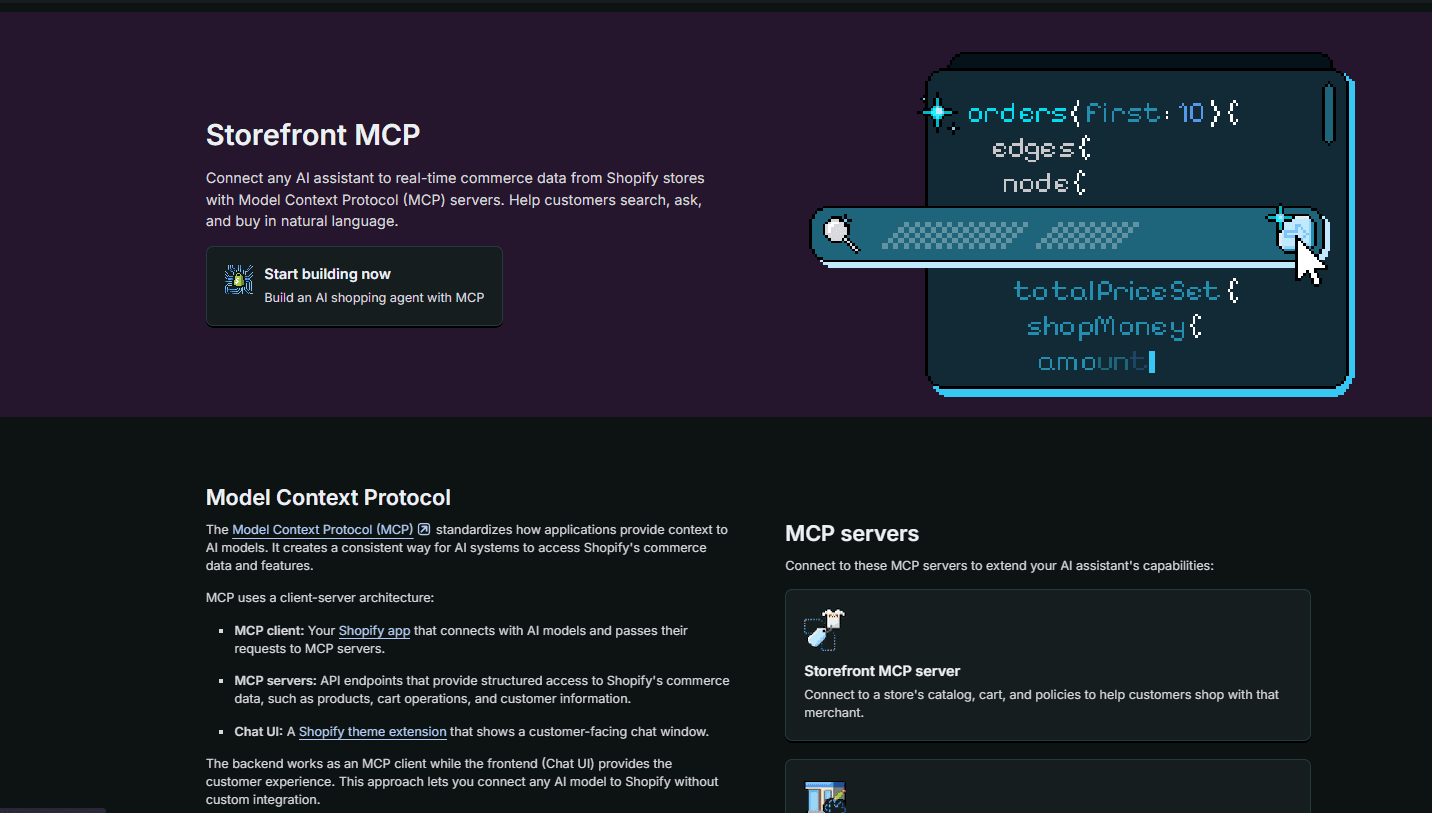
The abstract potential of an MCP becomes clear when you imagine it as a concrete reality for millions of store owners. What if a major platform like Shopify decided to go all-in on agentic commerce by adopting a standard like MCP? In such a future, Shopify could ship native MCP endpoints on every single one of its stores. With no setup required, every Shopify store would have a live, read-only endpoint, perhaps at `your-store.myshopify.com/api/mcp`. This "Storefront MCP" server would make a store's public data instantly and programmatically accessible to any MCP-compliant AI agent. An agent could then directly and securely search the product catalog, check for variants, manage a shopping cart, and query store policies in natural language, all through a standardized, official, and high-performance channel. A single move like this would instantly activate millions of nodes in a new, intelligent commerce graph, creating a foundational layer for true AI-native shopping experiences to be built.
This would be a fundamental platform shift, ending the inefficient war of web scraping. Without a standard like MCP, an AI agent wanting to find a product on a Shopify store must either rely on a pre-built, proprietary app integration or resort to scraping the website like a primitive bot, a fragile process that breaks with simple theme updates, like a developer changing a CSS class name. The ongoing maintenance for such scrapers is a significant hidden cost, consuming developer time that could be spent on innovation. With a formal protocol, it would have a structured way to ask the store directly for the information it needs via a stable, versioned API. Shopify would essentially be giving every store its own front-door API designed specifically for AI agents. This ecosystem could include different MCP servers for different tasks. The public-facing Storefront MCP would be for AI shopping assistants helping customers. A separate, authenticated `Dev MCP` server could exist for developers, allowing their AI coding assistants to interact with Shopify's documentation and Admin API schemas to build apps faster and more reliably. For a store owner, the immediate impact would be that the barrier to adopting sophisticated AI has been dramatically lowered. Any developer building an AI shopping experience could connect to a Shopify store's live data with minimal effort, paving the way for a new generation of smarter, more capable, and truly interoperable shopping agents.
What This Means for Store Owners: From Chatbots to Sales Agents
The direct integration of a standard like the Model Context Protocol into Shopify would transform AI from a passive support tool into an active sales agent. When an AI can reliably access a store's complete and real-time context, it moves beyond answering simple questions to guiding the entire customer journey with unparalleled expertise. This isn't about replacing human agents; it's about equipping a digital touchpoint with the knowledge and capability of your best salesperson, available 24/7. Imagine a customer browsing your store for a jacket. An MCP-powered agent knows which products they've viewed and what's in their cart. When the customer asks, "Will this fit me?", the agent can access detailed garment measurements and cross-reference the customer's purchase history. It can respond, "I see you previously bought a size medium in Brand X, which you did not return. This jacket runs slightly smaller, so I recommend a size large for a similar fit. I have confirmed the large is in stock." This level of analysis can directly impact the 20-40% return rates common in online apparel, turning a potential loss into a confident sale.
This unlocks a level of dynamic, playbook-driven personalization that was previously impossible at scale. The agent becomes an executor of the store's strategy. For example, an store owner can define a rule: "If a customer adds the 'Pro-Level Skis' to their cart, proactively suggest the 'High-Performance Bindings' they viewed last week, and offer a 10% bundle discount if they add both." The agent can then execute this, increasing the average order value. It could guide a customer through a complex product quiz for skincare, using their answers to build a personalized bundle of items directly in their cart. During checkout, if a customer with a cart over $100 hesitates for more than five minutes, the agent could, based on rules you set, offer a one-time free shipping code to complete the purchase, combating cart abandonment which affects nearly 70% of all online shopping sessions. This is the core of agentic commerce: AI systems that don't just recommend but *execute*. They can make decisions and perform actions based on their understanding of the customer's needs and the store's goals. For the store owner, this means turning a cost center, customer support, into a powerful, automated revenue driver that improves conversion rates, increases AOV, and builds loyalty through genuinely helpful interactions.
The Road Ahead: Adoption, Standardization, and Your Store's Strategy
The idea of a Model Context Protocol and its potential adoption by platforms like Shopify would mark the beginning of a major shift, but it's important to recognize that this is still an early concept. Widespread adoption will require a concerted effort across the industry, with AI model developers, application builders, and e-commerce platforms all embracing an open standard, likely through a formal standards body similar to the W3C for web protocols. The path from today's siloed integrations to a future where agents can autonomously handle complex, write-heavy operations, like processing a multi-item exchange or applying a store credit, will be gradual. It will be built on a foundation of security and trust, likely using frameworks like OAuth 2.0 to manage granular permissions, so a store owner can grant an agent the `orders:write` or `discounts:create` scope with full confidence and a clear audit trail. For store owners, the immediate strategy is not to wait for this future to fully arrive, but to start thinking in terms of stateful, action-oriented AI. The crucial question is no longer "Does this AI answer questions?" but "Does this AI get jobs done?". The time is now to begin preparing your data, ensuring product descriptions, specifications, and inventory information are clean, structured, and ready for AI consumption.
While a formal Model Context Protocol is still a concept, the principle of a deeply integrated, action-capable AI is already shaping the next generation of tools. Platforms like Arbyn are built around the idea that an AI agent should do more than just talk; it should act. By integrating directly with Shopify's core Admin APIs to handle tasks like updating shipping addresses or, with your approval, processing returns and creating discounts, Arbyn tackles the same context problem from a different, more pragmatic angle. It acts as a proto-MCP agent, authenticating with the store's backend to gain the real-time data and the permissions it needs to resolve issues and drive sales within the conversation. This deep integration is paired with a flat-rate billing model, which strategically aligns incentives. Store owners are encouraged, rather than penalized by per-interaction token costs, to automate more complex, multi-turn conversations that deliver real value. This business model ensures the AI provider's success is tied directly to the store owner's: resolving the customer's issue as efficiently and effectively as possible. For store owners looking to move beyond simple chatbots without waiting for a universal standard to mature, the path is to choose tools that prioritize deep platform integration and a business model that rewards resolution, not just conversation. You can install Arbyn on the Shopify App Store to see the difference an action-oriented agent makes today.
Ultimately, the transition to agentic commerce is not about replacing human connection but augmenting it with perfect context and infinite patience. It is the critical evolution from AI as a simple interface to AI as an autonomous actor, capable of executing tasks to achieve a goal. The move from stateless bots that forget to stateful agents that remember, accelerated by standards like a potential MCP, represents a fundamental upgrade in the capability of digital commerce, akin to the shift from static web pages to dynamic applications. This is not a distant future; analysts at Bain & Company project that agentic commerce could account for 15% to 25% of all e-commerce sales by 2030, a market worth hundreds of billions of dollars. Other projections from Morgan Stanley and McKinsey support this, indicating a massive shift in retail revenue towards AI-driven transactions. The stores that will win in this new landscape are the ones that structure their data for AI consumption, prioritize tools that can take meaningful action, and understand that a customer conversation is not a cost to be minimized, but an opportunity to be seized. This is the new foundation for building a truly intelligent, responsive, and autonomous online retail experience.
Written by
For seven years I have led customer success and technical support inside high-growth SaaS and e-commerce companies. Customer Support Lead at DripShop.live, a live-commerce SaaS. Technical Support Specialist at Replo (Y...
View full profileKeep reading
View all posts
ChatGPT Shopping and Shopify: What Store Owners Should Actually Do About It
Odera Joseph · 9 min

What Is an AI Shopping Agent? A Definition for Shopify Store Owners
Odera Joseph · 8 min

Agentic Checkout on Shopify: What Changes When an AI Buys on a Customer's Behalf
Odera Joseph · 7 min