How to Write Policies Arbyn Can Actually Follow
Translate your store's operational rules into a language an AI agent can execute, turning abstract policies into automated actions.


You spend a week drafting the perfect new-hire document. It has everything: your return policy, the brand voice, the precise discount you offer for a first-time shipping delay, and the one you offer for a second. The tone is exacting. The rules are clear. You hand it to your new support hire on Monday. By Wednesday, you see them issue a 25% refund on a final sale item, an exception you never authorized, because the customer "seemed really upset." The policy was a guideline; the human made a judgment call. This is a familiar scene for any store owner who has tried to scale a support team. The core challenge is consistency. Now, imagine replacing that human with an AI agent. The fear is often the opposite: not that the AI will ignore your rules, but that it will follow them too rigidly, or worse, fail to understand them at all. Effective automation depends entirely on effective instruction. This is a guide to writing policies for an AI support agent, translating your operational logic into a format Arbyn can actually execute.
Why Your Human-Centric Policies Fail with AI
The documents you write for people are built on a foundation of shared context and inference. When you tell a human agent to "be friendly and helpful," you're relying on their lifetime of social experience to interpret what that means. They know when a customer's terse language signals frustration, not rudeness. They can infer that a policy to offer a 10% discount for a damaged box probably shouldn't apply if the item inside is a $2,000 television. This reliance on intuition is a feature of human teams, but a bug in automated systems. An AI agent doesn't infer intent; it follows logic. Without explicit instructions, it has no basis for making a judgment call. Natural language has become the new programming language for AI agents, but that doesn't mean they think like us. They process that language by breaking it down into structured commands and conditional logic, similar to the "IF-THEN" statements that have long governed business automation. This is the fundamental disconnect: a policy written for a human is a collection of suggestions and goals, while a policy for an AI must be a system of explicit, testable rules.
This distinction becomes costly when ignored. Ambiguity in business rules doesn't just cause confusion; it creates direct financial and operational friction. When policies are not followed consistently, the costs manifest as rework, unnecessary escalations, and even legal exposure from mismanaged records or privacy. According to a 2022 report from Coveo, employees can spend over three hours a day just searching for the information needed to do their jobs, a direct result of poorly documented or unclear processes. In customer support, this ambiguity translates into inconsistent customer experiences. One customer gets a refund, another doesn't. This lack of predictability erodes trust and can damage a brand's reputation far more than a single negative interaction. The goal of writing policies for an AI agent is to eliminate this ambiguity. It forces you to codify the implicit knowledge and exceptions that live in your head and your team's collective wisdom. It's not about stripping the nuance from your support, but about defining that nuance so precisely that a machine can execute it perfectly, every single time.
Furthermore, attempting to apply a human-centric policy to an AI often leads to a frustrating cycle of failure and correction. The AI, lacking the rules to handle an edge case, either makes an error or immediately escalates, defeating the purpose of automation. The store owner then adds a single, reactive rule to fix that one scenario, creating a brittle, patchwork system. A more robust approach starts by acknowledging the nature of the system. An AI doesn't need a mission statement; it needs a workflow. It needs its tasks, context, and guidelines defined upfront. The process of writing policies for Arbyn isn't about teaching it to *think* like your best agent. It's about designing a system where the right action is the logical and unavoidable output, given a specific set of inputs. This requires a shift in mindset, from manager to system architect. You are not just providing guidelines; you are building the decision-making engine of your support operation.
The Framework for AI-Ready Policies
To translate your store's operational DNA into a language Arbyn can understand, you need a structured approach. Instead of a single, monolithic document, think in terms of distinct policy layers that govern different aspects of the agent's behavior. A successful policy framework for an AI support agent rests on three pillars: Tone and Persona, Action Guardrails, and Escalation Paths. Each pillar addresses a specific function, and together they create a comprehensive operating system for your automated support. This modular approach allows you to define, test, and refine each aspect of the AI's behavior independently, making the entire system easier to manage and scale. It transforms the vague goal of "good support" into a series of concrete, configurable parameters. This is how you move from simply having policies to having an automated strategy that the AI can reliably execute.
The first pillar, **Tone and Persona**, is about codifying your brand's voice. This goes beyond simple adjectives like "friendly" or "professional." It involves defining the specific vocabulary, phrasing, and even emoji usage that constitutes your brand identity. For an AI, this needs to be translated into concrete instructions. For example, a "friendly" tone might be defined as "Always uses the customer's first name, includes one positive emoji per interaction where appropriate, and avoids technical jargon." Arbyn's Voice Fingerprint calibrates from a tone preset you select, any optional notes you provide, and the replies you approve during the initial setup. This provides the initial baseline, but a durable policy makes these rules explicit. The second pillar, **Action Guardrails**, is the logical core of your policy. This is where you define the "if-then" conditions for every action the AI can take. These rules govern everything from looking up an order to issuing a refund. Crucially, this layer must account for the different levels of autonomy. Some actions, like providing an order status, are low-risk and can be fully autonomous. Others, like processing a significant refund, carry financial risk and should require human approval. Writing effective action guardrails means mapping out these decision trees with precise criteria.
The final pillar, **Escalation Paths**, serves as the system's safety net. No AI can, or should, handle every single inquiry. A well-designed policy framework anticipates the limits of automation and defines clear triggers for handing a conversation over to a human. These triggers can be based on a variety of factors: specific keywords (e.g., "legal," "complaint"), customer sentiment (detecting high levels of frustration), task complexity (a request the AI doesn't have a defined action for), or simply a direct request to "speak with a human." A robust escalation policy does more than just pass the conversation along; it ensures a seamless handoff. The policy should specify what information the AI gathers before escalating, such as the order number, customer email, and a summary of the issue, so the human agent has all the necessary context to resolve the problem efficiently, without forcing the customer to repeat themselves. Building out these three pillars gives you a complete operational blueprint for your AI agent, turning abstract goals into a clear, manageable, and effective automated system.
Crafting Your Tone Policy: From Brand Guide to Bot Persona
Your brand's voice is one of its most valuable assets, but it's often the most difficult to standardize, even with a human team. When writing a tone policy for an AI like Arbyn, the goal is to translate abstract brand values into a concrete set of linguistic rules. The process begins with deconstructing your existing brand guide. Take a high-level directive like "Our voice is witty and confident." For a human, that's enough to set a direction. For an AI, you must break it down into programmable components. "Witty" might translate to: "Use light humor when responding to positive feedback, but maintain a formal tone for complaints." "Confident" could mean: "Never use phrases like 'I think' or 'maybe.' State facts directly, such as 'Your order has shipped' instead of 'I think your order has shipped.'" This level of granularity is essential for consistency.
Arbyn provides two key mechanisms to help implement your tone policy: the initial calibration and the persistent tone settings. The calibration process uses a tone preset you select, optional notes, and the replies you approve to create a baseline model of your voice. However, this should be seen as a starting point, not the final word. Your written policy is what solidifies the rules and handles the exceptions the AI might not infer on its own. After calibration, you can further refine the agent's persona using Arbyn's built-in tone system, choosing between modes like 'Professional,' 'Friendly,' or 'Concise.' Your policy document should specify which mode to use as the default and in what specific contexts to switch. For example, a policy might state: "Default to 'Friendly' for all initial interactions. Switch to 'Professional' if the customer's message contains negative sentiment or keywords like 'unhappy' or 'disappointed.'"
A comprehensive tone policy also includes a "dictionary" of preferred terms and phrases. This is where you list the words to use and the words to avoid. For an apparel brand, you might specify using "piece" or "garment" instead of "product." For a supplements company, you might ban medical claims and provide a list of approved descriptive phrases. This section should also cover formatting rules. Do you use contractions? Do you use the Oxford comma? How are numbered lists formatted? These seemingly minor details accumulate to create a consistent and recognizable brand voice. By defining these elements explicitly, you're not stifling the AI; you're giving it the clear, unambiguous instructions it needs to represent your brand accurately in every single conversation. This detailed work is what elevates an AI agent from a generic chatbot to a true extension of your brand.
Defining Action Policies: What Arbyn Can and Cannot Do Alone
The real power of an AI support agent is its ability to do more than just talk; it's the ability to take action directly within your Shopify store. This is also where the stakes are highest. A poorly defined action policy can lead to incorrect refunds, unauthorized discounts, or frustrated customers. Writing effective action policies requires a clear understanding of Arbyn's two-layer action system: fully autonomous actions and approval-gated actions. This distinction is the foundation of a safe and effective policy. You must decide which tasks the AI is permitted to execute without any human oversight and which tasks require a one-click approval from you or your team. This framework allows you to balance the efficiency of automation with the need for financial control and human judgment.
Fully autonomous actions are best suited for low-risk, high-frequency tasks where the decision logic is simple and the potential for error is minimal. The prime example provided in Arbyn's architecture is updating a customer's shipping address. An action policy for this might look like: "IF a customer requests a shipping address change AND the order has not yet been fulfilled, THEN Arbyn is authorized to update the shipping address autonomously and confirm the change with the customer. IF the order has already been fulfilled, THEN escalate to a human agent." Your policy document should list every autonomous action you're comfortable with, each accompanied by a precise set of conditions. This might include answering order status questions (WISMO), confirming delivery times, or starting the return process for an eligible item, which Arbyn can do on its own before it requires approval to complete.
For any action that involves moving money or making a significant change to an order, you will use approval-gated policies. These are the actions where Arbyn does the work but waits for your go-ahead. This category includes issuing refunds, canceling orders, applying discount codes, sending gift cards, and reshipping orders. Your policy's job is to define the conditions under which Arbyn should *propose* one of these actions. For example, a refund policy could state: "IF a customer reports a damaged item for a low-value order AND provides a photo, THEN Arbyn will prepare a full refund action and present it for approval. IF the order is high-value OR the customer has a history of multiple refunds, THEN the conversation must be escalated to a human for manual review." This approach gives you the best of both worlds: the AI handles the data gathering and prepares the solution, saving significant time, but you retain ultimate control over the final decision. Your policies become a set of pre-approved scenarios, empowering the AI to act as an effective assistant, not an uncontrollable agent.
The Art of the Escalation Policy: Building a Human Safety Net
No matter how sophisticated your AI or how detailed your policies, there will always be situations that require a human touch. An escalation policy is not an admission of failure; it is a critical component of a successful, hybrid support system. It provides a clear, predictable path for conversations to move from the AI agent to a human agent, ensuring that customers are never left in a frustrating loop. A well-designed escalation strategy anticipates these moments and makes the handoff seamless and efficient. The primary goal is to define exactly when and how this transfer should occur. This prevents the AI from attempting to handle issues beyond its capabilities, which can damage customer trust, and ensures that your human agents' time is reserved for the most complex, sensitive, or high-value interactions.
The first step in building your escalation policy is to define the triggers. These are the specific conditions that signal the need for human intervention. These triggers can be grouped into several categories. First are explicit triggers, where the customer directly asks to speak to a person. Second are keyword triggers, where the conversation contains words that suggest high sensitivity or risk, such as "legal," "sue," "safety issue," or "allergic reaction." Third are sentiment-based triggers, where the AI detects a high level of negative emotion, such as anger or extreme frustration. Fourth are complexity triggers, which occur when a customer's request falls outside the defined action policies or when the AI fails to resolve an issue after a set number of attempts. Finally, you can set value-based triggers, automatically escalating conversations from VIP customers or those with a high lifetime value.
Once a trigger is met, the "how" of the escalation becomes critical. A good policy ensures a context-rich handoff. The rule should state that before transferring, the AI must collect and package all relevant information for the human agent. This includes the customer's name and email, the order number in question, a full transcript of the conversation, and a summary of the actions the AI has already attempted. This simple step is crucial for customer satisfaction, as it prevents the all-too-common frustration of having to repeat information. The policy should also define the routing: where does the escalated conversation go? Does it go into a general support queue, or is it routed to a specific team based on the issue? For example, escalations triggered by "billing dispute" could be routed directly to the finance team, while technical product questions go to a product specialist. By designing these intelligent escalation paths, you create a resilient support system that leverages automation for efficiency while guaranteeing access to human expertise when it matters most.
Testing and Refining Your Policies in the Real World
Writing your initial set of policies is the first step, not the last. Policies are not static documents; they are living systems that must be observed, tested, and refined based on real-world performance. The most effective AI policy frameworks are built through an iterative process of deployment and analysis. The goal is to create a feedback loop where insights from actual customer conversations inform continuous improvements to your rules for tone, actions, and escalations. This approach ensures that your AI agent becomes more accurate and effective over time, adapting to new customer behaviors, product questions, and unforeseen edge cases. It is a mistake to view your policies as a "set it and forget it" task. They require ongoing attention and maintenance to remain effective.
Arbyn's initial calibration process is the perfect environment for this first phase of testing. This is your opportunity to see how your theoretical rules perform in practice. During this phase, you should closely monitor every conversation the AI handles. Look for moments of friction. Did the AI misinterpret a customer's request? Did its tone feel off-brand in a specific context? Was there a scenario where it should have escalated but didn't? Each of these instances is a valuable data point. Document these gaps. For example, you might find that your policy for handling "out of stock" inquiries is too rigid, causing frustration. This observation should lead to a policy update, perhaps empowering the AI to suggest similar, in-stock products as an alternative.
After the initial calibration, this process of review should become a regular operational habit. Set aside time each week to review a sample of conversation logs. This is where you will uncover the "unknown unknowns", the scenarios you couldn't have predicted when you first wrote your policies. As you identify patterns, update your policy document accordingly. For instance, if you notice multiple customers asking about the materials used in a new product, you can add a new informational rule to your knowledge base so the AI can answer it directly. This continuous refinement is what builds a truly robust and intelligent automation system. A policy that is regularly reviewed and updated ensures your AI support agent doesn't just follow rules, but evolves with your business and your customers' needs, creating a more resilient and effective support operation in the long run.
Ultimately, the quality of your AI support agent is a direct reflection of the quality of the instructions you provide. By moving from vague guidelines to a structured framework of explicit rules for tone, actions, and escalations, you build a system that is both powerful and predictable. This process forces a healthy operational clarity, turning the implicit knowledge of your team into a scalable asset. The result is an agent that not only resolves customer issues with precision and consistency but also frees up your human team to focus on the relationships and complex problems that truly drive your business forward. You can begin building this system for your own store by installing Arbyn for free from the Shopify App Store and starting the process of translating your rules into results.
Written by
For seven years I have led customer success and technical support inside high-growth SaaS and e-commerce companies. Customer Support Lead at DripShop.live, a live-commerce SaaS. Technical Support Specialist at Replo (Y...
View full profileKeep reading
View all posts
Configuring Approval Workflows in Arbyn: What Requires Your Tap and What Doesn't
Odera Joseph · 8 min

How Arbyn's Calibration Period Works: Teaching Your Agent Your Voice
Odera Joseph · 9 min
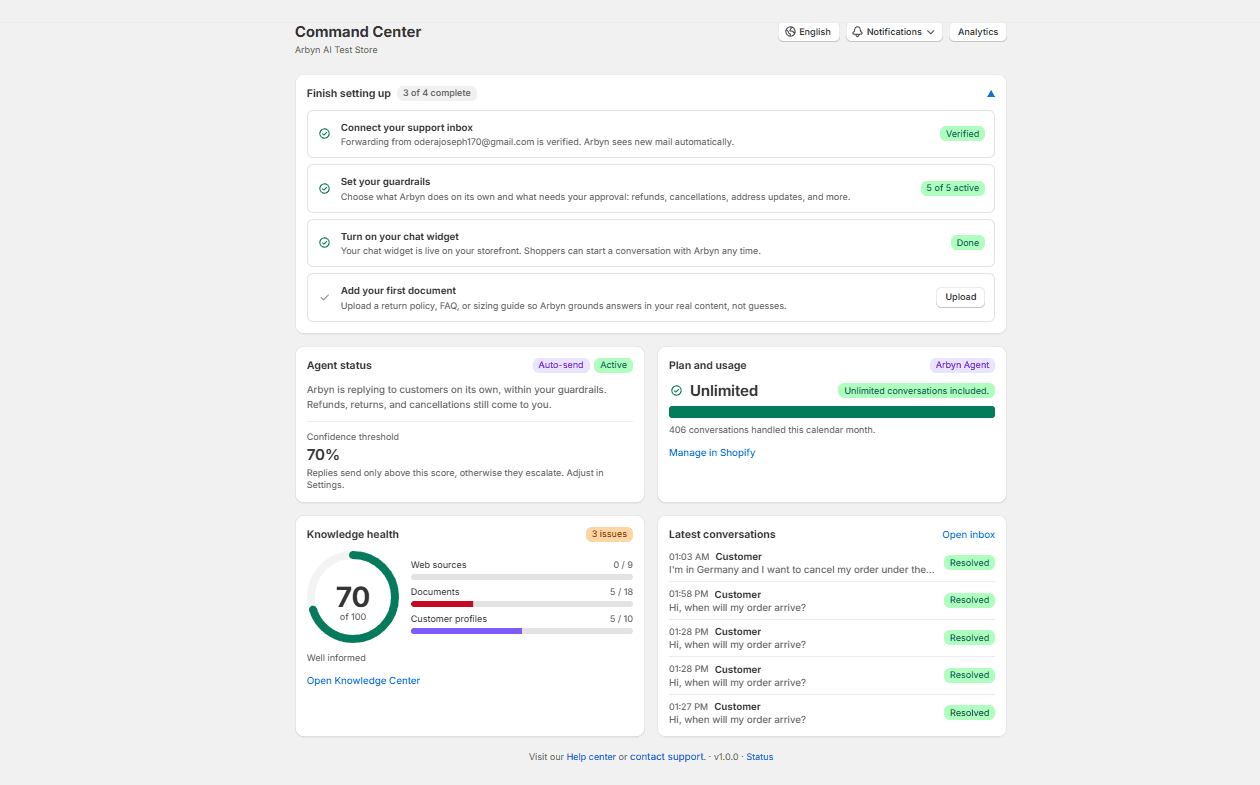
Setting Up Arbyn on Shopify: What Happens in Your First 10 Conversations
Odera Joseph · 5 min