How Arbyn Decides When to Escalate a Conversation to You
The single most expensive mistake an AI support agent can make happens when it tries to be a hero. Here’s the exact logic Arbyn uses to balance autonomous action with human control, keeping your store safe.


The single most expensive mistake an AI support agent can make happens when it tries to be a hero. An AI that acts with complete autonomy, especially when money is involved, is not a feature; it is a liability. The race to automate every customer interaction has created a generation of tools that prioritize resolution rates over risk management, leaving store owners exposed to the fallout from a single incorrect action. A confidently wrong AI can issue a fraudulent refund, apply a discount that wipes out your margin, or handle a sensitive complaint with robotic detachment, causing damage that costs far more to fix than the initial ticket was worth. Recent research shows that 74% of companies that have deployed AI chatbots have been forced to roll them back due to failures, with many citing reputational damage and loss of customer trust as the primary impacts. This isn’t a failure of AI technology itself, but a failure of implementation philosophy. The goal should not be 100% containment; the goal should be safe, accurate, and trustworthy operation.
This is why understanding the underlying logic of an AI agent is so critical. For store owners, the core question isn't just "what can this AI do?" but "what will it *not* do without my permission?" The answer determines who is ultimately in control of your business. The most effective AI systems are not fully autonomous; they are designed with intentional friction. They operate as a human-in-the-loop system, where the AI handles the vast majority of routine, predictable work but is programmed to pause and request human judgment at critical decision points. This model recognizes that while AI excels at efficiency, humans provide irreplaceable oversight, especially in high-stakes situations involving financial transactions or complex customer emotions. The real intelligence lies not in answering every question, but in knowing when to ask one. This is the entire principle behind Arbyn's features and its built-in escalation guardrails: to give you the full efficiency of automation without sacrificing an ounce of control over the decisions that matter.
The All-or-Nothing Fallacy in Support Automation
The prevailing narrative in customer service technology pushes store owners toward a dangerous binary: either endure the high cost and slow response times of a fully human team, or surrender your support inbox to a fully autonomous AI. This presents a false choice. The industry's obsession with metrics like "containment rate", the percentage of conversations an AI handles without human intervention, has created a perverse incentive. Tools are now optimized to prevent escalations at all costs, even when an escalation is the correct and safest course of action. While a high containment rate looks impressive on a dashboard, it often conceals a trail of frustrated customers and unresolved issues. Studies consistently show that consumers still overwhelmingly prefer human interaction for complex problems, with 79% of Americans stating a strong preference for speaking with a person over an AI agent. When a customer feels trapped in a loop with a bot that cannot solve their problem, their frustration is directed at the brand, not the technology.
This all-or-nothing approach ignores the significant financial and reputational risks of unchecked automation. A single AI error, such as incorrectly processing a large refund or mishandling a sensitive data request, can have devastating consequences. The cost of refund fraud alone is a massive drain on retailers, with some estimates suggesting businesses lose over 10% of the value of returned merchandise to fraudulent claims. Allowing an AI to authorize refunds without strict oversight opens a significant vulnerability. Similarly, chargebacks, which can cost a business anywhere from $15 to over $100 per dispute in fees alone, on top of the lost revenue and product, are often initiated by customers frustrated with their service experience. When an AI fails to resolve an issue, it can directly contribute to these costly disputes. The pursuit of total automation, driven by competitors like Gorgias or Intercom Fin whose business models often charge per resolution, creates a system where the AI is financially motivated to act, even when it's not certain. This dynamic puts the store owner's capital and brand reputation at risk for the vendor's benefit.
A more intelligent and sustainable approach is one of "human-in-the-loop" (HITL) governance. This model doesn't see human agents as a failure point for AI, but as a critical component of a robust system. The AI handles the high volume of predictable, low-risk queries, order status lookups, product questions, shipping inquiries, freeing up human agents to apply their judgment to complex, sensitive, or high-value interactions. This hybrid model is not a compromise; it is a superior architecture. It acknowledges that while customers appreciate the instant response of an AI for simple questions, their trust plummets when they need real help and can't reach a person. In fact, a staggering 81% of consumers believe companies use AI primarily to save money, not to improve service, a perception that damages trust from the outset. By building a system with deliberate escalation points, you align your support operations with customer expectations, providing speed where it's valued and human judgment where it's needed.
Why 'Fully Autonomous' Is a Bug, Not a Feature
In the context of ecommerce operations, any system that can move money without direct, explicit approval from the store owner is a source of profound risk. The promise of a "fully autonomous" AI that can handle refunds, cancellations, and discounts sounds like a dream of efficiency, but in practice, it functions as a bug. The financial consequences of an error are simply too high. Consider the mechanics of refund fraud, where individuals exploit return policies to gain financially. This is not a niche problem; return fraud and abuse were estimated to cause over $100 billion in losses for US retailers in one year. An AI agent given the authority to issue refunds based on its interpretation of a customer's message becomes an attack vector for this type of abuse. It lacks the human intuition to spot suspicious patterns or the context to understand when a request deviates from legitimate behavior. The same applies to chargebacks, which can be triggered by everything from criminal fraud to simple customer confusion, and whose associated fees can erode profitability.
The core issue is that AI models, for all their sophistication, do not comprehend financial consequence. They are pattern-matching engines that associate certain phrases with certain actions. An AI can be trained that the words "I want my money back" should trigger a refund workflow, but it cannot understand that issuing a $5,000 refund on a high-value order based on a cleverly worded email from a fraudulent actor could put a small business in jeopardy. This is where the concept of human oversight becomes essential for risk management. Research from the National Institute of Standards and Technology (NIST) emphasizes that documented human oversight is a cornerstone of responsible AI risk management, especially in systems that can have a direct financial or legal impact. For a Shopify store owner, this isn't an abstract guideline; it's a fundamental business control. You wouldn't give a brand-new employee a company credit card with no spending limit and no approval process, yet many support tools ask you to grant an equivalent level of trust to an algorithm.
This is why a system built with deliberate approval checkpoints for all money-moving actions is inherently safer and more robust. It reframes the role of AI from an autonomous decision-maker to a powerful co-pilot. The AI can still do the heavy lifting: it can understand the customer's request, gather the relevant order information, verify the item's eligibility for a refund or cancellation, and prepare the entire transaction. It can do everything right up to the final step of execution. But at that critical moment, it pauses and presents its proposed action to the store owner for a simple, one-click approval. This single step transforms the interaction from a potential liability into a controlled, auditable business process. It maintains all the efficiency of automation while retaining the essential human judgment that protects the business's bottom line and the trust it has built with its customers. The cost of a bad automated decision, in lost revenue, wasted shipping, and reputational harm, far outweighs the few seconds it takes for a human to validate a critical action.
The Logic of Arbyn Escalation Guardrails
Arbyn is built on a two-layer system of action and escalation designed to give store owners maximum automation efficiency with non-negotiable human control over financial decisions. These are the arbyn escalation guardrails, and they are not a configurable setting but a core part of the product's architecture. The system distinguishes between actions that are informational or logistical and actions that involve moving money or creating a liability for the store. This distinction determines whether Arbyn acts completely autonomously or pauses to request your approval. It’s a philosophy of deliberate friction, ensuring the agent is empowered to be helpful but not reckless. This approach directly addresses the deep-seated consumer distrust of purely AI-driven service, where a majority of customers believe AI is used to cut costs rather than improve the experience.
The first layer is full autonomy for low-risk, high-volume tasks. When a customer asks, "Where is my order?" (WISMO), needs to update a shipping address, or has a question about a product's specifications, Arbyn handles it end-to-end without any human intervention. These are tasks where speed and accuracy are paramount and the risk of a costly error is minimal. For example, changing a shipping address is a direct Shopify action that Arbyn can perform autonomously because it modifies logistical data, it doesn't create a financial transaction. By handling these thousands of repetitive queries instantly and 24/7, Arbyn frees up countless hours of human labor, allowing your team to focus on growth and more complex customer relationships. This aligns with what customers find most useful about AI agents: getting immediate answers to straightforward questions like order confirmations.
The second layer is the crucial approval gate for all high-risk actions. This is the heart of the arbyn escalation guardrails. For any action that involves the store's money or inventory, Arbyn prepares the action but requires a one-click approval from you before it executes. This category includes:
| Action | Arbyn's Role | Why It Requires Approval |
|---|---|---|
| Issue Refund | Prepares the refund against the order, then waits. | Directly moves money out of your business. Human oversight is essential to prevent fraud and policy abuse. |
| Cancel Order | Prepares the cancellation, then waits. | Affects revenue and inventory. A store owner may need to assess the situation before agreeing to a cancellation. |
| Apply Discount | Generates the discount code, then waits. | Impacts profit margin. You maintain control over when and why discounts are offered. |
| Send Gift Card | Creates the gift card, then waits. | This is equivalent to issuing cash and is a highly sensitive action requiring explicit consent. |
| Reship an Order | Creates a new draft order for the items, then waits. | Incurs both product and shipping costs. This is a financial decision, not just a logistical one. |
| Start a Return | Initiates the return request in Shopify, then waits. | While the initial request is logged, final approval ensures the return is valid and adheres to store policy. |
This two-layer system is not a technical limitation; it is a deliberate design choice rooted in safety and trust. It ensures that you, the store owner, are the final checkpoint for any decision that has a material impact on your finances. The AI acts as an incredibly efficient assistant, doing all the preparatory work, but it never takes control of your wallet.
The Anatomy of an Approval: How Arbyn Performs the Action
When an interaction triggers one of the arbyn escalation guardrails, the process is designed for speed and clarity, ensuring you remain in control without being slowed down. It’s crucial to understand that an escalation in Arbyn does not mean the work is simply handed off to you. Arbyn doesn’t just notify you of a problem and then force you to log into Shopify, find the order, and manually perform the task. That would negate much of the efficiency gained. Instead, Arbyn presents a fully prepared action for your approval. Think of it as a co-pilot who has already navigated the plane to the runway and is simply asking for the final clearance to land. You are the air traffic controller, providing the critical "go/no-go" decision, not the pilot who has to fly the plane.
When a customer requests, for example, a refund for a damaged item, Arbyn’s AI first understands the intent. It then authenticates the customer and retrieves the relevant order from your Shopify store. It analyzes your store’s policies, checks the item's eligibility for a refund, and calculates the correct refund amount. At this point, in a fully autonomous system, the AI would execute the refund. This is where Arbyn pauses. You receive a notification containing the complete context: the customer, the order, the request, and a simple "Approve" button. The entire case is summarized for a quick review. You don't need to dig for information or piece together the conversation history; it's all presented in a clear, actionable format. This "human review before action" is a common and effective pattern for implementing human-in-the-loop systems safely.
Once you click "Approve," Arbyn immediately executes the action within Shopify's system on your behalf. It calls the necessary Shopify APIs to process the refund, adjust inventory levels, and officially log the transaction. After the action is complete, Arbyn then communicates the resolution back to the customer in a natural, helpful tone, confirming that the refund has been processed and letting them know when to expect the funds. This final step closes the loop, providing a seamless experience for the customer while ensuring you had complete oversight. This workflow combines the best of both worlds: the AI handles nearly 100% of the labor, while the human provides the essential 1% of judgment. This model is shown to be highly effective, as smooth bot-to-agent handoffs (or in this case, bot-to-approval workflows) can lead to higher customer satisfaction than interactions that are purely automated or purely manual.
What Stays Autonomous: Speed Where It Matters Most
While the approval gates on financial transactions are a critical safety feature, the power of an AI agent lies in its ability to handle the vast majority of customer interactions without any human involvement. The purpose of arbyn escalation guardrails is not to interrupt every conversation, but to intelligently filter out the small fraction that carry real risk. For everything else, Arbyn operates with full autonomy, delivering the instant, 24/7 support that customers have come to expect for routine inquiries. This is where you see the dramatic gains in efficiency and the reduction in your team's support load. These are the conversations that, while simple, can consume hundreds of hours a month when handled manually. By automating them, you free your team to focus on high-value activities like sales, marketing, and building customer relationships.
The largest category of autonomous resolutions is "Where is my order?" or WISMO requests. These inquiries are purely informational and often make up the bulk of a Shopify store's support volume. Arbyn integrates directly with your Shopify order data to provide real-time, accurate tracking information instantly, at any time of day or night. The customer gets their answer immediately, and a ticket is prevented from ever hitting your inbox. This aligns perfectly with consumer preferences, as studies show that shipping and order confirmations are one of the top use cases where customers find AI agents genuinely useful. Another key area of autonomy is in handling product-related questions. Arbyn learns your entire product catalog, enabling it to answer questions about materials, sizing, compatibility, and features. It can act as a personal shopper in the chat widget, helping customers find the right product and even making proactive recommendations or bundle suggestions to increase order value.
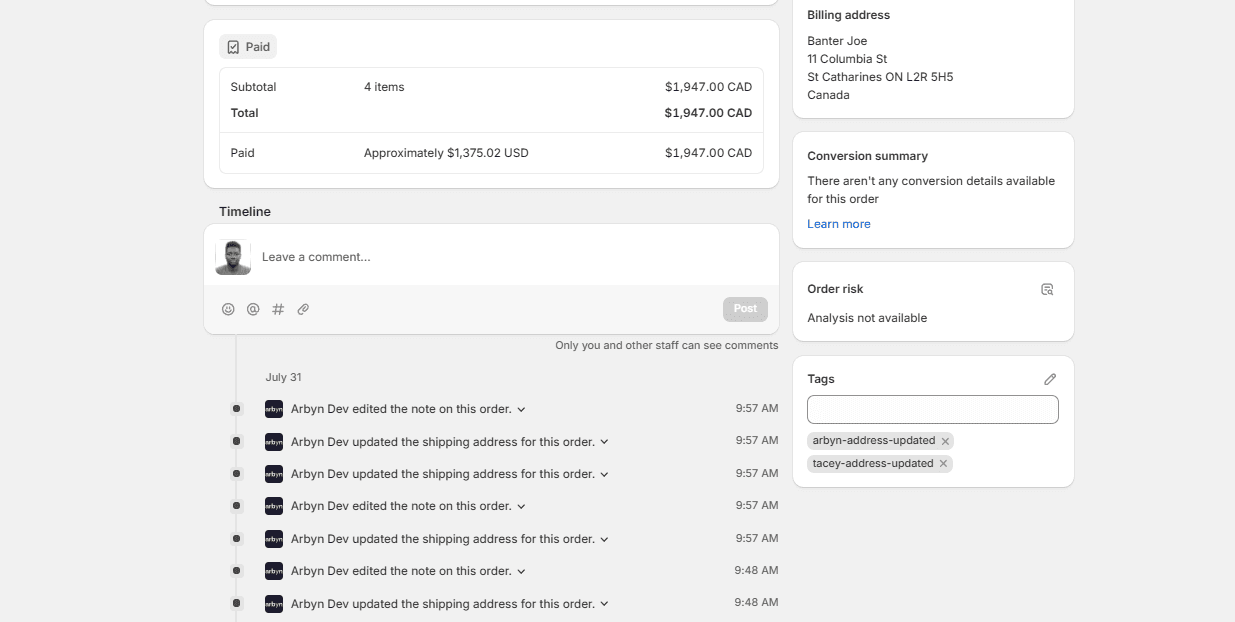
Furthermore, Arbyn is fully autonomous in executing logistical changes that do not involve financial transactions. The most common example is a customer request to update their shipping address post-purchase. This is a frequent source of manual work for store owners. Arbyn can authenticate the customer, access the order, and perform the address update directly in Shopify without needing your approval. This single capability can save a significant amount of administrative overhead and prevent costly shipping errors. The AI also autonomously manages its own conversational flow, detecting the customer's language to reply in their native tongue and adjusting its tone based on the calibration settings you've established. The system is designed to be a true agent, capable of independent action within a clearly defined, safe operational boundary. The escalations are the exception, not the rule, ensuring that your workflow is only interrupted when your direct oversight is genuinely required to protect your business.
Putting Control in the Hands of the Store Owner
Ultimately, the philosophy behind the Arbyn escalation guardrails is about placing final authority where it belongs: with the store owner. It’s a system designed not just for automation, but for trust. The goal is to create a support operation that is both highly efficient and fundamentally safe, eliminating the need to choose between speed and control. By automating the 95% of interactions that are repetitive and low-risk, you reclaim hundreds of hours. By placing a simple, one-click approval gate in front of the 5% of actions that involve your money, you protect your business from costly errors and fraud. This balanced approach allows you to scale your support capacity without scaling your headcount or your risk exposure. It’s a system that assists, but never presumes; it acts, but only with permission where it counts.
If a customer gets a wrong answer, gets stuck or feels like the company is hiding behind a bot to save money, the loss is much bigger than one bad ticket. It can lead to loss of trust, loss of brand reputation, and eventually, loss of that customer.
This structure provides a clear and predictable framework for your customer service. You know exactly what the AI will handle on its own and where it will pause to ask for your input. This eliminates the uncertainty and anxiety that can come with deploying a "black box" AI solution. You are not just hoping the AI makes the right call; you have a guarantee that for every critical decision, you will make the final call. This allows you to leverage the full power of modern AI for your store, confident that you have the right controls in place to protect your revenue, your inventory, and the relationship you have with your customers. The result is a support system that is not only more efficient and scalable but also more resilient and trustworthy.
If you're tired of the trade-off between manual overload and risky automation, and you want an AI agent that works for you without ever taking control from you, the solution is to use a tool built with the right philosophy from the ground up. Arbyn’s tiered system of autonomy and approval is designed to be that solution. You can handle a generous number of conversations for a single flat fee, with plans scaling up to unlimited volume, knowing you have complete control over every action that impacts your bottom line. To see how these guardrails can transform your support workflow, you can install Arbyn for free from the Shopify App Store and start with 150 full-featured AI conversations every month at no cost. It’s time to embrace automation without sacrificing authority.
Written by
For seven years I have led customer success and technical support inside high-growth SaaS and e-commerce companies. Customer Support Lead at DripShop.live, a live-commerce SaaS. Technical Support Specialist at Replo (Y...
View full profile