From Zero to AI Agent: Setting Up Your Free Arbyn Plan in Under 10 Minutes
Install a fully-featured AI support and sales agent on your Shopify store with our free plan, and get it handling real customer conversations in less than ten minutes.


It’s 9:17 AM on a Saturday. You’re not with your family, you’re not working on new product designs, and you’re certainly not relaxing. You are staring at an inbox of forty-seven nearly identical emails, all asking, "Where is my order?" Each one requires you to open your Shopify admin, find the customer's order, copy the tracking number, paste it into a canned response, and hit send. At ninety seconds per email, you’ve already lost over an hour of your weekend to a task a machine could do. This is not the work of a founder, whose time is better spent on high-leverage activities like negotiating with suppliers or analyzing ad campaign performance. This is the work of a human macro, a state that leads directly to the burnout that 51% of e-commerce entrepreneurs report experiencing on a daily basis. It's costing you the one resource you cannot buy more of: time. For store owners drowning in this exact scenario, the promise of a free shopify ai support setup feels like the only way out, a way to reclaim your weekend and focus on growth activities, like planning your next marketing campaign, without letting your customer service fall apart. But it has to be fast, it has to be real, and it cannot come with a surprise bill at the end of the month.
The False Choice: An Expensive Tool or the Manual Grind
For years, the Shopify ecosystem presented store owners with a deeply flawed choice for managing customer support. On one side, you have the manual grind. This is the default for every new store, the reality of answering every single email and chat message yourself or with a small team. While it offers complete control, its costs are deceptively high. They don't show up on a P&L statement as "Support Costs," but as founder burnout, missed growth opportunities, and a ceiling on how large your business can scale. With studies showing that an overwhelming 87% of founders report experiencing burnout, anxiety, or depression, the manual grind is a direct path to exhaustion. Every hour spent looking up an order status is an hour not spent scouting for new influencer partnerships, analyzing customer feedback for the next product iteration, or building a 12-month financial forecast. The true cost of this path is measured in the stagnation of your business, a direct consequence of the founder being trapped in the operational weeds instead of steering the ship.
On the other side of this dilemma are the traditional helpdesk and automation platforms. Tools like Gorgias and Zendesk promise a way out of the inbox, offering powerful tools to manage conversations at scale. The problem is that their billing models were built for a different era of the internet. Many are based on per-ticket or per-resolution pricing, which creates a fundamental conflict of interest: the more your business grows and the more customers you have, the more you are penalized with a higher bill. A recent analysis shows that the average cost per support ticket in ecommerce can range from $2.70 to $5.60, and sometimes much higher. For a store handling just 500 tickets a month, this can quickly translate into a software bill of thousands of dollars a year, even before accounting for the AI features. Critically, this often doesn't include the add-on fees for the AI itself, which can cost an additional dollar or more per automated resolution, creating a scenario where success is punished with escalating costs.
This structure forces store owners into a constant, stressful calculation. Can you afford to offer excellent, responsive support during your busiest season, or do you need to throttle customer engagement to keep your software costs from exploding? A founder might look at their Gorgias bill, see that automated interactions cost $1.50 each past the allowance their plan includes, and realize a Black Friday weekend with 2,000 automated interactions on the Pro plan, which includes 190, could add an unexpected $2,715 to their invoice. The $1.50 rate and the 190 allowance are Gorgias', read on their pricing page on 27 July 2026; the 2,000-interaction weekend is our assumption. This calculation is not hypothetical; it is the lived reality for thousands of brand store owners. Consequently, they might disable their site's live chat during a sale specifically to avoid these fees, knowingly hurting conversion rates and frustrating customers in the process. You are forced to choose between providing a great customer experience and protecting your margins. This is not a strategic decision; it's a structural failure of the tools themselves. They are designed to extract more value as your volume increases, rather than providing a fixed, predictable cost that allows you to scale with confidence. The search for a free solution isn't just about saving a few dollars; it's about breaking free from a billing model that punishes growth and reclaiming the operational stability needed to run your business effectively.
What a "Free" AI Agent Must Do to Be Useful
The market is flooded with "free" tools, but for a Shopify store owner, the word "free" can often be a Trojan horse for something useless. A free chatbot that can only say "Hello, how can I help?" before immediately asking for a human is not a solution; it's just another step in a broken process. It deflects nothing, creates a new ticket in your helpdesk, and frustrates customers who were promised instant help, resulting in a satisfaction-negative interaction. This type of bot violates the customer's expectation of immediacy, making the experience worse than simply sending an email. A truly effective free AI agent cannot be a glorified contact form. To actually solve the problem of inbox overload and deliver a positive customer experience, it must perform real work. This means it needs deep, functional integration with the Shopify platform itself. With "Where is my order?" (WISMO) inquiries consistently making up between 25% and 40% of all support volume for ecommerce stores, a figure that can rise to 60% during peak seasons, a free agent that cannot answer this one question on its own, instantly and accurately, has failed at its primary job.
To be genuinely useful, an AI agent must be able to access order information securely. When a customer provides their email address or order number, the agent needs the permission and the capability to look up that order in your Shopify admin, retrieve the current fulfillment status and tracking information, and present it clearly to the customer. This is accomplished through the same secure, standardized Shopify APIs used by major shipping apps like ShipStation and review platforms like Yotpo, ensuring data is handled safely and with your explicit consent. This single function, when performed reliably, can eliminate more than half of a typical store's support volume overnight. For a founder spending many hours per week on support, that translates to significant reclaimed time immediately. That is an entire workday restored, enough time to design and launch a complete email marketing flow, a task with a direct ROI that has been on the back burner for months. It frees up human agents to deal with the complex, nuanced, and high-value conversations that actually drive the business forward, like pre-sales questions or complex issue resolution.
Furthermore, a useful agent needs to be more than just a reactive WISMO-bot. It must understand the context of the conversation and the identity of the brand. This means having the ability to adopt your store's specific tone of voice, whether that's professional, friendly, or concise. A generic, robotic response like "Your order status is SHIPPED" reflects poorly on your brand; a tuned agent for a skate shop might say, "Good news! Your board is on its way," reflecting the brand's personality. The agent also needs guardrails, clear instructions on what it should and should not attempt to answer. You need the ability to define topics it can handle autonomously and to ensure it escalates any sensitive or complex queries, such as those containing words like "damaged," "allergic," "unhappy," "chargeback," or "legal," to a human immediately. A truly valuable free AI support setup provides not just automation, but also the control and confidence that come from knowing the agent is operating safely within the boundaries you've established, protecting your brand from both reputational and financial risk.
The 10-Minute Setup: A Step-by-Step Operational Walkthrough
Getting a real AI agent live on your site should not require a week of technical consultations or a complex implementation project. The entire point is to save time, starting with the setup itself. While typical business software implementations for small to medium businesses can take anywhere from four to eight weeks, involving multiple discovery calls, data mapping sessions, and user acceptance testing, a modern AI tool should be operational in minutes. This speed is not a gimmick; it reflects a fundamental difference in product philosophy, one that prioritizes founder efficiency over billable implementation hours. With the right tool, you can go from a cluttered inbox to a fully functioning AI agent in the time it takes to drink a cup of coffee. The following steps walk through the exact process for setting up your Arbyn agent, a process designed for busy store owners, not IT departments. From start to finish, this should take less than ten minutes. The process is simple, requires no code, and by the end of it, you will have a tangible asset working for your business, saving you from the tasks that lead to founder burnout.
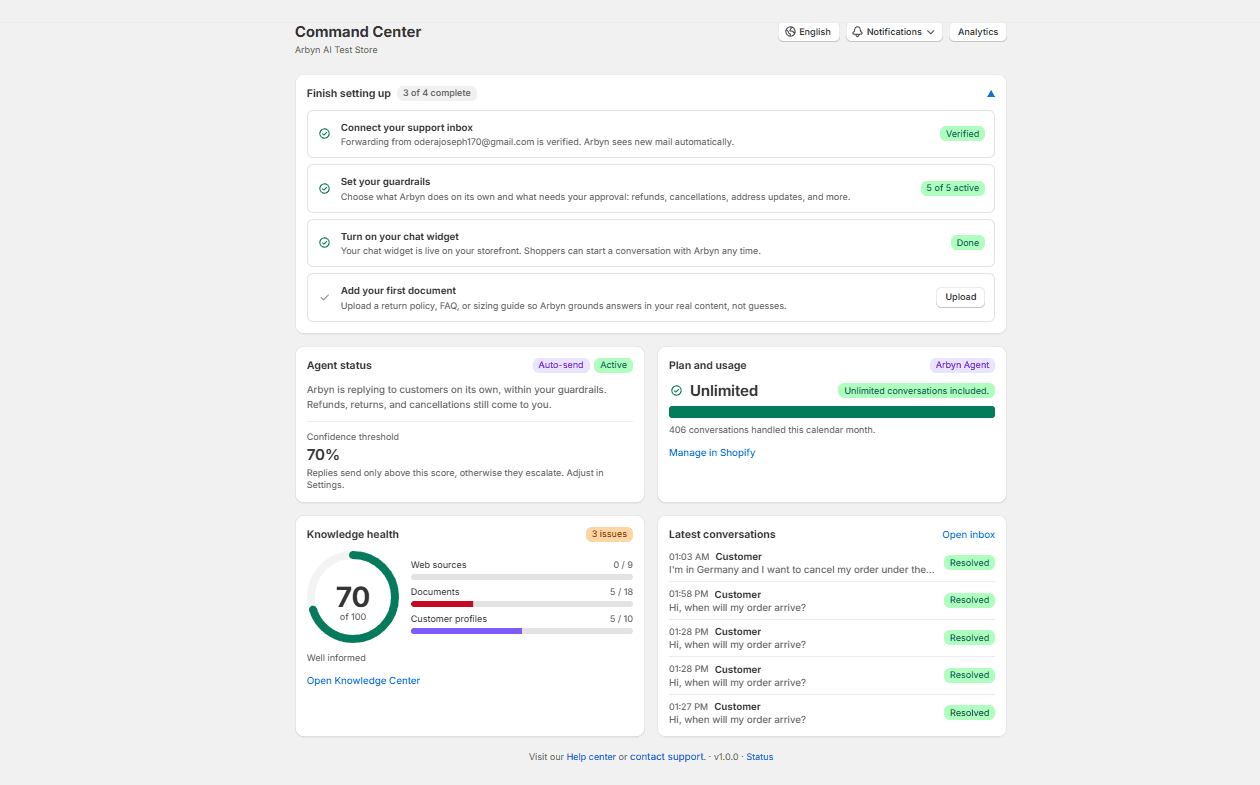
First, you will install the agent from the Shopify App Store. This process is standardized for all Shopify apps and ensures a secure connection to your store. Navigate to the Arbyn: Support & Sales Agent listing on the app store and click "Install." Shopify will then present you with a permission screen. This is a critical step to understand, as it preempts any anxiety about security. The permissions Arbyn requests, like read access to orders and customers, are what allow it to perform real work. Access to orders is required to find tracking numbers and check fulfillment status, and access to customer profiles is needed to match an email address to an order history. The app does not request permissions to alter products or process payments. Approving these permissions is what gives the agent its power. Once installed, you will be taken directly into the Arbyn dashboard, which is embedded seamlessly within your Shopify admin for a smooth, integrated experience that feels native to your existing workflow.
The second and final phase of the core setup involves the initial configuration. You will be prompted to choose your plan. Select the Arbyn Starter plan, which is permanently free and includes 150 AI-handled conversations per month. This is not a temporary offer that relies on you forgetting to cancel; it is simply free, permanently. Next, you will set your agent's tone. You have three initial options: Professional, Friendly, or Concise. This choice dictates the personality of your agent by adjusting hundreds of micro-decisions it makes, from using contractions to choosing synonyms, ensuring its responses align with your brand's voice from the very first interaction. Finally, you will activate the on-site chat widget. With a single click, the chat icon will appear on your storefront, ready to engage with customers. That's it. In these few clicks, a process that takes less time than a single manual WISMO response, you have installed, configured, and deployed a live AI agent. It is now actively monitoring your site, ready to handle incoming chats and emails and give you back your time.
Calibrating Your Agent: From Raw Install to Trusted Teammate
The initial 10-minute setup gets your agent on the field, but the next phase is what turns it into an all-star player. This is the fine-tuning process, a crucial period where the AI moves from a generic tool to a specialized member of your team. This initial phase is not a passive waiting game; it's an active opportunity for you to train the agent on the nuances of your business, ensuring its responses are not just accurate, but also contextually intelligent and perfectly aligned with your brand's unique voice and policies. Think of it less like configuring software and more like onboarding a new employee who happens to be a very fast learner, but with a training period that costs you nothing and requires minimal hands-on management from you.
The primary source for this fine-tuning is your own history. Arbyn will analyze the sent mail folder of your connected support inbox, studying the thousands of replies you've already written. It learns your phrasing, your tone, and the specific ways you handle recurring questions about shipping, returns, and product details. This is not about simply copying and pasting your old responses. The AI identifies patterns in your language and operational logic to build its own understanding of your store's "correct" way of communicating. For instance, if you consistently tell customers in California that shipping takes 3-5 business days, but tell customers in New York it takes 5-7, the agent learns this regional shipping nuance directly from your past behavior without you programming a single rule. This process is foundational because it ensures that when the agent starts talking to customers, it sounds like it comes from you, maintaining the consistent brand voice you've already worked hard to establish.
Beyond analyzing past emails, you can actively guide the agent by setting up guardrails and knowledge sources. Within the Arbyn dashboard, you can provide links to your store's FAQ page, shipping policy, and return policy. The agent will ingest and learn from these documents, using them as its source of truth when answering customer questions. This is far more effective than manually programming dozens of responses because it eliminates "knowledge rot," where a bot's answers become outdated. If you update your return policy on your website, you only need to update it in that one place; the agent will automatically learn the new information upon its next sync. You can also set explicit escalation triggers that combine conditions for more sophisticated routing. For example, you can instruct the agent to immediately escalate any conversation where `order_status` is `delivered` AND the `message` contains `not received`, as this could indicate a stolen package requiring a human touch. This combination of passive learning from your history and active guidance through your policies creates a reliable, trustworthy teammate in just a few days, not weeks or months.
Beyond WISMO: Setting Up Proactive Sales Triggers
Once your AI agent has mastered the art of reactive support and is competently handling the daily flood of "Where is my order?" inquiries, its true potential begins to emerge. A properly configured agent is not just a defensive tool for cost-saving and time-saving; it is a proactive asset for revenue generation. Research consistently shows that website visitors who engage with live chat convert at a significantly higher rate, with some studies showing a 40% increase in conversion rate. The biggest mistake founders make is viewing support as purely a cost center. Your most engaged customers are often those with a question; they have high purchase intent and are actively seeking information. The same technology that allows the agent to understand a customer's support query can be used to identify and act on buying signals. Moving beyond basic support is the final, and most valuable, step in leveraging your new AI teammate. This is about transforming your support channel from a cost center into a profit center, a function that is included and ready to be activated even on the free Arbyn Starter plan.
The first step is to configure proactive triggers. Instead of waiting for a customer to ask a question, the agent can initiate a conversation based on their behavior on your site. For instance, you can set up a trigger for a visitor who has been dwelling on a specific product page for more than 60 seconds. The agent can pop up with a helpful, non-intrusive message like, "I see you're looking at the M-65 jacket. We have a sizing guide that might be helpful, would you like to see it?" This is a context-aware intervention designed to overcome a specific point of friction. With sizing uncertainty being a key driver of cart abandonment in the fashion industry, which sees abandonment rates as high as 76.48%, this single prompt can directly address a major conversion blocker. You can set up similar triggers for customers who have a high-value cart but seem to be hesitating for over three minutes, turning visitor hesitation into active, helpful engagement that can save a sale.
The next level of proactive engagement is using the agent as a conversational sales associate. Arbyn can be configured to run product quizzes directly within the chat widget. For a skincare brand, the agent could ask, "What's your primary skin concern?" and "What's your skin type?" before recommending a specific routine of products from your catalog. This is a far more engaging and effective experience than making a customer read through dozens of product descriptions. The agent can also make intelligent upsell and cross-sell recommendations. If a customer asks about the warranty on a specific camera, after answering the question, the agent can add, "Many photographers who buy that model also pick up an extra battery pack to extend their shooting time. Would you like me to add one to your cart?" This is the digital equivalent of the helpful, knowledgeable retail employee, and it's a powerful way to increase average order value, something customers who engage with chat are already prone to do, spending up to 60% more per order.
The traditional divide between support and sales is an artificial one, a relic of siloed departments and disconnected software. In reality, the best time to make a sale is when you have a customer's full attention and are actively helping them solve a problem. That Saturday morning inbox of forty-seven emails is not an inevitability; it is a choice. In the ten minutes it took to read this guide, you could have already completed your free shopify ai support setup. An agent could be live on your site right now, not just answering the repetitive questions that drain your day, but actively engaging customers, solving their problems, and intelligently guiding them toward a purchase. Studies show that 79% of businesses report that implementing live chat has had a positive effect on their sales, revenue, and customer loyalty. Reclaiming the 5 to 10 hours you lose each week to manual support is the first step. What you do with that reclaimed time, developing new products, optimizing ad spend, or finally taking a Saturday off, is how your business will truly grow. The first step is to install Arbyn from the Shopify App Store and reclaim your time.
Written by
For seven years I have led customer success and technical support inside high-growth SaaS and e-commerce companies. Customer Support Lead at DripShop.live, a live-commerce SaaS. Technical Support Specialist at Replo (Y...
View full profileKeep reading
View all posts
How Arbyn's Calibration Period Works: Teaching Your Agent Your Voice
Odera Joseph · 9 min
Setting Up Arbyn on Shopify: What Happens in Your First 10 Conversations
Odera Joseph · 5 min

Shopify Abandoned Cart Emails Not Working? Why a Chat Agent Is Your Next Best Bet
Odera Joseph · 6 min