Configuring Approval Workflows in Arbyn: What Requires Your Tap and What Doesn't
Learn how to configure Arbyn’s two-layer action model, separating fully autonomous tasks from money-moving actions that require your approval.


You open your laptop, and the support inbox is already a minefield of decisions. One customer needs a shipping address corrected, a simple typo. Another wants to cancel an order placed two hours ago. A third just sent a photo of a damaged item, requesting a full refund. Each requires a different level of scrutiny and a different set of clicks inside the Shopify admin. The address change is a quick fix, but you still have to find the order, open the editor, and save. The cancellation is straightforward, but you need to ensure it hasn't shipped. The refund is a judgment call; it involves inspecting the photo, checking the order value, and then navigating Shopify's refund interface, all while your actual work for the day waits. This constant context-switching isn't just a time sink; it's a drain on your focus. An effective arbyn approval workflow setup is designed to eliminate this friction, not by taking away your control, but by giving you a smarter, faster way to exercise it.
The Hidden Operational Tax of Manual Action
For most Shopify store owners, the daily grind of processing post-purchase requests feels like a non-negotiable cost of doing business. You handle them between other tasks, thinking of it as a few minutes here and there. In reality, this manual intervention carries a steep, often invisible, operational tax. Every request to cancel, refund, or reship an order forces a workflow diversion. You must stop what you are doing, open a new browser tab, log into Shopify, search for the order, verify the customer's request, and then carefully execute a series of clicks. A single manual data entry error during this process, a mistyped address on a reshipment or an extra zero on a refund, can turn a two-minute task into a costly, multi-day cleanup. Research indicates that even a modest manual data entry error rate of 1-4% can translate into significant costs, with the cost to fix a single error estimated to be between $10 and $40. For a store handling hundreds of orders, this isn't a rounding error; it's a substantial and preventable business expense.
This process is not just inefficient; it's prone to failure as your business grows. What works at ten orders a day begins to crack at fifty and completely shatters at two hundred. The time spent manually processing these actions is time not spent on marketing, product development, or strategic planning. One study found that nearly two-thirds of inventory or fulfillment issues stem from human error in manual processes. These aren't just logistical headaches. When you have to tell a customer you sold them an item that was actually out of stock, or when a refund takes days longer than promised because you were buried in other tasks, it directly erodes trust. The cumulative effect is a business that is constantly reacting, putting out small fires instead of building for the future. Automating the execution of these tasks is the clear solution, but complete, unchecked automation comes with its own set of significant risks.
The core tension lies between efficiency and control. You want to eliminate the tedious clicks, but you cannot afford to give an automated system a blank check to issue refunds or send out free products. The fear of an AI agent being too generous with discounts, falling for a fraudulent return claim, or refunding a high-value order without a second look is entirely valid. This is where the concept of a "fully autonomous" support agent often breaks down for store owners. The goal shouldn't be to remove your authority but to make exercising that authority as fast and frictionless as possible. The ideal system absorbs the administrative burden of the task while leaving the critical go-or-no-go decision squarely in your hands, presented with all the necessary context to make a five-second judgment call instead of a five-minute investigation.
Why Full Autonomy Is a Double-Edged Sword
The promise of a completely hands-off, fully autonomous support agent is alluring. The idea of an AI handling every customer request from start to finish while you focus on growth is the ultimate ecommerce dream. However, for any action that directly moves money or inventory out of your business, this dream can quickly become a nightmare. Giving an AI agent unrestricted permission to issue refunds, cancel orders, or send gift cards is a significant financial risk that most store owners are right to be wary of. The threat of return fraud and policy abuse is not theoretical; it's a massive and growing problem, costing retailers over $103 billion in 2024, with about one in seven returns involving some form of abuse. An AI, no matter how intelligent, may not have the nuanced human judgment to distinguish a legitimate complaint from a sophisticated "digital wardrobing" scheme.
This is not a failure of AI technology but a recognition of business reality. Certain decisions are, and should remain, the store owner's prerogative. A request for a 50% discount on a future order because of a minor shipping delay is a strategic decision, not a technical one. It depends on the customer's lifetime value, your current margins, and your store's policies. A request to return a high-value item requires a level of scrutiny that balances customer satisfaction with fraud prevention. Handing these decisions over entirely to an automated system means ceding control over your store's financial health and customer service policies. An AI optimized to close tickets quickly might issue a refund where a human would have offered a replacement, or grant a discount that violates your established rules. This loss of control is a steep price to pay for saved time.
The challenge, therefore, is not to achieve 100% autonomy across all actions. Instead, it is to build a system that intelligently separates low-risk, high-frequency administrative tasks from high-risk, money-moving decisions. An AI should be able to update a shipping address on its own because the risk is low and the customer benefit is high. But when it comes to issuing a $200 refund, the AI's role should be to do all the legwork: understand the customer's request, pull up the order details, calculate the refund amount, and present a clear, one-click action for your approval. This model, often called "human-in-the-loop" automation, provides the best of both worlds. It grants the massive efficiency gains of automation while preserving the essential financial and policy control that a store owner needs to maintain. The goal is not to be hands-off, but to be hands-on in a fraction of the time.
A Practical Guide to Your Arbyn Approval Workflow Setup
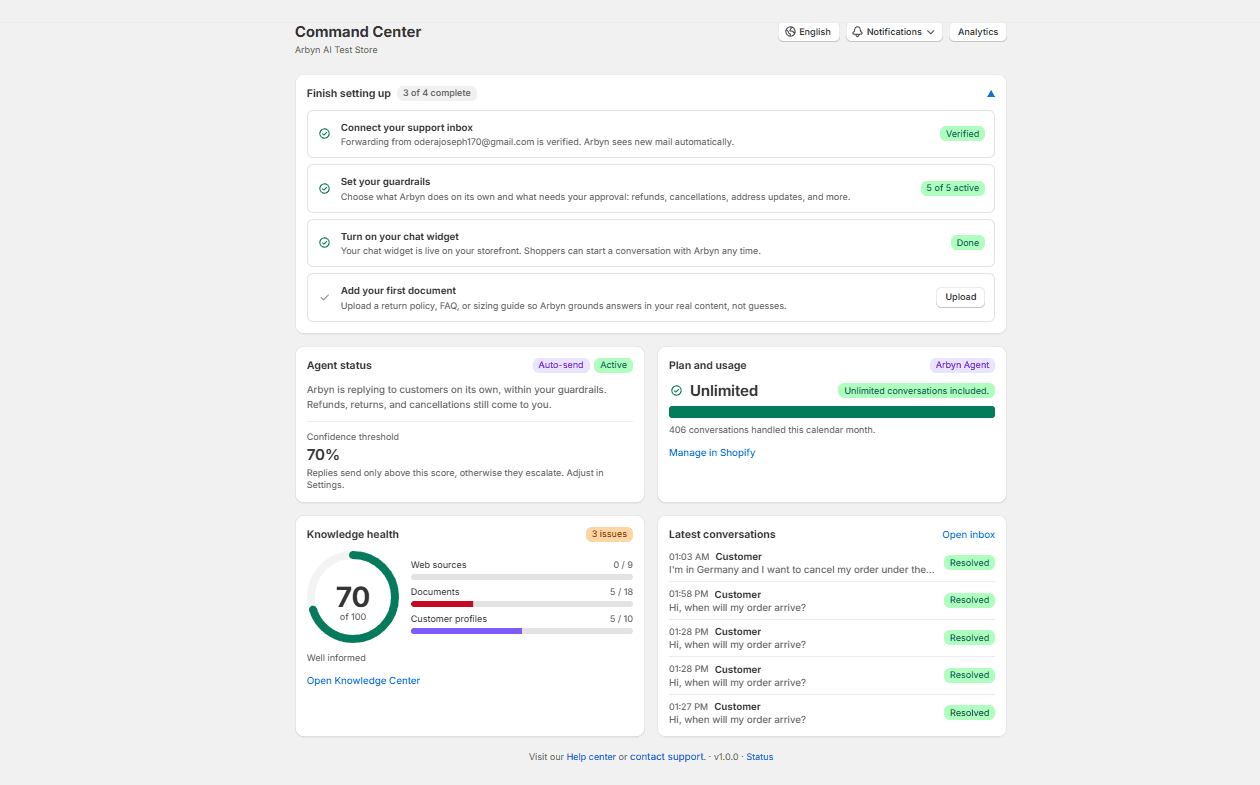
Arbyn is built on this exact principle of smart, gated autonomy. It doesn't treat all Shopify actions the same. Instead, it operates on a two-layer model that distinguishes between tasks it can perform entirely on its own and those that require your explicit, one-tap approval. Understanding this distinction is the key to a successful arbyn approval workflow setup. It allows you to delegate the busywork without ever surrendering control over the actions that have a real financial impact on your store. This structure is not a temporary limitation; it is a deliberate design choice that prioritizes your security and control over your cash flow and inventory. The system is engineered to make your approval step as fast and seamless as possible, turning a multi-step process in the Shopify admin into a single interaction within the conversation thread.
This section provides a concrete walkthrough of Arbyn's action model, clarifying exactly what happens automatically versus what waits for your tap. For store owners coming from systems like Gorgias or dealing with the complexities of Intercom, this approach is fundamentally different. It’s not about escalating a ticket for you to handle manually. It’s about Arbyn teeing up the *entire* action, ready to execute, and waiting for your final confirmation. Once you tap "Approve," Arbyn performs the real Shopify mutation, processing the refund, canceling the order, creating the discount, and then confirms the action back to the customer. You never have to leave the conversation or open the Shopify admin. This is the core of the workflow: you provide the judgment, Arbyn provides the execution.
Layer 1: The Fully Autonomous Action
In Arbyn's current framework, there is one critical customer request that is handled with complete autonomy, requiring no human intervention at all: changing a shipping address. This action was chosen specifically because it represents a high-frequency, low-risk task that offers immense value when automated. Customers frequently make small typos in their address or realize they need to ship an order to a different location shortly after purchase. Manually handling these requests, while simple, is a repetitive time sink. Arbyn identifies the customer's intent to change their address, collects the new information within the chat or email conversation, validates it, and directly updates the shipping address on the corresponding Shopify order. This happens in the background without you ever needing to see the conversation. The benefit is twofold: the customer gets an instant resolution, and your team is freed from a constant stream of simple administrative edits, allowing them to focus on more complex issues.
Layer 2: The Approval-Gated Actions
This is where Arbyn’s model provides a powerful combination of automation and control. For any action that involves moving money, creating liabilities, or sending out products, Arbyn’s AI does all the preparatory work but pauses for your final approval. This is the safety net that prevents unwanted financial transactions. Here’s how it works for each specific action:
- Cancel Order: When a customer requests to cancel an order, Arbyn understands the intent and verifies the order's fulfillment status. It then presents the cancellation request to you directly within the conversation view. You see the order details and a simple "Approve" button. If you tap it, Arbyn proceeds to cancel the order in Shopify and informs the customer. If you deny it, perhaps because the order has already shipped, you can instruct Arbyn to relay that information instead. You make the strategic call; Arbyn handles the execution.
- Issue Refund: This is one of the most sensitive actions. A customer might request a refund for a damaged item, a late delivery, or simple dissatisfaction. Arbyn's AI parses the request, identifies the order, and calculates the proposed refund amount based on the conversation (e.g., a full refund or partial refund for a specific item). This proposed refund is then surfaced to you for approval. You have the final say on whether to release the funds. This workflow prevents automated refunds for fraudulent claims or in situations that violate your store’s return policy, giving you complete financial control.
- Apply Discount: Offering a discount to appease an unhappy customer or to incentivize a future purchase is a common support tactic, but it directly impacts your margin. If a customer is asking for a discount, Arbyn can create a unique discount code based on your pre-set rules (e.g., "15% off next order"). However, it will not send this code to the customer without your approval. You see the request and can approve the creation and sharing of the code with a single tap, ensuring your discount policies are never abused.
- Send Gift Card: Similar to discounts, issuing a gift card is a direct financial liability. Whether it's to resolve an issue or as a gesture of goodwill, you need to control when and for how much these are issued. Arbyn will tee up the gift card creation, specifying the amount and recipient, but will wait for your explicit approval before executing the action in Shopify and sending the gift card to the customer.
- Reship an Order: When a package is lost in transit or an item arrives broken, a reshipment is often necessary. This involves creating a new draft order in Shopify, which has inventory and cost implications. Arbyn can prepare this entire draft order for you, duplicating the original items and setting the price to zero. It then presents this to you for final confirmation before creating the order and notifying the customer that a new shipment is on its way.
- Start a Return: Managing returns is a complex process. Arbyn can initiate the first step by understanding the customer's request to return an item. It will then flag this for your approval, allowing you to confirm that the item is within its return window and eligible for return according to your policy. Once you approve, Arbyn formally starts the return process in Shopify and provides the customer with the next steps. This gated approach is crucial for managing the logistics and costs associated with reverse logistics, which is a significant challenge for online retailers.
Reclaiming Your Time: The Operational Impact
Adopting a structured approval workflow is not just an incremental improvement; it fundamentally changes the nature of your daily operations. The manual process of handling post-purchase requests is a classic example of "death by a thousand cuts." Each individual task, a refund, an address change, a cancellation, might only take a few minutes, but the cumulative effect is a significant drain on your most valuable resource: your time. When you spend two or three hours a day toggling between your inbox, your helpdesk, and the Shopify admin, you are losing entire blocks of time that could be dedicated to strategic growth. This constant context switching fragments your attention, making deep work on marketing campaigns, supplier negotiations, or product sourcing nearly impossible. The operational impact of an intelligent approval workflow is the consolidation of these scattered minutes into reclaimed hours, giving you back the headspace to run your business instead of just reacting to it.
Imagine the morning routine described earlier, but with Arbyn's workflow in place. Instead of a to-do list of manual tasks, you see a short queue of approval requests inside a single interface. The address change has already been handled autonomously. The cancellation request appears with the order details and a single "Approve" button; you tap it, and Arbyn executes the cancellation and notifies the customer. The refund request for the damaged item is presented with the customer's photo, the order value, and a proposed refund amount. You review it, tap "Approve," and move on. What previously took an hour of fragmented, error-prone work across multiple browser tabs is now completed in under two minutes. This is not about abdicating responsibility; it's about making your decisions more efficient. You are still the one in control, but your involvement is reduced to the most critical step: the judgment call.
This efficiency compounds over time. For a store owner handling 20-30 such requests per day, a savings of five minutes per request translates into over two hours of reclaimed time daily. This is time you can now invest in activities that actually grow your bottom line. Furthermore, it introduces a level of consistency and speed that is difficult to achieve manually. Customers receive faster resolutions, which improves satisfaction and builds loyalty. Your operational processes become more robust and less dependent on your constant, direct involvement. This scalability is crucial. As your order volume grows, an automated workflow with approval gates scales effortlessly. The process for approving ten refunds is the same as for approving one hundred. In contrast, a manual process quickly becomes a bottleneck, limiting your store's growth potential because you simply run out of hours in the day.
Setting Guardrails Beyond the Default Workflow
A powerful arbyn approval workflow setup goes beyond simply approving or denying requests as they appear. The true potential is unlocked when you combine these approval gates with Arbyn’s underlying calibration and escalation guardrails. This allows you to define the policies and conditions under which the AI should even surface an approval request in the first place. Think of it as setting the rules of engagement for your AI agent. You can teach Arbyn your store's specific policies on refunds, discounts, and returns, ensuring that it only presents you with requests that are already within the realm of your established business logic. This proactive configuration acts as a filter, reducing the number of invalid or out-of-policy requests that ever reach your approval queue, further saving you time and mental energy.
For example, you can configure guardrails around your refund policy. You might instruct Arbyn that refunds are only considered for orders placed within the last 30 days and only if the customer provides a photo of the damage. When a request comes in from a customer who ordered 60 days ago, Arbyn can be trained to automatically inform them that the order is outside the return window, without ever needing to bother you. Conversely, when a request meets all your criteria, it gets packaged neatly and sent to you for that final, one-tap approval. Similarly, you can set rules for discounts. You might establish a policy that a 10% discount can be offered for a shipping delay of more than five days, but never more. Arbyn will learn this rule and only propose a 10% discount for your approval in those specific scenarios.
This level of calibration turns your approval workflow from a reactive process into a strategic one. You are no longer just a gatekeeper; you are the architect of your store's automated support policy. By investing a small amount of time upfront to teach Arbyn your rules, you create a system that reflects your business values and protects your margins. This also allows you to define clear escalation paths. For complex or sensitive situations that fall outside the defined rules, like a loyal customer with an unusual request, you can instruct Arbyn to immediately escalate the entire conversation to a human agent. This ensures that nuanced issues receive the personal attention they deserve, while routine, policy-bound requests are handled with maximum efficiency. Ultimately, this combination of calibration and gated approvals creates a robust, scalable, and secure support operation that empowers you to delegate tasks without ever giving up meaningful control.
The distinction between full autonomy and gated, one-tap approvals is the critical factor in building a support system you can trust. By automating low-risk administrative tasks and streamlining the approval process for all money-moving actions, you get the efficiency of AI without the financial exposure. This two-layer approach ensures that you, the store owner, always retain the final say on decisions that impact your bottom line. It transforms support from a manual chore into a quick, decisive review process, freeing up hours of your time to focus on growing your brand. If you are ready to implement a smarter workflow that balances automation with control, you can install Arbyn from the Shopify App Store and configure your approval settings today.
Written by
For seven years I have led customer success and technical support inside high-growth SaaS and e-commerce companies. Customer Support Lead at DripShop.live, a live-commerce SaaS. Technical Support Specialist at Replo (Y...
View full profile