CHATTERgo vs Arbyn: Agentic AI Chatbot vs Support and Sales Agent
The line between an agentic chatbot and a true support and sales agent is defined by one thing: the ability to take action.


A new vocabulary is quietly taking over ecommerce operations. The term "agentic AI" has moved from research papers to the feature lists of the tools competing for a spot on your Shopify store, with the market for agentic AI in retail expected to reach over $60 billion in 2026. It promises an AI that doesn't just talk but does. It can plan, reason, and act to achieve a goal, such as diagnosing a customer’s complex, multi-part question like, "My order #12345 just shipped, but can I still add the matching belt to it, and will it arrive by Friday?" and synthesizing a single, perfect answer from product data, order history, and store policies. This evolution marks a clear break from the scripted, keyword-driven chatbots of the past, which often felt more like interactive FAQ pages than genuine assistants, leading to significant customer frustration and, in many cases, outright purchase abandonment. But as this new category matures, a critical distinction is emerging between two very different philosophies: the agentic AI chatbot, designed to master the conversation, and the true support and sales agent, designed to own the outcome. Understanding the difference isn't just academic; it has a direct and significant impact on your support costs, your team's workload, and your ability to turn service conversations into revenue.
The split comes down to a simple question. When a customer asks for something that requires changing an order, issuing a discount, or processing a return, what happens next? Does the AI provide a helpful explanation of the process for the customer to follow, or does it perform the action itself? One model informs, the other executes. One is a concierge, the other is a store owner. A tool like CHATTERgo, a name representing the new wave of powerful conversational AI, excels at the former. It lives in the chat widget, understands complex natural language, and offers personalized recommendations, much like a hotel concierge who can give you a brilliant restaurant recommendation but cannot drive you there. It is a brilliant conversationalist, capable of handling a huge number of inquiries. An integrated support and sales agent like Arbyn is built on a different premise: that conversation is a means to an end. The goal isn't just to answer the question, but to resolve the underlying need by taking real, concrete actions inside your Shopify admin, like actually processing the return and sending the shipping label. This distinction, between talking and doing, is the central economic and operational choice facing store owners today.
The Agentic Chatbot Model: A Powerful Conversationalist
The new generation of AI chatbots, which we can represent with archetypes like CHATTERgo, are a world away from their predecessors. They leverage large language models to understand nuance, recall conversational context, and access your product catalog in real time, meaning they can parse complex sentences, understand typos, and maintain a consistent brand personality, from playful to formal, throughout a conversation. They can guide a customer through complex product comparisons, offer styling advice like which earrings best complement a specific dress, and proactively engage a hesitant shopper with a timely offer. Research consistently shows that visitors engaged through chat convert at significantly higher rates, making this a powerful feature. In essence, they are expert digital sales associates, available 24/7. This is a massive leap forward from rigid decision trees, providing fluid and personalized shopping experiences that can increase average conversion rates by 20% or more. They are designed to be brilliant front-of-house staff, capable of turning a casual browser into a confident buyer.
The core design principle of the agentic chatbot is conversational mastery. It aims to handle any question a customer could have about products, policies, or promotions, all within the confines of the chat widget. It can expertly tell a customer how to initiate a return by linking to a returns portal, explain the shipping policy for international orders, or confirm if an item is out of stock. The "agentic" part comes from its ability to reason and plan its conversational path to achieve a goal, such as making a sale or providing a complete answer. However, the architecture of these tools often confines their actions to the conversation itself. This is an intentional design choice, making the tools easier to deploy across various platforms but limiting their depth on any single one. When the time comes to execute a task outside the chat, like canceling an order, changing a shipping address, or issuing a refund for a damaged item, the model typically hits a hard wall. Its tone shifts from a capable assistant to a passive go-between: "I've created a ticket for you; our team will respond within 24 hours."
This isn't a failure of the technology, but a deliberate design choice. These tools are built to be exceptional communicators and information retrievers, operating as a sophisticated layer on top of your existing store. They solve the informational part of customer service, which for many stores can be a significant volume of tickets; inquiries like "Where Is My Order?" (WISMO) alone can account for 20% to 40% of all support volume. But they leave the operational tasks, the ones that directly manipulate orders and customer data in the Shopify backend, for the human team. This creates a clear division of labor: the AI handles the talking, and the humans handle the doing. For a store owner, the critical question is what percentage of their support workload falls into that second category. Even if an AI handles the initial conversation, the true cost includes the manual labor, context-switching time, and potential for human error that comes with every ticket the human team must still manually complete. Studies show that task switching can reduce an employee's productivity by up to 40%, a hidden but substantial operational expense.
Where Chatbots Hit the Wall: The Action Gap
The moment a customer conversation requires more than information, the limits of a pure chatbot model become clear. A shopper asking, "Can you change the shipping address on my last order? I accidentally used my old address," or "This arrived damaged, I'm so disappointed and need a refund," has moved beyond a query and into a request for action. An agentic chatbot can understand the request perfectly. It can verify the customer's identity, pull up the order details, and even tell them what the process for an address change or refund is. But in most cases, it cannot perform the final step because it lacks the "write" permissions to the core Shopify platform. The conversation ends with the bot creating a ticket, assigning it to a human, and telling the customer someone will be in touch. This is the "action gap": the space between knowing what needs to be done and having the authority and integration to do it.
This gap has significant operational costs. First, it introduces a delay that directly impacts customer satisfaction. The customer, who was having an instant, real-time conversation, is now placed in a queue, turning a 60-second chat into a potential multi-hour wait for resolution. This erodes the seamless experience the AI was supposed to provide, and research shows that satisfaction drops sharply with every additional contact required to solve a problem. Second, it creates a broken workflow for your team. Your support staff receives a ticket with the AI's conversation context, but they still have to open multiple browser tabs for the helpdesk and Shopify admin, copy-paste the order number, execute the task, and then return to the ticket to confirm the action. This constant "context switching" is a major productivity drain, with studies indicating it can take over 23 minutes to fully refocus after an interruption, leading to errors and burnout. The AI has acted as a highly effective intake coordinator, but your team is still performing the core operational task, a "last mile" of manual action that represents a substantial and recurring labor cost.
Furthermore, this model often comes with a complex and unpredictable billing structure. Many leading platforms, including Gorgias and Intercom Fin, use a usage-based model that charges per ticket or per "resolution." A resolution is typically defined as a conversation the AI handles without human intervention. This sounds straightforward, but it can lead to surprising bills as you are paying for conversations, not completed actions. An AI might successfully answer a dozen WISMO ("Where Is My Order?") questions, and you pay for each one. Some platforms even "double-bill," where an automated interaction counts against your plan's ticket allowance and incurs a separate AI fee. As your ticket volume grows, or during seasonal peaks like Black Friday, these per-resolution fees can accumulate rapidly. This turns a seemingly affordable tool into a major monthly expense, creating "meter anxiety" where you're penalized for successfully engaging more customers.
The Support and Sales Agent: A Different Philosophy
In contrast to the chatbot model, a true support and sales agent is designed to bridge the action gap. This approach, embodied by Arbyn, views the AI not as a conversational layer, but as an integrated store owner. The goal is not just to understand the customer's request, but to fulfill it from end to end. This requires a deeper level of integration with the Shopify platform, built as a native app with "write" permissions. An agent doesn't just read product and order data; it can modify it. When a customer asks to change a shipping address, the agent doesn't escalate, it validates the new address and updates the order directly in Shopify. It can add tags like ‘VIP’ to customer profiles, modify order notes with conversation summaries, or even generate a draft order for a custom request, all within the same interaction. This is the core philosophical difference: the AI is empowered to perform the job, not just talk about it.
Of course, giving an AI autonomous control over business operations, especially those involving money, requires careful controls. This is where a hybrid approach becomes essential. For sensitive, money-moving actions like issuing refunds, canceling orders, or sending gift cards, Arbyn uses an approval-gated workflow. The AI understands the request, prepares the action by calculating the precise refund amount according to store policy, and presents it to the store owner for a single-click approval in a notification, such as a Slack message or mobile alert. The key distinction is that the store owner provides authorization, but the agent does the work. Once approved, the agent executes the action, processing the refund through Shopify Payments, officially canceling the order, or generating and sending the gift card code. This maintains human oversight on critical decisions while still automating the laborious, multi-step process, turning a five-minute manual task into a five-second review.
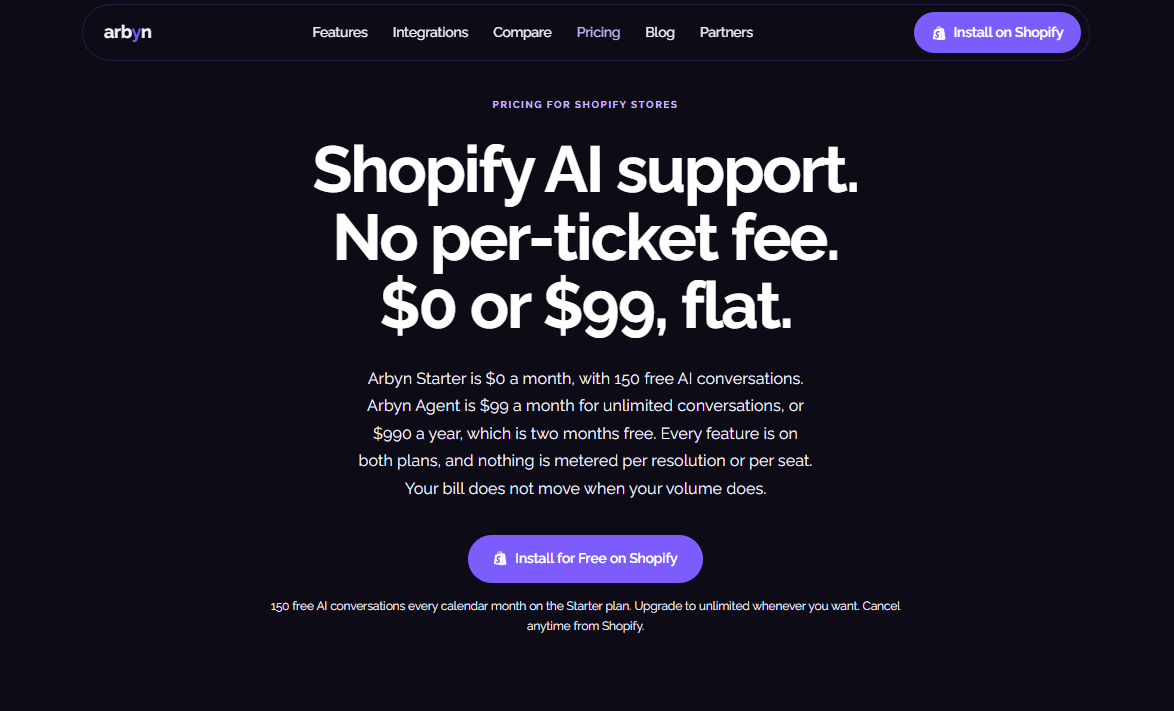
This model fundamentally changes the economic equation. Instead of paying per conversation or per resolution, you pay a flat monthly fee for an agent that can handle unlimited conversations and actions. Arbyn's pricing is structured this way, with a free plan for up to 150 conversations, a $59/month plan for 500, and a $99/month plan for unlimited volume. There are no overage fees and no charges per AI action. This predictable cost structure allows store owners to scale their support volume without fearing a runaway bill. The value is measured not by the number of chats handled, but by the number of end-to-end tasks completed. This shifts the AI from a metered cost center to a fixed-cost operational asset, freeing up the human team to focus on complex, high-value customer relationships rather than repetitive, error-prone duties.
The Economics of AI: Per-Resolution vs. Flat Rate
The choice between an agentic chatbot and an integrated support agent ultimately comes down to economics. The prevailing pricing model in the market is usage-based, typically charging per resolution, per interaction, or per ticket, often on top of a monthly base fee and per-seat costs for human agents. This model can seem attractive at low volumes, but it carries inherent unpredictability and can scale in ways that penalize growth. A store experiencing a viral moment, a new product launch, or a holiday rush can see its support bill triple overnight. This happens not because its base subscription changed, but because the volume of billable AI interactions exploded. This creates "meter anxiety," where a business might hesitate to fully leverage automation for fear of running up the bill, effectively punishing success and high engagement.
Let's look at the numbers. Intercom Fin, a powerful AI agent, is priced at $0.99 per resolution on top of seat-based plans that can range from $29 to over $132 per agent per month. A small team with two agents handling 500 AI resolutions a month could see a bill around $665. Gorgias, a dominant player in the Shopify ecosystem, has a structure involving ticket allowances, overage fees, and a separate AI resolution fee of around $0.90 to $1.00 per resolution. It's common for stores to be billed for both the helpdesk ticket and the AI automation fee for the same interaction. Zendesk takes a similar approach, layering a per-resolution fee reported to be around $1.50 to $2.00 on top of its suite subscription and a mandatory $50/agent/month AI add-on. For a team of 8 agents handling 800 AI resolutions, the monthly total can easily exceed $2,000.
| Tool / Model | Pricing Structure | Estimated Cost (500 conversations/mo) |
|---|---|---|
| CHATTERgo (Archetype) | Per-Resolution Fee + Base Plan | ~$450 - $650 |
| Intercom Fin | $0.99/resolution + Seat Costs | ~$550 - $700 |
| Gorgias AI | Ticket Tiers + $0.90/resolution | ~$450 - $635 |
| Arbyn | Flat-Rate Tiers (Conversations) | $59 (Arbyn Growth Plan) |
Note: Competitor costs are estimates based on publicly available pricing information as of August 2026 and can vary based on plan tiers, add-ons, and human agent seat counts.
The alternative is a flat-rate model. Arbyn's approach is simple: $99 per month for unlimited conversations and actions. If your volume is lower, the Growth plan offers 500 conversations for $59, and the Starter plan gives you 150 for free. The price is fixed. It doesn't matter if you have 800 conversations or 8,000. It doesn't matter if the AI changes a thousand shipping addresses or processes five hundred returns. The bill is the same. This model provides budget certainty and aligns the tool's incentives with the store owner's. The goal is to resolve as much as possible, as efficiently as possible, without creating a financial penalty for success. For a growing store, this predictability is not just a convenience; it's a strategic advantage, allowing you to forecast operational costs accurately and invest in growth without your support software becoming a runaway variable expense.
Beyond Support: An Agent That Sells
The most significant limitation of a support-focused chatbot is that it's fundamentally a cost center. Its primary function is to deflect tickets and reduce the burden on human agents, with success often measured by "ticket deflection rate." While valuable, this is a defensive posture focused on preventing human interaction rather than creating value. A true support and sales agent, however, is designed to be a revenue generator. Because it is deeply integrated with your product catalog and customer data, it can move beyond simply answering questions and actively participate in the sales process. This transforms the role of the AI from a passive problem-solver into a proactive growth engine. It’s not just about saving money on support tickets; it’s about making money in every conversation, especially since customers who engage with chat are 2.8 times more likely to convert.
This sales capability manifests in several ways. First, through proactive engagement. Instead of waiting for a customer to ask a question, an agent can initiate a conversation based on specific user behavior, a long pause on a product page, a high-value cart that's been idle for several minutes, or exit intent on the checkout page. This is the digital equivalent of a helpful store associate noticing a customer's interest and offering assistance. According to some studies, visitors who are proactively engaged are significantly more likely to complete a purchase. Second, through intelligent, in-chat product recommendations. When a customer asks about a product that is out of stock, the agent can instantly suggest relevant alternatives. When a customer is buying a camera, it can access their order history and recommend a compatible lens and memory card that fits a backpack they previously purchased, making the sale happen right in the chat. This transforms a potential dead-end into a successful upsell.
Finally, a sales-aware agent can leverage promotional tools intelligently. It can be given strict rules to offer a unique, single-use discount code to a hesitant first-time buyer with a cart over a certain value, turning discounting into a precision sales tool rather than a blunt instrument. The agent can also create conversational product quizzes that guide a shopper to the perfect item. For example, it might ask a customer about their skin type and concerns, then present a curated bundle of products with explanations, ready to be added to the cart with a single click. This guided selling feels personal and helpful, increasing both conversion and average order value. These are not just support functions; they are sales functions, woven directly into the fabric of the customer service experience. This dual capability is what distinguishes a "Support and Sales Agent" from a simple chatbot. One manages costs; the other drives revenue. When evaluating AI tools, store owners should ask not only "How many tickets can this deflect?" but also "How many sales can this create?"
Choosing the right AI partner for your store is one of the most consequential decisions you'll make. The market is crowded with tools that promise to automate your customer service, but they are built on fundamentally different ideas about what "automation" means. The agentic chatbot offers a powerful, articulate conversationalist that can handle an immense volume of customer questions, but often leaves the final, crucial actions to your team and bills you for every interaction along the way. The integrated support and sales agent offers a different bargain: a true store owner that can not only talk but also do, completing tasks from end to end with predictable, flat-rate pricing. It's the difference between hiring a receptionist to direct traffic and hiring a general manager empowered to run the store. Both are valuable, but only one is empowered to grow the business. As you scale, choosing the model that acts, sells, and grows with you, without sending you a surprise bill, is the path to building a more efficient, profitable, and truly automated business. If you're ready to see what an agent that works on a flat fee can do, you can install Arbyn for free on the Shopify App Store and handle your first 150 conversations for $0.
Written by
For seven years I have led customer success and technical support inside high-growth SaaS and e-commerce companies. Customer Support Lead at DripShop.live, a live-commerce SaaS. Technical Support Specialist at Replo (Y...
View full profile