6 Shopify AI Agents That Take Real Actions, Not Just Chat
Most AI chatbots just answer questions, leaving you to do the work, these six AI agents for Shopify actually take action, from processing refunds to canceling orders.


A customer conversation that ends with the phrase “I’ll have to pass this to my team” is a failure. It’s a polite admission that the tool you’re paying for is a deflection layer, not a resolution engine. For years, Shopify store owners have been sold AI chatbots that are little more than interactive FAQ pages, skilled at answering “Where is my order?” but helpless when a customer wants to change the shipping address, cancel the order, or process a return. This creates a broken experience where the customer explains their problem twice, a frustration for 72% of customers, and your team still has to perform the manual action. A true Shopify AI agent doesn't just talk; it acts. It connects to your store's backend and performs the same tasks a human employee would, directly within the conversation, functioning as a genuine digital employee. The distinction is not academic, it's the difference between adding another workflow step and removing one entirely, saving your team from manual data entry and your customers from repeating themselves.
The market is finally shifting. A new class of AI tools has emerged that possess the permissions and the intelligence to execute real order mutations. They can issue refunds, process cancellations, update shipping details, and start returns based on your store's policies, often without any human intervention. This is not about deflecting tickets; it's about resolving them autonomously. The global conversational commerce market is expected to grow from $14.9 billion in 2024 to over $63 billion by 2034, a clear signal of this change. However, these capabilities are not universal, and they are certainly not priced equally. Understanding which agents can perform which actions, under what conditions, and how they bill for that work is the new standard for evaluating support automation. This guide moves past the marketing claims to profile six AI agents that are equipped to take meaningful, revenue-affecting actions inside a Shopify store, examining the mechanics and the business models that define this new category.
Gorgias: The Helpdesk-Native Action Engine
For many Shopify stores, Gorgias is the system of record for customer communication, and its evolution into an action-taking platform is a natural extension of its deep integration with Shopify. The platform's AI capabilities are not a separate, bolted-on widget but are woven directly into the helpdesk environment where agents already work. Powering over 25,000 Shopify stores, Gorgias has become the default for brands that prioritize deep Shopify integration. This is a critical distinction because it means the AI has access to the same rich customer history and order data that a human agent does, all within a single view. The Gorgias AI Agent is designed to augment and automate the tasks that human agents would otherwise perform manually within the same interface. It can view order history, understand customer context, and, most importantly, trigger what Gorgias calls "Actions" to modify orders directly. These are not just pre-written text responses; they are API calls that execute changes in your Shopify admin, making it a genuine agent that acts on customer requests.
The specific actions are what set it apart from simpler chatbots. According to its own documentation, the AI Agent can be configured to handle requests for order cancellations, shipping address updates, and even removing items from an order. For example, when a customer emails asking to cancel an order they just placed, the AI can validate the request, check if the order is eligible for cancellation (e.g., it hasn't shipped yet), and execute the cancellation and associated refund without ever creating a ticket for a human to review. This capability extends to more than a dozen pre-built templates for common tasks, including reshipping an order or sending a return portal link, automating what can be up to 50% of a support team's daily volume. The value proposition is clear: reduce the volume of routine, transactional tickets that consume a support team's time, freeing them to focus on complex, revenue-generating, or relationship-building conversations that drive customer loyalty.
However, this power comes with a pricing model that store owners must carefully consider. Gorgias has historically been built around a per-ticket helpdesk model, and its AI features follow a similar logic, billing on a per-resolution basis. While the base plans provide a certain number of tickets, the AI resolutions often come as an add-on or are billed separately, with most plans charging around $0.90 per automated resolution. This can lead to unpredictable costs as your ticket volume grows or as you automate more conversations. A store owner might eliminate the labor cost of handling 500 cancellations a month only to replace it with a variable AI resolution fee of $450 for those same 500 events. The tool is undeniably powerful, and for teams already embedded in the Gorgias ecosystem, it represents the most seamless path to true support automation. The primary consideration becomes a financial one: at what scale does the per-action cost outweigh the benefit, especially during high-volume periods like holidays?
Richpanel: The Agent Focused on Autonomous Resolution
Richpanel enters the conversation with a different philosophical approach, positioning its AI not as an assistant to human agents, but as an autonomous digital workforce capable of resolving issues end-to-end. The platform's entire marketing and product language is built around the concept of "resolution," not just answers or deflection. It explicitly claims to handle complex workflows that go far beyond basic Q&A, including issuing store credit, swapping products for an exchange, changing delivery addresses, and managing subscriptions. This framing suggests a tool designed to operate with a higher degree of independence, functioning as a first-line employee that only escalates exceptions. The platform claims it can resolve up to 50% of conversations autonomously, a bold benchmark that stands out in an industry where average resolution rates are lower.
The mechanism behind these claims involves deep integration with a store's backend systems, including Shopify, to both retrieve information and execute commands. When a customer inquiry arrives, Richpanel's AI doesn't just parse the text for keywords; it understands the intent, cross-references it with customer data and order history, and determines the appropriate action based on the store's pre-defined standard operating procedures (SOPs). For a damage claim, this could mean verifying the issue, routing it, and processing the refund without a human ever seeing the ticket. For a subscription cancellation request, it might involve executing a "save offer," like a discount on the next renewal, before processing the cancellation if the customer declines. This level of conditional logic is a significant step beyond simple, one-shot commands and mimics the decision-making process of an experienced support agent, turning the AI into a strategic tool for retention and not just ticket closure.
Interestingly, Richpanel offers a level of assurance that is rare in the AI space: a performance guarantee. The company states, "50% resolution in 30 days, guaranteed. Or every dollar back." This kind of money-back promise on a specific performance metric forces a level of accountability that per-seat or per-resolution pricing models often lack. The pricing itself is listed with a base fee and then "about $0.20 per conversation," positioning it as a direct alternative to the per-resolution fees charged by competitors. The trade-off for this autonomy and guaranteed performance is the setup process. The AI manager first studies a store's past tickets, help center, and product catalog to write the SOPs the agents will follow. This is not a plug-and-play widget; it is an AI system being trained for a specific job over a period that can take around 14 days. For store owners who want to buy an outcome, fewer tickets, guaranteed, rather than just a tool, this model presents a compelling option.
Intercom Fin: Blending Sales and Support Actions
Intercom's AI agent, Fin, has been purpose-built for the entire ecommerce journey, blending pre-purchase shopping assistance with post-purchase support actions. This is a key strategic difference from tools focused solely on resolving support tickets. Fin is designed to exist in a single, continuous conversation where it can guide a customer to the right product, answer their questions, and then, if needed, process a return for a previous order without ever leaving the chat window. This unified experience is powerful because it mirrors how a conversation with a great in-store associate would work. The context is never lost, and the transition from selling to supporting is seamless because the same agent is handling both tasks. This approach aims to prevent the scenario where a support issue derails a new purchase, a crucial capability when AI chat can deliver 4X higher conversion rates.
On the action-taking front, Fin is explicitly equipped to handle the critical tasks. Intercom's materials state that "returns, refunds, and order changes can all be resolved in the same conversation." Fin connects directly to Shopify to sync the product catalog and order data, enabling it to answer questions with real-time information and execute changes. When a customer asks about their order, Fin can provide the status; if they want to change that order, it can process the change. Intercom uses a concept called "Procedures," which are automated workflows that Fin can trigger to handle multi-step tasks reliably, such as canceling an order or processing a refund according to specific business rules. This makes it a direct competitor to other action-oriented agents, with the added dimension of being a sales-focused tool as well, capable of increasing conversions by proactively helping shoppers.
This dual capability is financed by a clear and direct pricing model: Fin is priced at $0.99 per resolution. A resolution is counted when the AI successfully answers a question or resolves an issue without negative feedback from the customer, though it can also include "assumed resolutions" where the customer simply stops replying. While transparent, this model requires careful financial modeling by the store owner. A month with high support volume could lead to a significant bill, even if the issues were resolved efficiently. For a store automating 2,000 tickets, the AI fee alone would approach $2,000, on top of any platform seat costs. The value calculation hinges on whether the combined benefit of automated support resolutions and AI-assisted sales conversions outweighs the per-resolution cost. For stores that see support not just as a cost center but as a revenue opportunity, Fin presents a compelling, albeit potentially expensive, vision of an AI agent that can both save a sale and make a new one.
Adelante: An Action-Taking AI Layer for Zendesk
Not every store wants to replace its entire helpdesk to gain AI capabilities. For the thousands of Shopify businesses built on Zendesk, which holds a massive 33% market share in customer service software, Adelante offers a different path: an AI agent that works inside the existing Zendesk environment while connecting to Shopify to take real action. This model is less about disruption and more about augmentation. It allows a store to keep its established workflows, ticket management system, and agent interface, while layering a powerful automation engine on top. Adelante positions itself as a "Done For You AI Agent," emphasizing that they build, test, and manage the agent, which can go live in about ten days. This service-oriented approach is a stark contrast to the DIY prompt-building required by some other platforms and is a major selling point for teams without dedicated technical resources.
The agent's capabilities are squarely focused on action, not just conversation. Adelante's Shopify App Store listing and website state that it "takes approved actions, edits orders, starts returns, sends labels." It connects directly to Shopify to read live order data, shipping information, and customer profiles, using that context to resolve tickets that would otherwise require human lookup and manual entry. The promise is to resolve over 80% of common tickets like WISMO, returns, exchanges, and order edits. The "approved actions" framing is crucial; it provides a human-in-the-loop safeguard for sensitive operations, where an agent might prepare a refund or order edit, but a human gives the final click to approve it. This hybrid approach can provide peace of mind for store owners wary of granting full financial autonomy to an AI, offering the efficiency of automation with the security of human oversight.
Because Adelante is an add-on for Zendesk, the total cost of ownership includes both the Zendesk subscription and Adelante's own pricing, which starts from $99/month. This makes it an attractive option primarily for businesses already committed to the Zendesk platform. Migrating an entire support operation is a massive undertaking, involving data loss risks, retraining staff, and reconfiguring dozens of integrations. Tools like Adelante provide a path to advanced automation without that operational upheaval. It acknowledges that for many established stores, the helpdesk is a deeply integrated system, and the best AI solution is one that enhances it rather than demanding a full replacement. For a Shopify store on Zendesk, Adelante represents a way to get the action-taking capabilities of a native AI agent without leaving the platform their team knows and trusts.
Flyweight AI: Direct Actions via API and Shopify Flow
Flyweight AI emerges as a more specialized tool, but one with a very clear and direct focus on taking action within Shopify. Its value proposition is simple and powerful: it extends a Shopify chatbot's capabilities from just answering questions to executing specific, critical order modifications. The company explicitly states its AI can now "update shipping addresses" and "cancel orders." This is not vague marketing language; it is a direct statement of features that address two of the most frequent and urgent post-purchase requests. This focus on a few high-impact actions makes it an interesting case study in how AI agents are evolving. Rather than trying to be an all-encompassing platform, Flyweight appears to be solving some of the most common and time-sensitive post-purchase requests that plague support teams and lead to customer dissatisfaction if handled slowly.
What makes Flyweight particularly noteworthy is the technical flexibility it offers in how these actions are executed. It provides two distinct methods: direct Shopify API calls or triggering a Shopify Flow. Using the API is the most direct route: the AI validates the customer's request, verifies their identity, and instantly updates the order in Shopify. This is ideal for straightforward tasks like an address change on an unfulfilled order. The second method, using Shopify Flow, offers a higher degree of control and customization. Instead of acting directly, the AI triggers a pre-built automation workflow. A store owner could design a Flow for cancellations that automatically processes the refund, restocks the item, tags the order for fraud review, and sends a notification to a specific Slack channel. This approach doesn't require the AI to have direct order edit permissions, which can be a comfort for security-conscious brands, and allows for more complex, multi-step business logic to be built around the AI's action.
This dual-method approach demonstrates a sophisticated understanding of the needs of Shopify store owners. It acknowledges that "taking action" is not a one-size-fits-all problem. Some stores will prioritize speed and opt for direct API access for maximum efficiency, while others will prioritize control and custom logic, preferring the Shopify Flow integration for its audit trails and ability to connect multiple apps. By offering both, Flyweight allows businesses to choose the level of autonomy and operational integration that best suits their risk tolerance and workflow complexity. While not as broad in scope as a full helpdesk replacement, its focused and flexible approach to taking real, tangible actions makes it a significant player in the shift from passive chatbots to active AI agents. It serves as a powerful upgrade for stores that are happy with their current conversational tool but need it to actually *do* more.
Arbyn: The Flat-Rate Agent That Acts on Your Approval
While many AI agents focus on full autonomy, Arbyn operates on a principle of controlled action, combining autonomous capabilities for routine tasks with a deliberate, store-owner-approved workflow for anything that moves money. This hybrid model is designed to provide the efficiency of automation without sacrificing the financial oversight that is critical to running a business. For instance, Arbyn can autonomously handle a shipping address change, a common request that is urgent but carries low financial risk. However, for more sensitive actions like issuing a refund, canceling an order, applying a discount, or sending a gift card, Arbyn prepares the action and waits for a one-click approval from the store owner. Crucially, once approved, Arbyn performs the actual Shopify mutation and confirms it to the customer. This isn't an escalation where the owner does the work; it's an approval gate where the owner retains control while the AI does the labor.
This two-layer system is a core part of the product's design, intended to build trust and provide a safe entry point into true support automation. Beyond these core actions, Arbyn functions as a complete support and sales agent, handling customer conversations across email and live chat. It is trained on a store's product catalog and policies to answer questions, but its real power lies in its ability to drive revenue within those same conversations. It can make proactive product recommendations, suggest bundles, and guide customers through a conversational product quiz, attributing any resulting sales directly to the AI's interaction. For example, it can see a customer asking about a specific tent and proactively suggest the matching weather-proof groundsheet, adding it to the cart within the chat. This turns the support channel into a measurable revenue stream, reframing the agent as a profit center rather than just a cost-saving tool.
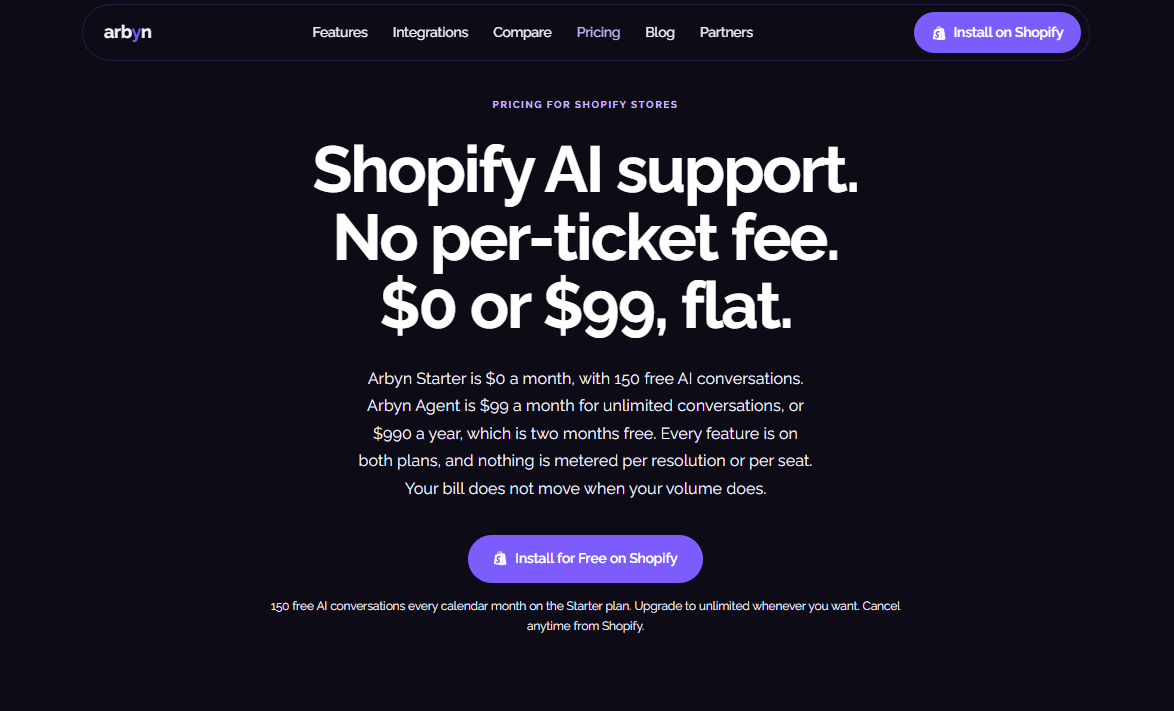
The most significant differentiator, however, is the business model. Where most competitors charge per ticket, per resolution, or per agent seat, leading to unpredictable monthly bills that scale with support volume, Arbyn uses a simple flat-rate subscription. The Starter plan is permanently free for up to 150 conversations a month, while the Growth plan offers 500 conversations for a flat $59/month, and the Agent plan provides unlimited conversations and actions for a flat $99/month. There are no overages, no per-action fees, and no feature gates between plans. This predictable pricing completely changes the financial equation for store owners. It means a Black Friday weekend with ten times the normal support volume costs exactly the same as a quiet Tuesday in February. For stores burned by surprise overage charges from other platforms, this flat-rate model is the central argument. You can add it to your store and get the benefits of an action-taking agent without the risk of a runaway support bill.
The rise of the action-taking AI agent marks a fundamental turning point for ecommerce operations. The conversation has shifted from "Can an AI answer this question?" to "Can an AI complete this task?" As we've seen, several platforms now offer a resounding "yes" to that question, but they do so with vastly different technical approaches and financial models. The decision for a store owner is no longer just about the quality of an AI's chat responses. It's now a more strategic choice about the desired level of autonomy (fully autonomous vs. human-approved actions), the importance of a fixed-cost structure (flat-rate vs. usage-based), and whether the goal is simply to reduce ticket volume or to build a fully integrated sales and support engine. The tools are ready; the challenge is to choose the one whose philosophy of action aligns with your own business goals and budget.
Written by
For seven years I have led customer success and technical support inside high-growth SaaS and e-commerce companies. Customer Support Lead at DripShop.live, a live-commerce SaaS. Technical Support Specialist at Replo (Y...
View full profile